Willow Warbler
Phylloscopus trochilus
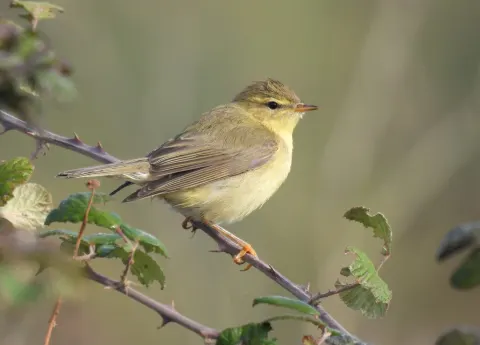
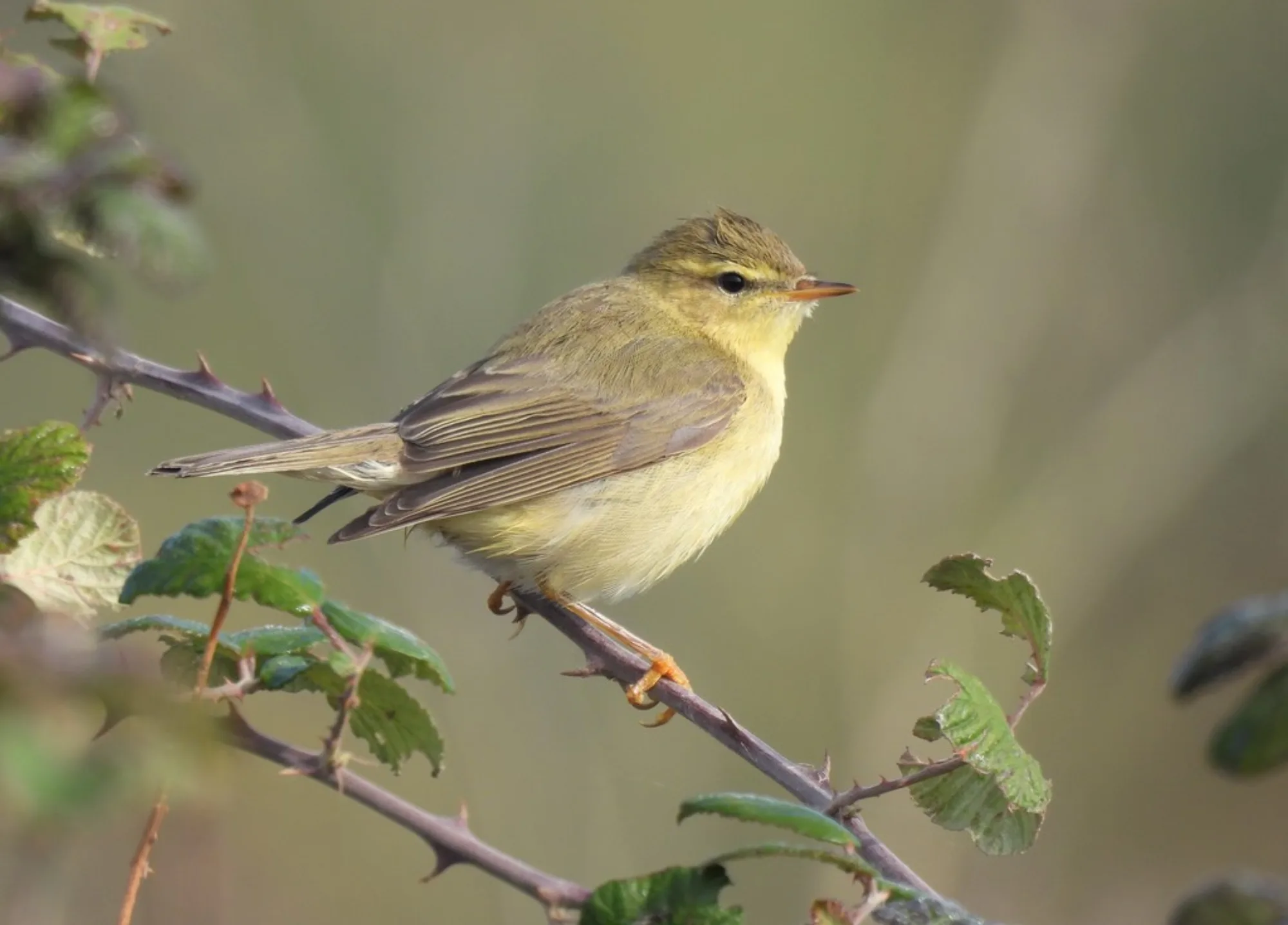
Small and widespread, the Willow Warbler is a leaf warbler that breeds across northern and temperate Europe and east through the Palearctic. It measures 11 to 12.5 cm long, with greenish brown upperparts, an off-white to yellowish underside and plain wings without bars. Young birds are yellower below than adults. Its song is a simple, repeated whistle that descends, while its contact call sounds like 'hoo-eet'. A similar bird, the chiffchaff, generally has darker legs, while the Willow Warbler has paler pinkish-yellow legs and a longer, paler bill.
Look for it in young, open, scrubby woodland, especially damp areas with birch, alder and willow. It also uses coppice, young plantations and young or open coniferous forest. Streams, bracken, moss and low bramble are among the features of its preferred habitat, with bramble providing cover for the nest. The nest is usually close to the ground, often in low vegetation. It eats insects and generally raises one brood during a breeding season that runs from late April to August, though two broods are possible.
Willow Warblers are highly migratory, and almost all spend the winter in sub-Saharan Africa. Birds arrive in their breeding range from mid-March to mid-May, then travel back to Africa from August to October. Some make an especially long journey: birds breeding in eastern Siberia can migrate up to 12,000 km to southern Africa. Deer browsing can damage the low cover they need. In England, numbers have fallen by an average of 70% over the last 25 years, with the steepest declines in the southeast; some increases have occurred in Scotland.
Written from the English Wikipedia article Willow warbler (CC BY-SA 4.0).
- Records
- 1,730,771
- Countries
- 125
- Atlas places
- 24
- Volcanoes National Park· Rwanda
- Zambezi National Park· Zimbabwe
- Ngorongoro Conservation Area· Tanzania
- Okavango Delta· Botswana
- Queen Elizabeth National Park· Uganda
- Serengeti National Park· Tanzania
- Aberdare National Park· Kenya
- Akagera National Park· Rwanda
- Arusha National Park· Tanzania
- Bwabwata National Park· Namibia
- Bwindi Impenetrable National Park· Uganda
- Chobe National Park· Botswana
- Etosha National Park· Namibia
- Hell's Gate National Park· Kenya
- Kibale National Park· Uganda
- Lake Manyara National Park· Tanzania
- Lake Mburo National Park· Uganda
- Lake Nakuru National Park· Kenya
- Madikwe Game Reserve· South Africa
- Nairobi National Park· Kenya
- Rwenzori Mountains National Park· Uganda
- Tsavo East National Park· Kenya
- Tsavo West National Park· Kenya
- uKhahlamba-Drakensberg Park· South Africa
These are open occurrence records, so they show where people looked for and recorded the Willow Warbler as much as where it lives. Cells are up to 25 km across, and every location is generalised to its cell.
Generalised encounter areas, not exact locations. Each shape is a grid cell coloured by how likely the species is there.
- Very likelySweden25 km zone · high confidence · 691239 records · updated 86 days ago
- Very likelyFinland25 km zone · high confidence · 573775 records · updated 86 days ago
- Very likelyNorway25 km zone · high confidence · 157428 records · updated 86 days ago
- Very likelyDenmark25 km zone · high confidence · 52739 records · updated 86 days ago
- Very likelyUnited Kingdom25 km zone · high confidence · 42958 records · updated 86 days ago
- Very likelyBelgium25 km zone · high confidence · 35388 records · updated 86 days ago
- Very likelyÅland Islands25 km zone · high confidence · 27442 records · updated 86 days ago
- Very likelySpain25 km zone · high confidence · 16945 records · updated 86 days ago
- Very likelyPortugal25 km zone · high confidence · 15867 records · updated 86 days ago
- Very likelyFrance25 km zone · high confidence · 11865 records · updated 86 days ago
Conservation status not assessed here yet, so every location is generalised to its grid cell.