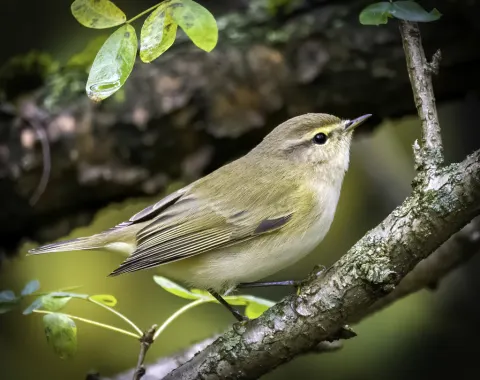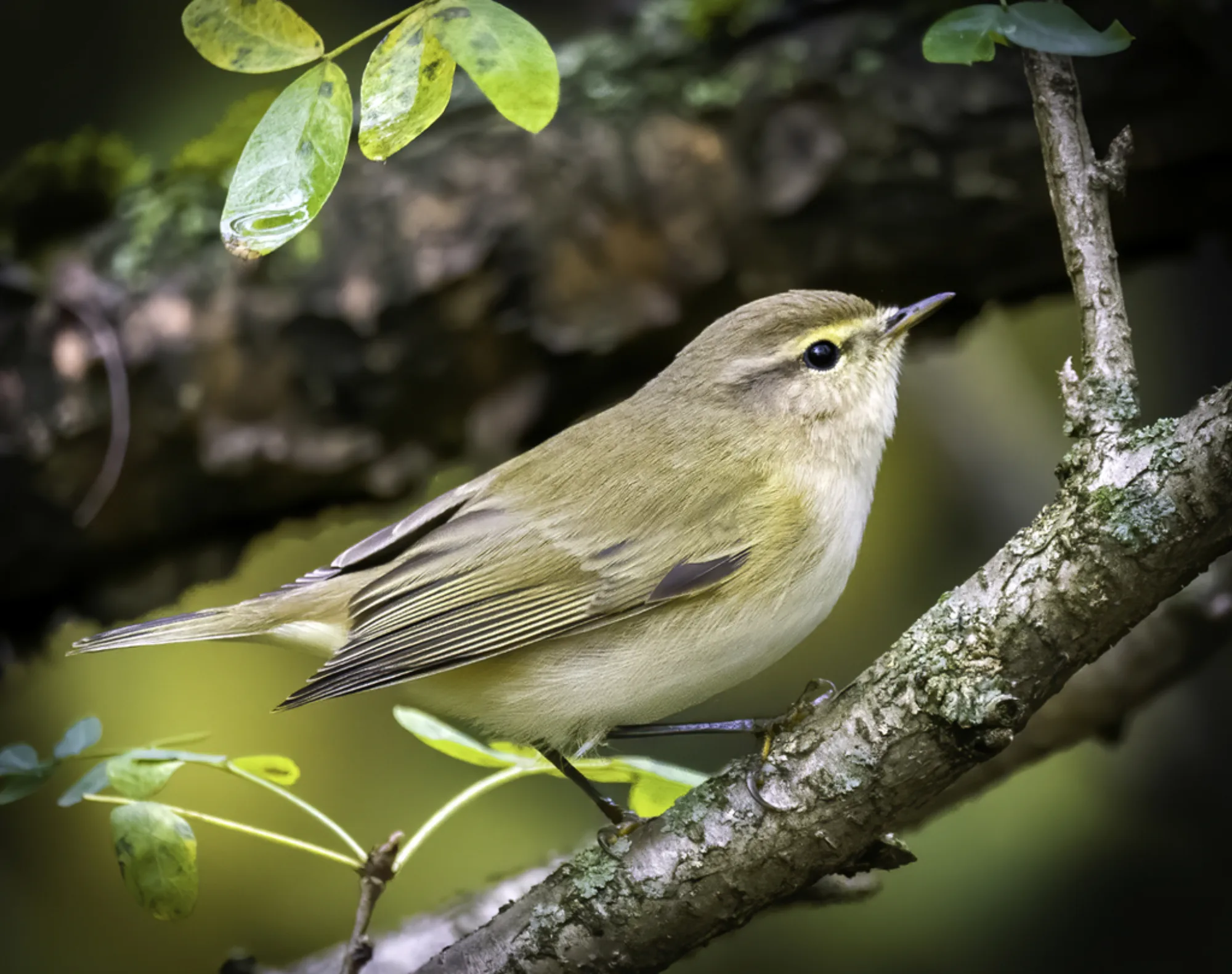
Common Chiffchaff
Phylloscopus collybita
Listen for a repeated chiff-chaff song in open woodland, then look for a small, dumpy leaf warbler with greenish-brown upperparts and an off-white underside. The Common Chiffchaff has dark legs and a fine dark bill, while a dip followed by a sideways wag of the tail can help distinguish it from other leaf warblers. Birds that are not singing can be difficult to separate from similar species, particularly the willow warbler.
The chiffchaff breeds across Europe and Asia as far east as eastern Siberia, with isolated populations in northwest Africa, parts of Turkey and northwestern Iran. Its breeding habitat is open woodland with taller trees and ground cover, often including grasses, bracken and nettles. In winter it uses a wider range of places, including scrub, and is often found near water. Its winter range includes north Africa, southern Asia and parts of western and southern Europe, with more birds now wintering farther north in western Europe.
Watch for it moving restlessly through foliage or hovering briefly as it searches for insects and other small invertebrates. Flies feature heavily in its diet, along with butterfly and moth eggs and larvae. During the breeding season, the male sings from a prominent perch and defends his territory, sometimes attacking potential nest predators. The female builds a domed nest concealed in low vegetation, and does most of the brooding and feeding of the chicks. After breeding, chiffchaffs may join small flocks with other warblers before migrating. Woodland clearance affects their habitat, while cats prey on them and some birds collide with buildings, windows or cars. Stoats, weasels and crows take eggs and young, and birds of prey hunt adults.
Written from the English Wikipedia article Common chiffchaff (CC BY-SA 4.0).
- Records
- 1,364,122
- Countries
- 111
- Atlas places
- 9
These are open occurrence records, so they show where people looked for and recorded the Common Chiffchaff as much as where it lives. Cells are up to 25 km across, and every location is generalised to its cell.
Generalised encounter areas, not exact locations. Each shape is a grid cell coloured by how likely the species is there.
- Very likelyUnited Kingdom25 km zone · high confidence · 295636 records · updated 86 days ago
- Very likelyBelgium25 km zone · high confidence · 217665 records · updated 86 days ago
- Very likelyNorway25 km zone · high confidence · 130499 records · updated 86 days ago
- Very likelySpain25 km zone · high confidence · 121075 records · updated 86 days ago
- Very likelyFrance25 km zone · high confidence · 111621 records · updated 86 days ago
- Very likelySweden25 km zone · high confidence · 106161 records · updated 86 days ago
- Very likelyPortugal25 km zone · high confidence · 61946 records · updated 86 days ago
- Very likelyNetherlands25 km zone · high confidence · 38769 records · updated 86 days ago
- Very likelyLuxembourg25 km zone · high confidence · 34001 records · updated 86 days ago
- Very likelyIsrael25 km zone · high confidence · 33061 records · updated 86 days ago
Conservation status not assessed here yet, so every location is generalised to its grid cell.