Common Seadragon
Phyllopteryx taeniolatus
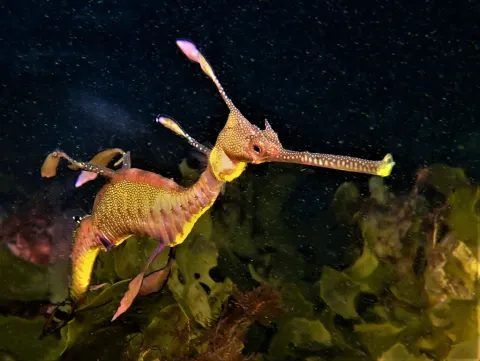
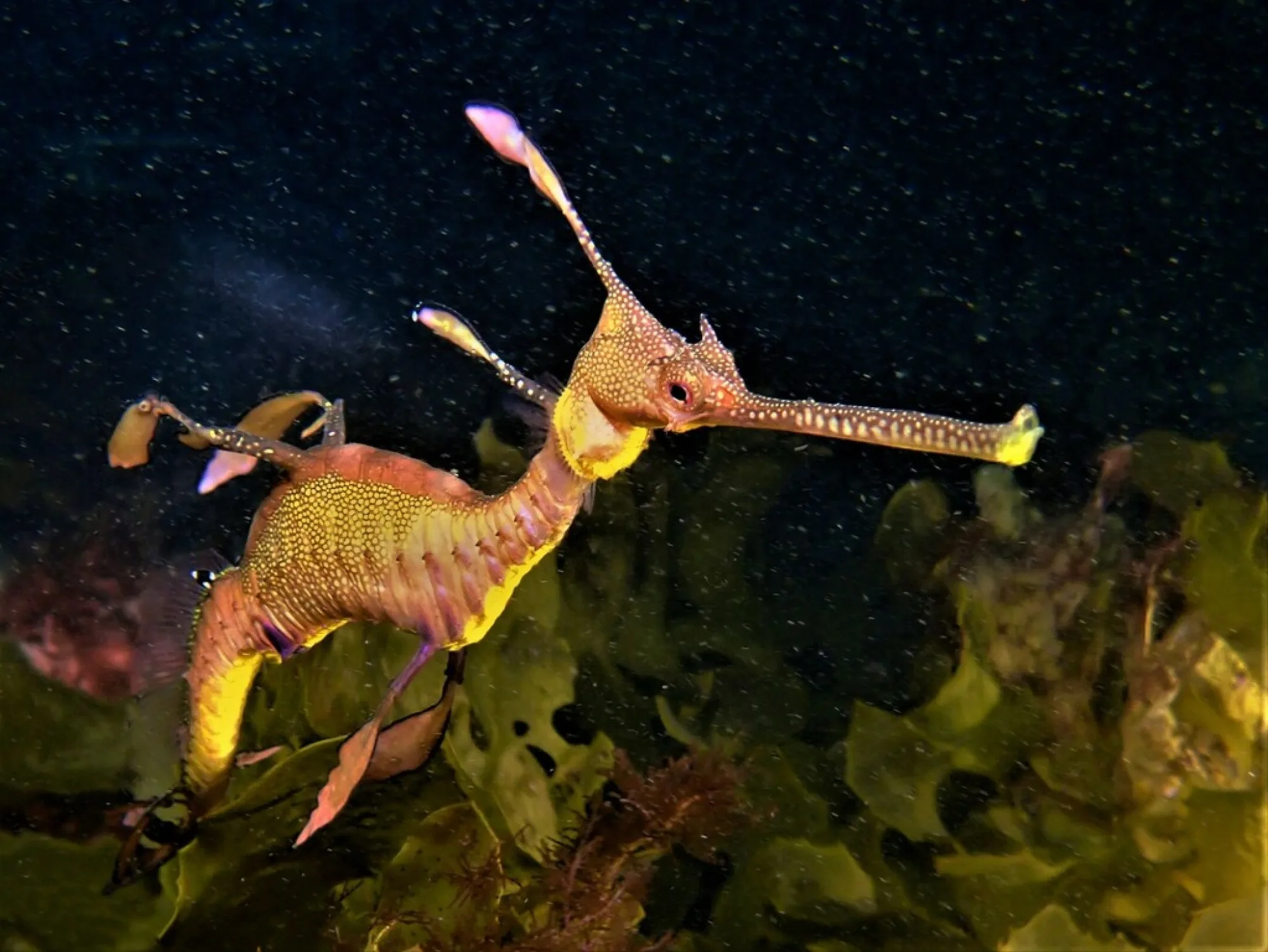
With its reddish body, yellow and purple stripes and small leaf-like appendages, the Common Seadragon can look much like the seaweed around it. This marine fish, also called the weedy seadragon, has a tubular snout and short protective spines, and can reach 45 cm in length. Males are darker and more slender than females.
The species lives in Australian coastal waters, generally along the continent's southern coastline, including Tasmania and other offshore islands. It is regularly seen from around Port Stephens in New South Wales to Geraldton in Western Australia, as well as off South Australia and the Great Australian Bight. Look for it in coastal waters around 10 m to 30 m deep, where seaweed grows on reefs and other structures, or among beds of seaweed and seagrass. Slow moving and well camouflaged, it drifts among masses of kelp and seaweed, where its leafy appendages help it blend in. Individuals may be seen alone or in pairs, sucking up tiny crustaceans and other zooplankton.
Males care for the developing eggs and carry them for around a month before they hatch. The young are independent from birth and begin eating soon afterwards, although their survival rate in the wild is low. A common seadragon reaches sexual maturity at about 28 months and can live as long as six years. Habitat loss and degradation from human activities and pollution are their main threats, including the loss of seagrass beds and seaweed canopy on inshore rocky reefs. Climate change-driven marine heatwaves on the Great Southern Reef may also put them at risk, though available data are too sparse to establish a population trend.
Written from the English Wikipedia article Common seadragon (CC BY-SA 4.0).
- Records
- 925
- Countries
- 1
- Atlas places
- 3
These are open occurrence records, so they show where people looked for and recorded the Common Seadragon as much as where it lives. Cells are up to 25 km across, and every location is generalised to its cell.
Generalised encounter areas, not exact locations. Each shape is a grid cell coloured by how likely the species is there.
- Very likelyAustralia25 km zone · high confidence · 925 records · updated 80 days ago
Conservation status not assessed here yet, so every location is generalised to its grid cell.