Golden Poison Frog
Phyllobates terribilis
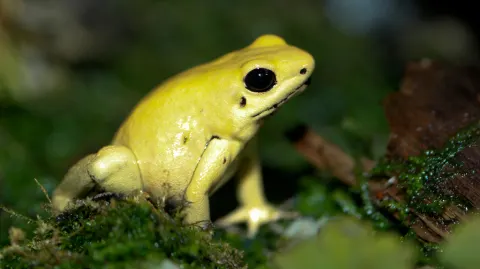
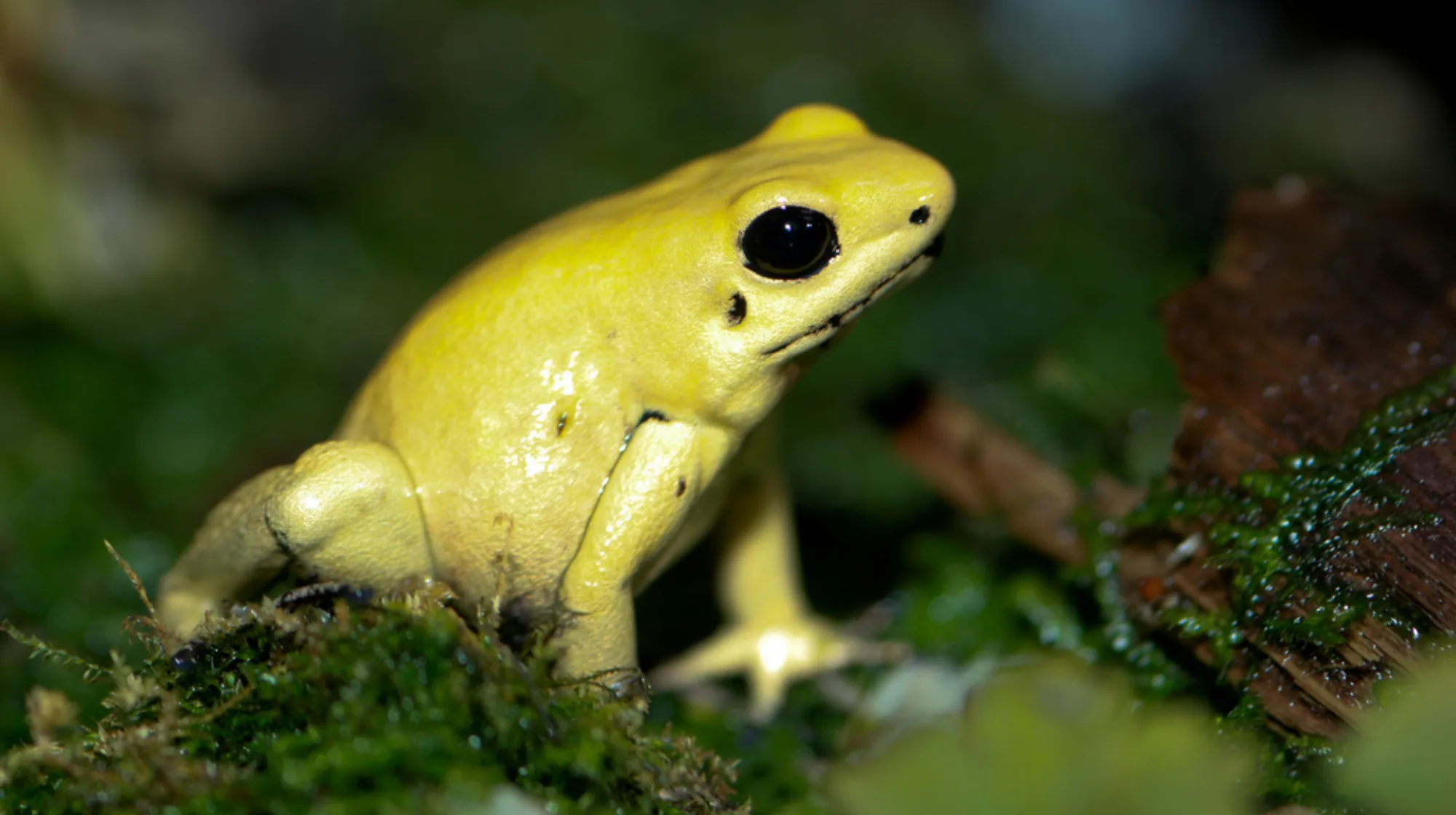
Bright colour warns predators that the Golden Poison Frog is toxic. Adults can reach 6 cm in length and weigh nearly 30 grams, making them the largest members of the poison dart frog family. Females are usually larger than males. Wild frogs can be pale to deep golden yellow, metallic or pale green, white, metallic orange, or yellow-orange. Young frogs are mostly black, with a pair of golden-yellow stripes along the back; their dark colouring gradually disappears as they grow. Contact with the skin is dangerous, and predators generally risk poisoning if they try to eat the frog.
This frog lives only in Colombia's humid Pacific coastal forests, including parts of Cauca and Valle del Cauca. Its preferred rainforest habitat has heavy rainfall, temperatures of at least 26 °C and elevations from sea level to 200 m. Usually active by day, the frogs keep an even distance from one another rather than gathering in large groups. They hunt by ambush, eating mainly ants as well as other insects and small invertebrates. Males give a trilling call, and eggs are laid on the ground beneath leaf litter. After hatching, tadpoles ride on their parents' backs to water held in bromeliads and tree holes in the canopy, where they eat algae and mosquito larvae.
Habitat destruction threatens the frog within a range of less than 5,000 square km. Poaching for the pet trade was once a serious threat, but demand for illegally collected wild frogs has fallen as captive-bred animals have become widely available.
Written from the English Wikipedia article Golden poison frog (CC BY-SA 4.0).
- Records
- 0
- Countries
- 1
No atlas park has a record of the Golden Poison Frog in or around it yet.
These are open occurrence records, so they show where people looked for and recorded the Golden Poison Frog as much as where it lives. Cells are up to 25 km across, and every location is generalised to its cell.
Generalised encounter areas, not exact locations. Each shape is a grid cell coloured by how likely the species is there.
- Very likelyColombia25 km zone · low confidence · 0 records · updated 80 days ago
Conservation status not assessed here yet, so every location is generalised to its grid cell.