Leafy Seadragon
Phycodurus eques
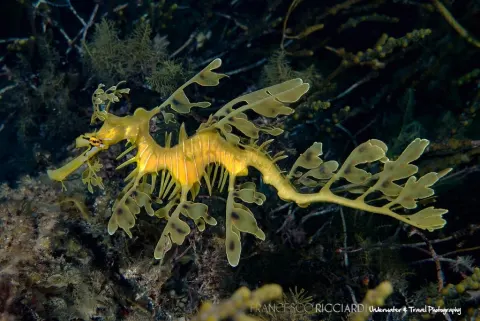
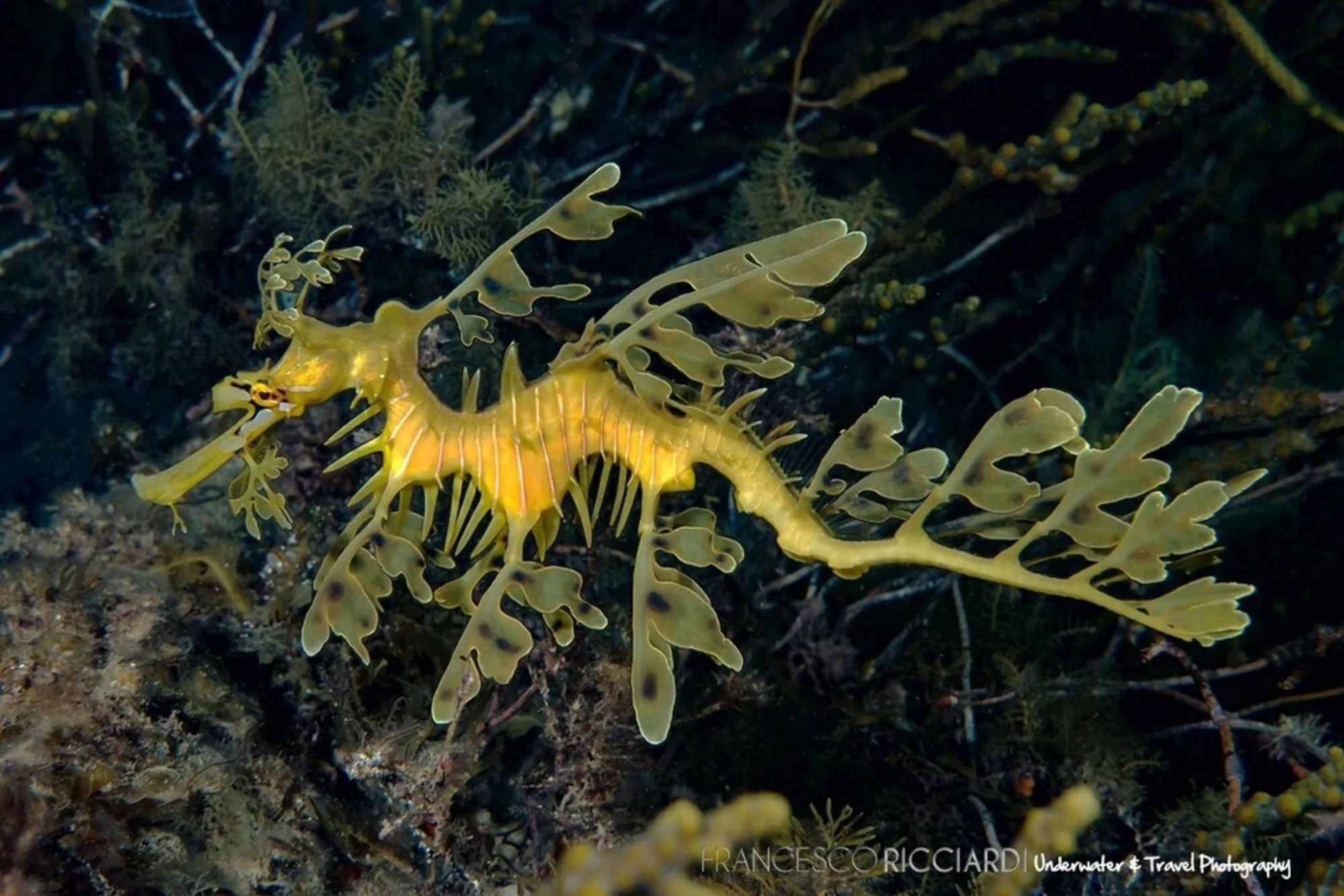
Drifting like a piece of seaweed, the Leafy Seadragon is a marine fish with long, leaf-like projections across its body. These growths provide camouflage, while small, nearly transparent fins carry it slowly through the water. It grows to about 20 to 24 cm and can change colour to blend in, although its diet, age, location and stress level affect that ability.
Found only in southern Australian waters, it ranges from Wilson's Promontory in Victoria west to Jurien Bay in Western Australia. Look for it above sandy patches among seagrass and rocks covered in kelp, in water up to 50 m deep. Scuba divers commonly sight it near Adelaide, particularly at Rapid Bay, Edithburgh and Victor Harbor. Usually solitary, it may stay in one place for extended periods or travel several hundred metres from its usual location before returning to the same spot. It sucks up plankton, larval fish and small crustaceans, including amphipods and mysid shrimp, through its long snout.
When it is time to breed, males court females and the fish pair up. The male cares for the eggs, and the young are independent from the moment they hatch. Young seadragons eat small zooplankton until they are large enough to hunt mysids. Pollution, industrial runoff and collection for the aquarium trade threaten the species. Its slow swimming makes escape from predators difficult, and storms sometimes wash seadragons ashore.
Written from the English Wikipedia article Leafy seadragon (CC BY-SA 4.0).
- Records
- 147
- Countries
- 1
No atlas park has a record of the Leafy Seadragon in or around it yet.
These are open occurrence records, so they show where people looked for and recorded the Leafy Seadragon as much as where it lives. Cells are up to 25 km across, and every location is generalised to its cell.
Generalised encounter areas, not exact locations. Each shape is a grid cell coloured by how likely the species is there.
- Very likelyAustralia25 km zone · medium confidence · 147 records · updated 80 days ago
Conservation status not assessed here yet, so every location is generalised to its grid cell.