Texas Horned Lizard
Phrynosoma cornutum
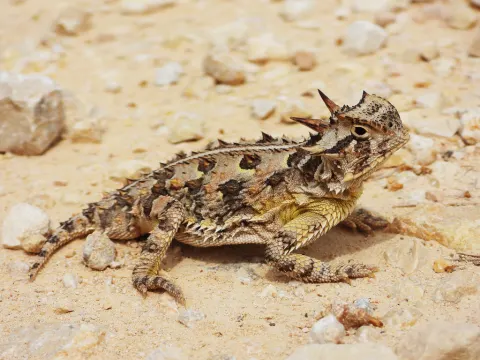
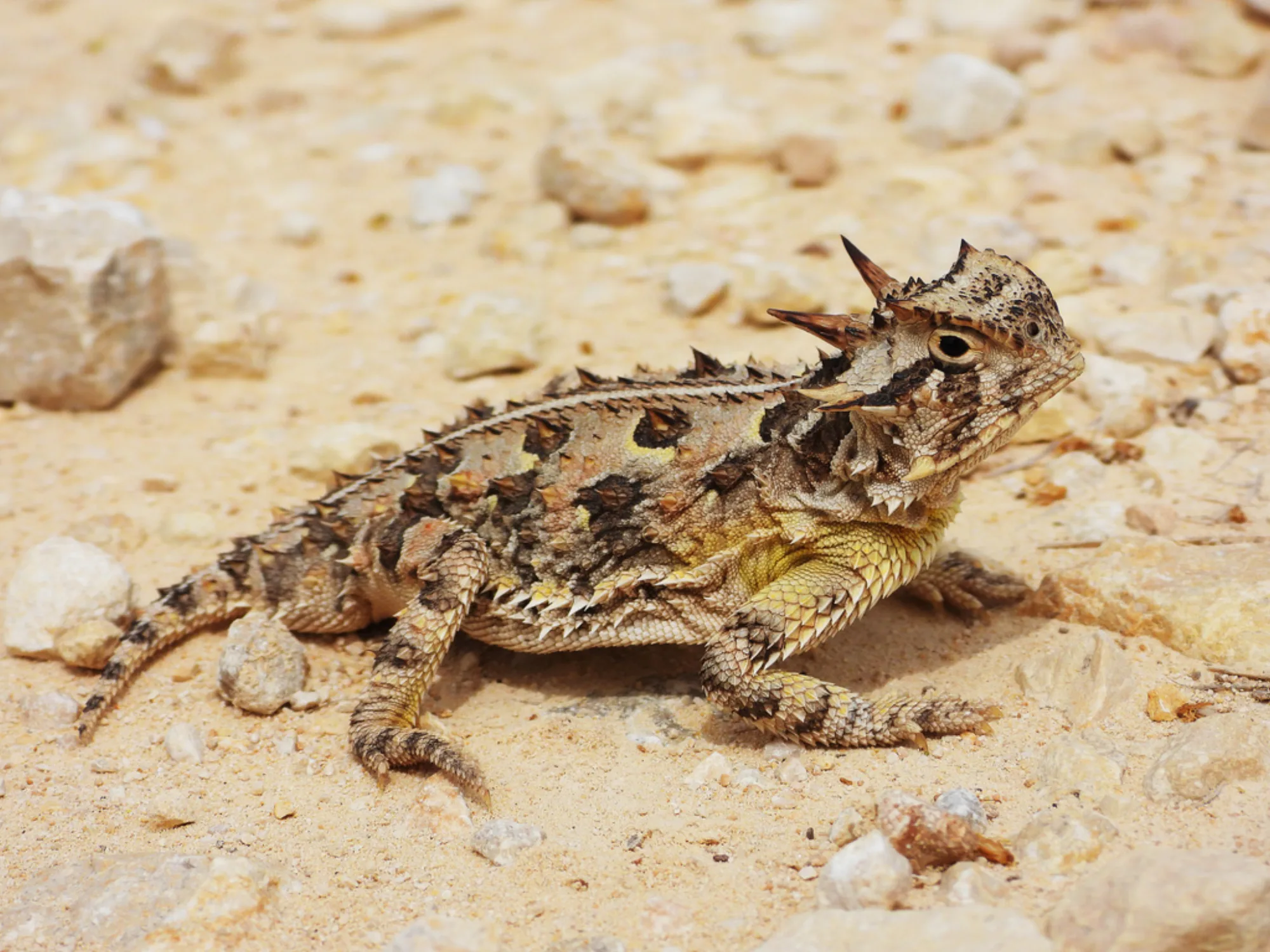
With a rounded body, blunt snout and crown of horns, the Texas Horned Lizard can look rather like a toad. Its largest horns sit on its head, while rows of spikes run along its sides and back. Colour helps it blend into the ground: desert animals may be yellow or reddish-brown, while those on prairies tend towards tan. Dark lines run from the eyes towards the horns, and a white line is flanked by black spots.
Its natural range extends across parts of the south-central United States and northeastern Mexico, from grasslands and prairies to the Chihuahuan Desert. It occurs from Gulf Coast barrier islands at sea level to elevations of about 1,830 metres. Look for it beside roads or in open, rocky places, where it basks in bright sunlight. At night it buries itself in sand, and it hibernates in burrows. Usually reluctant to move far, it can dart into grass or dig underground when threatened. It may also swell its body or squirt blood towards a predator. Harvester ants make up about 70% of its diet, supplemented by termites, beetles and grasshoppers. The lizard digs burrows in which to lay its eggs.
Populations have declined severely in many parts of Texas and Oklahoma, although some remain stable. Habitat loss and fragmentation, expanding urban areas, and predation by domestic dogs and cats all contribute to the decline. Pesticides and invading fire ants can destroy the harvester ant colonies on which the lizard depends. In some places, small towns with suitable habitat and food may offer shelter from predators.
Written from the English Wikipedia article Texas horned lizard (CC BY-SA 4.0).
- Records
- 1,150
- Countries
- 2
- Atlas places
- 1
These are open occurrence records, so they show where people looked for and recorded the Texas Horned Lizard as much as where it lives. Cells are up to 25 km across, and every location is generalised to its cell.
Generalised encounter areas, not exact locations. Each shape is a grid cell coloured by how likely the species is there.
- Very likelyUnited States25 km zone · medium confidence · 877 records · updated 80 days ago
- Very likelyMexico25 km zone · medium confidence · 273 records · updated 80 days ago
Conservation status not assessed here yet, so every location is generalised to its grid cell.