Redtail Catfish
Phractocephalus hemioliopterus
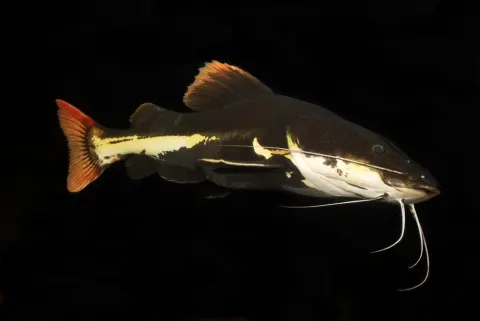
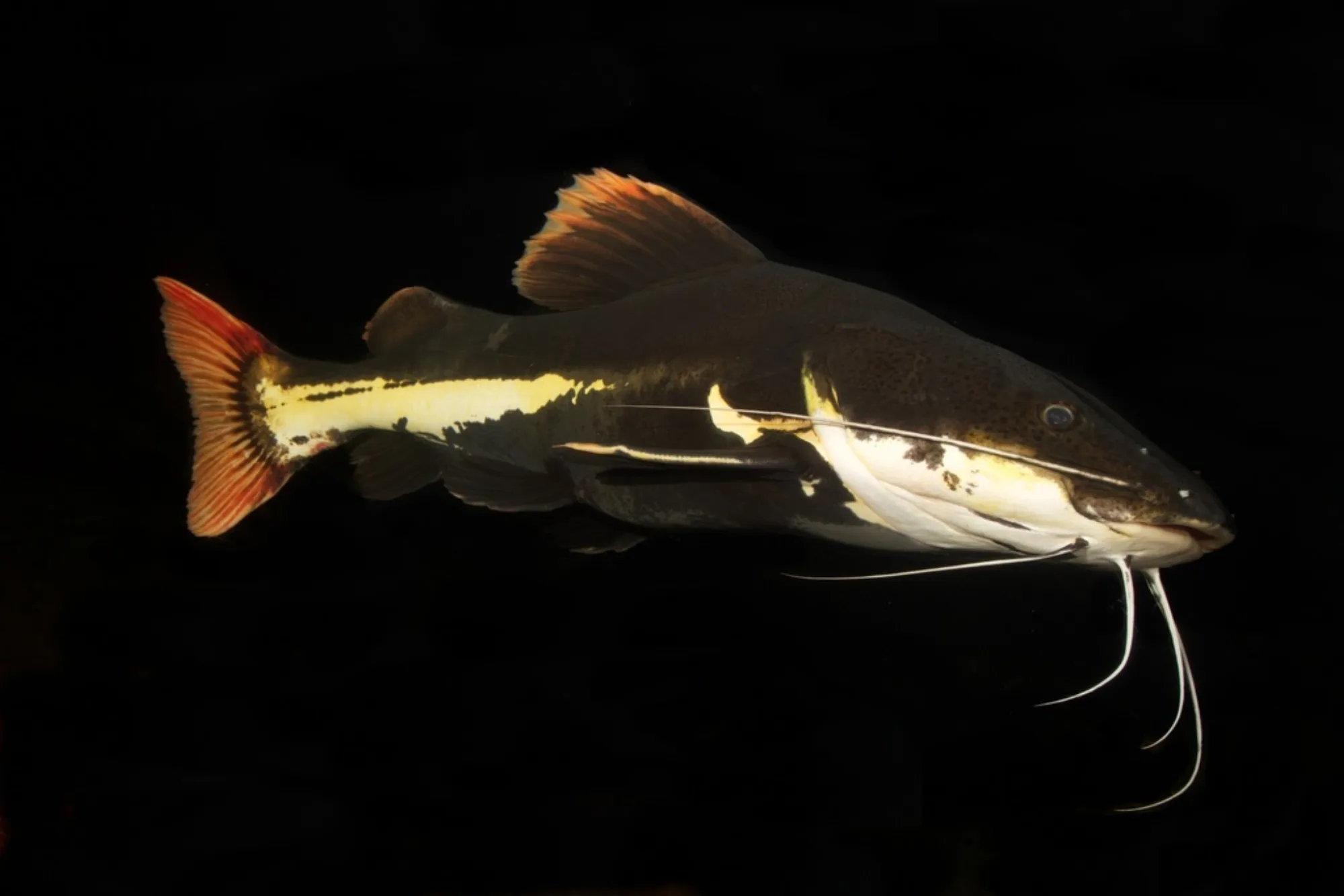
A broad head, long whiskers and an orange-red tail fin help distinguish the Redtail Catfish, a large South American freshwater fish. Its back is brownish, its sides are yellow, and a white area runs underneath from the mouth to the tail. The dorsal fin is also orange-red, while other fins can sometimes be red. Most do not approach the exceptional maximum of about 1.8 m and 80 kg, with average lengths of 1.1 to 1.4 m.
In South America, it inhabits larger rivers, streams and lakes within the Amazon, Orinoco and Essequibo basins. Its range extends across Brazil, Bolivia and Peru, as well as Ecuador, Colombia, Venezuela, Guyana and Suriname. It is territorial and generally moves slowly near the bottom, remaining motionless by day and feeding in the evening and at night. Unlike some bottom-dwelling catfish, however, it swims actively rather than waiting on the riverbed to ambush prey. Its varied diet includes fish, crustaceans, aquatic worms and frogs, as well as fallen fruit, seeds and tree nuts. It also makes clicking sounds to warn of potential danger, and lays eggs.
Young fish face predators both in the water and on land. Larger adults have fewer predators, although humans, jaguars, giant otters, crocodiles and caimans can consume redtail catfish of any size. People also catch them as game fish. Juveniles are commonly sold for aquariums, but can outgrow their tanks, and some have likely been released outside their natural range. In aquariums, overfeeding is a common cause of death, while swallowing and regurgitating inedible objects can also cause problems.
Written from the English Wikipedia article Redtail catfish (CC BY-SA 4.0).
- Records
- 47
- Countries
- 3
- Atlas places
- 1
These are open occurrence records, so they show where people looked for and recorded the Redtail Catfish as much as where it lives. Cells are up to 25 km across, and every location is generalised to its cell.
Generalised encounter areas, not exact locations. Each shape is a grid cell coloured by how likely the species is there.
- Very likelyColombia25 km zone · medium confidence · 38 records · updated 80 days ago
- LikelyPeru25 km zone · medium confidence · 8 records · updated 80 days ago
- PossibleBrazil25 km zone · medium confidence · 1 record · updated 80 days ago
Conservation status not assessed here yet, so every location is generalised to its grid cell.