Common Redstart
Phoenicurus phoenicurus
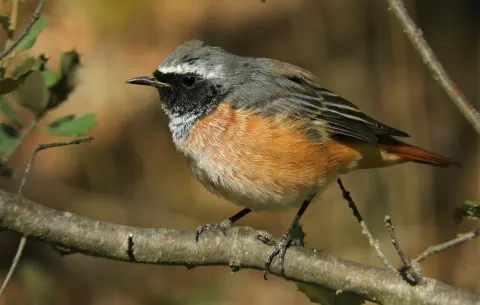
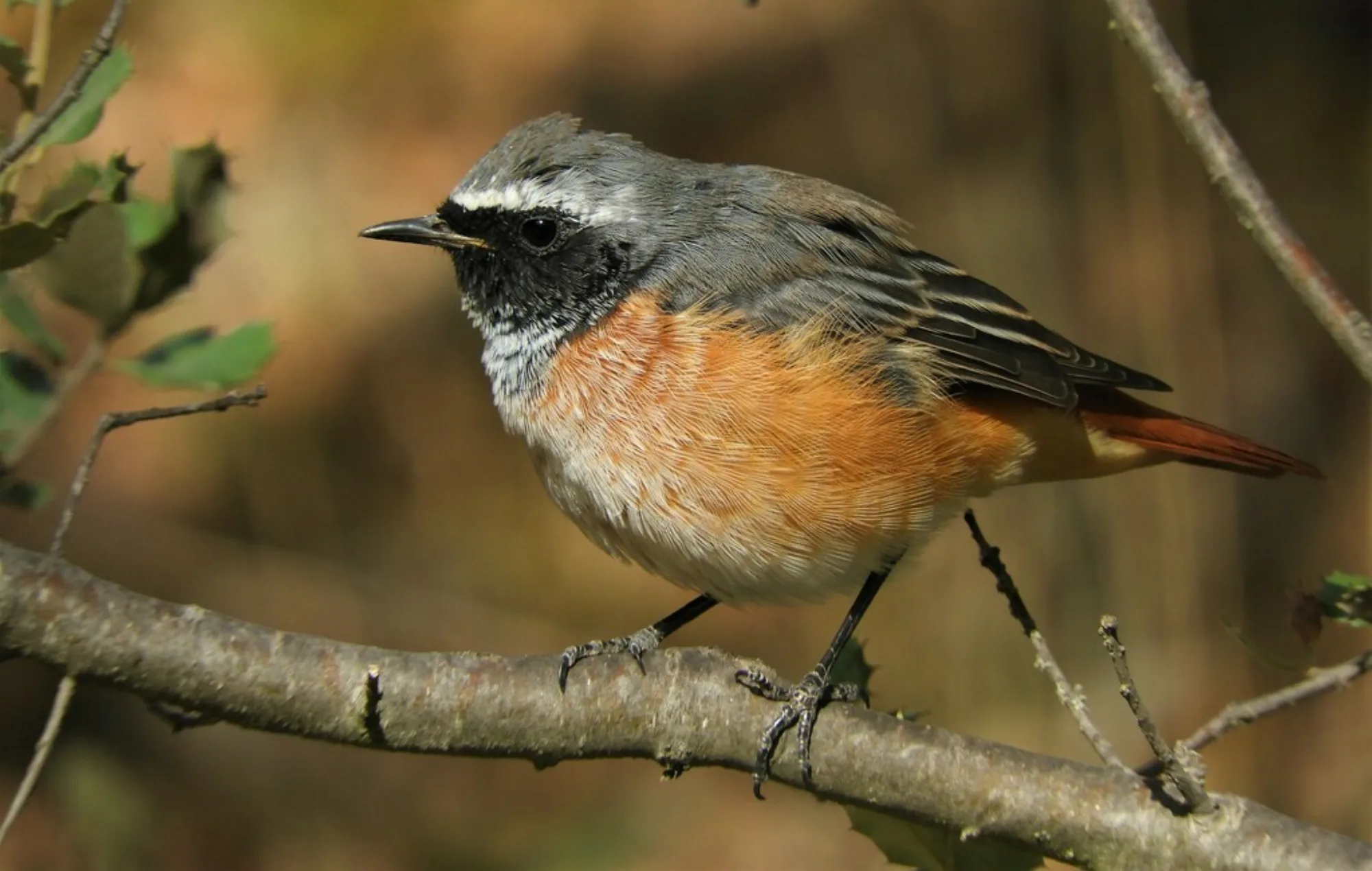
A small, slim bird with a frequently quivering orange-red tail, the Common Redstart measures 13 to 14.5 cm in length. In summer, the male has a slate-grey head and upperparts, a white forehead, and black sides to its face and throat. Its orange flanks fade to an almost white belly, while its wings are grey-brown. Females are grey-brown above, with buff-white or light orange underparts and usually a whitish throat. Some birds have a pale wing patch, particularly males of the southeastern subspecies.
The species spends the summer across most of Europe and western Asia, reaching Lake Baikal, as well as Morocco in northwest Africa. It winters in central Africa and Arabia, from Senegal east to Yemen. Look for it in open, mature birch or oak woodland, or in conifer woodland in the north of its breeding range. It favours places with little undergrowth and old trees with suitable nesting holes, but also uses orchards, villages, parks and old gardens. In Britain it occurs mainly in upland areas, while in Ireland it is a very rare and local breeding bird.
Common Redstarts often dart into the air after passing insects, with winged insects making up most of their food. Males sing soft, melancholy phrases, and the birds also give ticking alarm calls. They nest in cavities such as natural tree holes and commonly use nestboxes. In May, a clutch contains five or six pale blue eggs; farther south, a second brood may follow around the middle of summer. Common cuckoos sometimes parasitise their nests, and the species has declined by 55% in England over the past 25 years.
Written from the English Wikipedia article Common redstart (CC BY-SA 4.0).
- Records
- 319,887
- Countries
- 106
- Atlas places
- 5
These are open occurrence records, so they show where people looked for and recorded the Common Redstart as much as where it lives. Cells are up to 25 km across, and every location is generalised to its cell.
Generalised encounter areas, not exact locations. Each shape is a grid cell coloured by how likely the species is there.
- Very likelyFinland25 km zone · high confidence · 76612 records · updated 86 days ago
- Very likelySweden25 km zone · high confidence · 61932 records · updated 86 days ago
- Very likelyFrance25 km zone · high confidence · 37214 records · updated 86 days ago
- Very likelyNorway25 km zone · high confidence · 22536 records · updated 86 days ago
- Very likelyBelgium25 km zone · high confidence · 17801 records · updated 86 days ago
- Very likelyUnited Kingdom25 km zone · high confidence · 10210 records · updated 86 days ago
- Very likelySpain25 km zone · high confidence · 8225 records · updated 86 days ago
- Very likelyÅland Islands25 km zone · high confidence · 8222 records · updated 86 days ago
- Very likelyPalestinian Territories25 km zone · high confidence · 8040 records · updated 86 days ago
- Very likelyIsrael25 km zone · high confidence · 7338 records · updated 86 days ago
Conservation status not assessed here yet, so every location is generalised to its grid cell.