American Flamingo
Phoenicopterus ruber
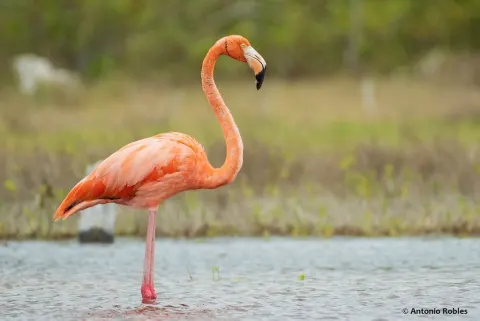
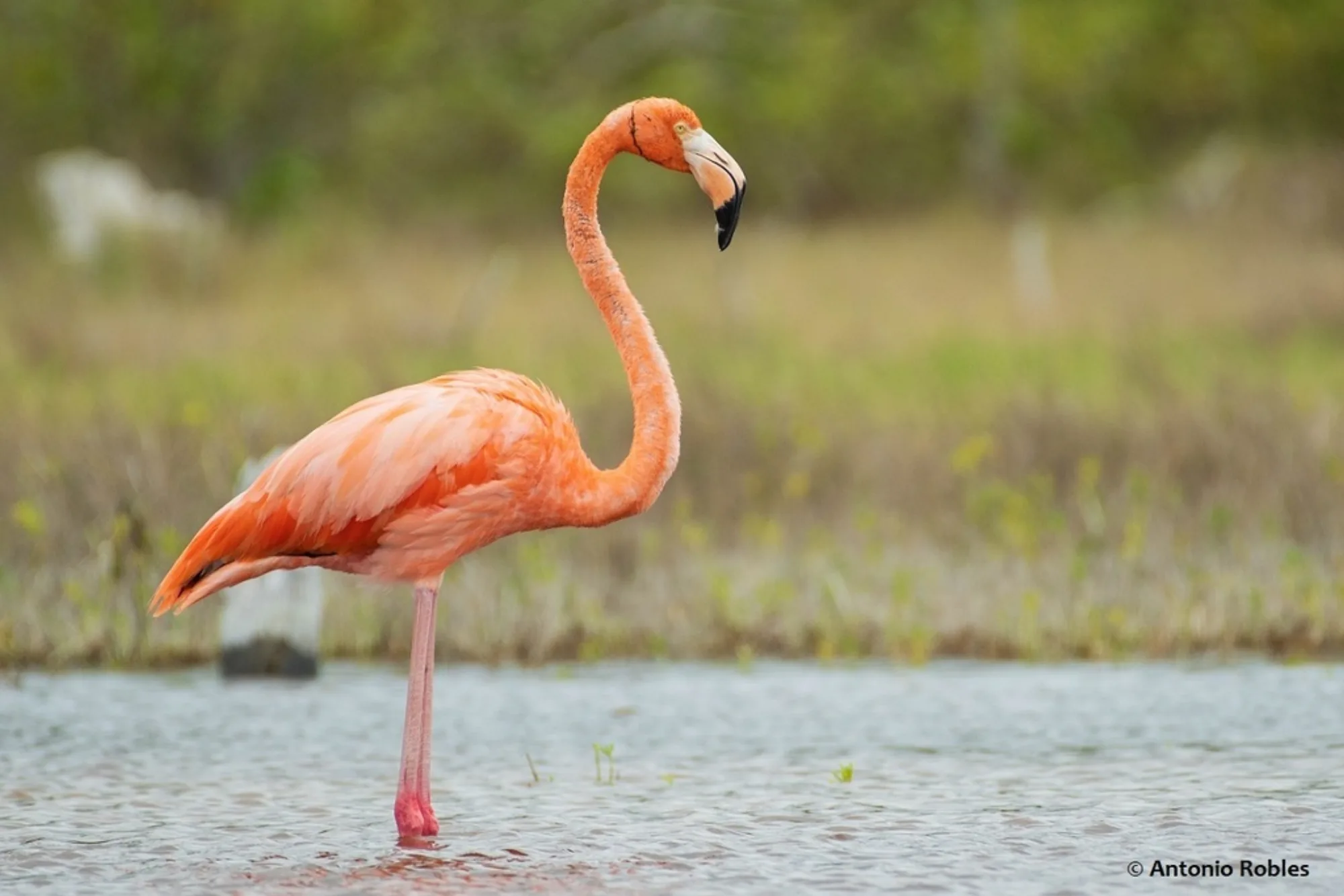
With reddish-pink plumage and entirely pink legs, the American Flamingo is a large wading bird that can reach 120 to 145 cm in height. Its bill is pink and white with a broad black tip, while red feathers on the wings contrast with black flight feathers. Listen, too, for a honking call reminiscent of a goose. Also known as the Caribbean flamingo, it occurs naturally across the West Indies, the north of South America and the Yucatán Peninsula in Mexico, as well as the Galápagos Islands. It favours saline lagoons, mudflats and shallow brackish lakes, both inland and along the coast.
In shallow water, flamingos wade on long legs and use their webbed feet to stir up food from the bottom. They dip their heads underwater to feed, filtering a varied diet that includes small crustaceans, molluscs, insects, small fish, seeds and algae. Pairs often stand, sleep and feed close together. Between May and August, a single chalky-white egg is laid on a mound of mud; it hatches after 28 to 32 days, and both parents care for the young. Chicks leave the nest at 7 to 11 days old and gather in groups called crèches. When food is insufficient or temperatures are unsuitable, the birds move to find better conditions; high water can also force them away from feeding grounds by making wading difficult.
In Florida, heavy hunting was reported in the past, and the population collapsed around 1900. Flamingos are now uncommon visitors there, although a few small populations may live in the state year-round. Hurricanes can carry flocks north, sometimes resulting in rare sightings far from their usual range.
Written from the English Wikipedia article American flamingo (CC BY-SA 4.0).
- Records
- 84,671
- Countries
- 22
- Atlas places
- 15
- Galápagos National Park· Ecuador
- Addo Elephant National Park· South Africa
- Everglades National Park· United States
- Namib-Naukluft· Namibia
- West Coast National Park· South Africa
- Dorob National Park· Namibia
- Table Mountain National Park· South Africa
- Etosha National Park· Namibia
- Garden Route National Park· South Africa
- iSimangaliso Wetland Park· South Africa
- Walvis Bay· Namibia
- Karoo National Park· South Africa
- Pilanesberg National Park· South Africa
- Tsau ǁKhaeb (Sperrgebiet) National Park· Namibia
- uKhahlamba-Drakensberg Park· South Africa
These are open occurrence records, so they show where people looked for and recorded the American Flamingo as much as where it lives. Cells are up to 25 km across, and every location is generalised to its cell.
Generalised encounter areas, not exact locations. Each shape is a grid cell coloured by how likely the species is there.
- Very likelySouth Africa25 km zone · high confidence · 23999 records · updated 80 days ago
- Very likelyUnited States25 km zone · high confidence · 15000 records · updated 80 days ago
- Very likelyMexico25 km zone · high confidence · 14137 records · updated 80 days ago
- Very likelyEcuador25 km zone · high confidence · 5983 records · updated 80 days ago
- Very likelyCuba25 km zone · high confidence · 5258 records · updated 80 days ago
- Very likelyCuraçao25 km zone · high confidence · 4836 records · updated 80 days ago
- Very likelyVenezuela25 km zone · high confidence · 4250 records · updated 80 days ago
- Very likelyColombia25 km zone · high confidence · 2439 records · updated 80 days ago
- Very likelyNamibia25 km zone · high confidence · 2178 records · updated 80 days ago
- Very likelyDominican Republic25 km zone · high confidence · 1486 records · updated 80 days ago
Conservation status not assessed here yet, so every location is generalised to its grid cell.