Andean Flamingo
Phoenicoparrus andinus
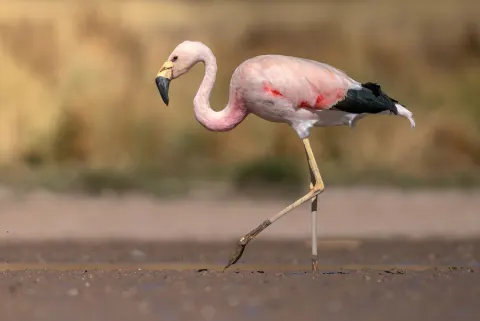
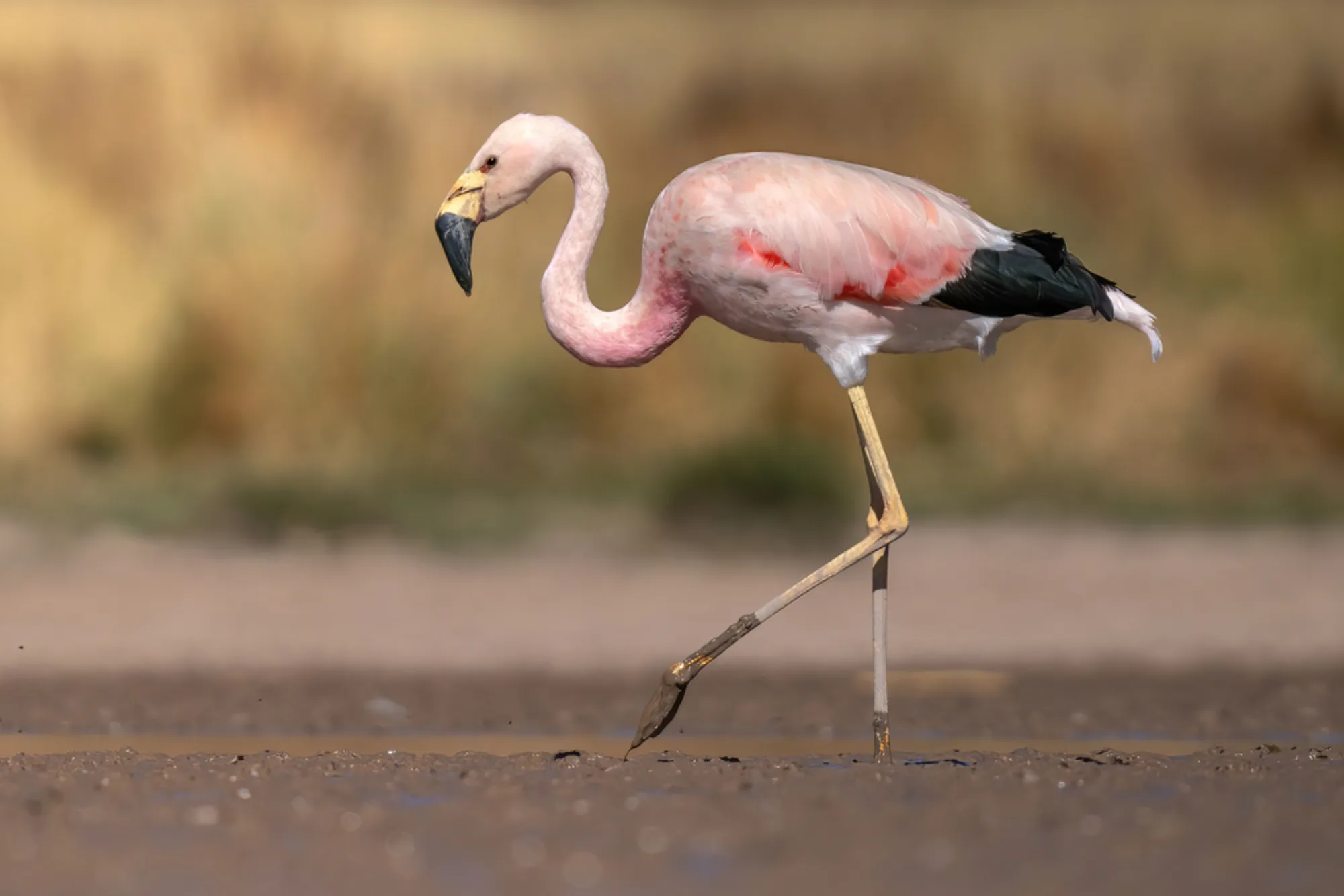
Across the high Andes, the Andean Flamingo stands out with yellow legs, a mostly black downward-curving bill and pale pink plumage. Adults have brighter pink on the lower neck and breast, while their folded wings show a bold black triangle. Young birds are pale grey, often with a darker head and neck. The largest flamingo in the Andes, it can reach 1.4 m in height.
Its high Andean wetland range extends across southern Peru, northern Chile and northwestern Argentina. In summer, these birds live on salt lakes; in winter, some move to wetlands and lakes at lower elevations, while others stay near their breeding sites. They live in colonies and sometimes share nesting areas with Chilean and James's flamingos. Most breeding takes place across northern Chile, northwestern Argentina and the far southwest of Bolivia. In shallow salty water, they filter food from the lake bottom, feeding mainly on diatoms, although their diet also includes fish, invertebrates, plants and microscopic algae. When feeding alongside other flamingo species, they adopt the foraging patterns of their companions.
Mining is a major threat, changing habitat, polluting surface water and accelerating the loss of lake moisture. At Salinas Lake in Peru, flamingos abandoned nesting sites when mining began nearby after colonies had formed. Mining can also create mud that traps the birds, while hydrocarbon exploration has been associated with lower breeding success. Egg collection can disturb nesting and cause adults to leave nests, even when eggs remain. Unregulated tourism and new roads add pressure to the habitat, making it more accessible to mining and tourism.
Written from the English Wikipedia article Andean flamingo (CC BY-SA 4.0).
- Records
- 7,331
- Countries
- 5
- Atlas places
- 1
These are open occurrence records, so they show where people looked for and recorded the Andean Flamingo as much as where it lives. Cells are up to 25 km across, and every location is generalised to its cell.
Generalised encounter areas, not exact locations. Each shape is a grid cell coloured by how likely the species is there.
- Very likelyChile25 km zone · high confidence · 3209 records · updated 80 days ago
- Very likelyArgentina25 km zone · high confidence · 2726 records · updated 80 days ago
- Very likelyBolivia25 km zone · high confidence · 845 records · updated 80 days ago
- Very likelyPeru25 km zone · high confidence · 392 records · updated 80 days ago
- Very likelyBrazil25 km zone · high confidence · 159 records · updated 80 days ago
Conservation status not assessed here yet, so every location is generalised to its grid cell.