Lesser Flamingo
Phoeniconaias minor
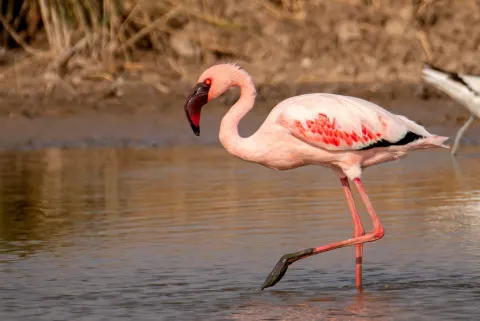
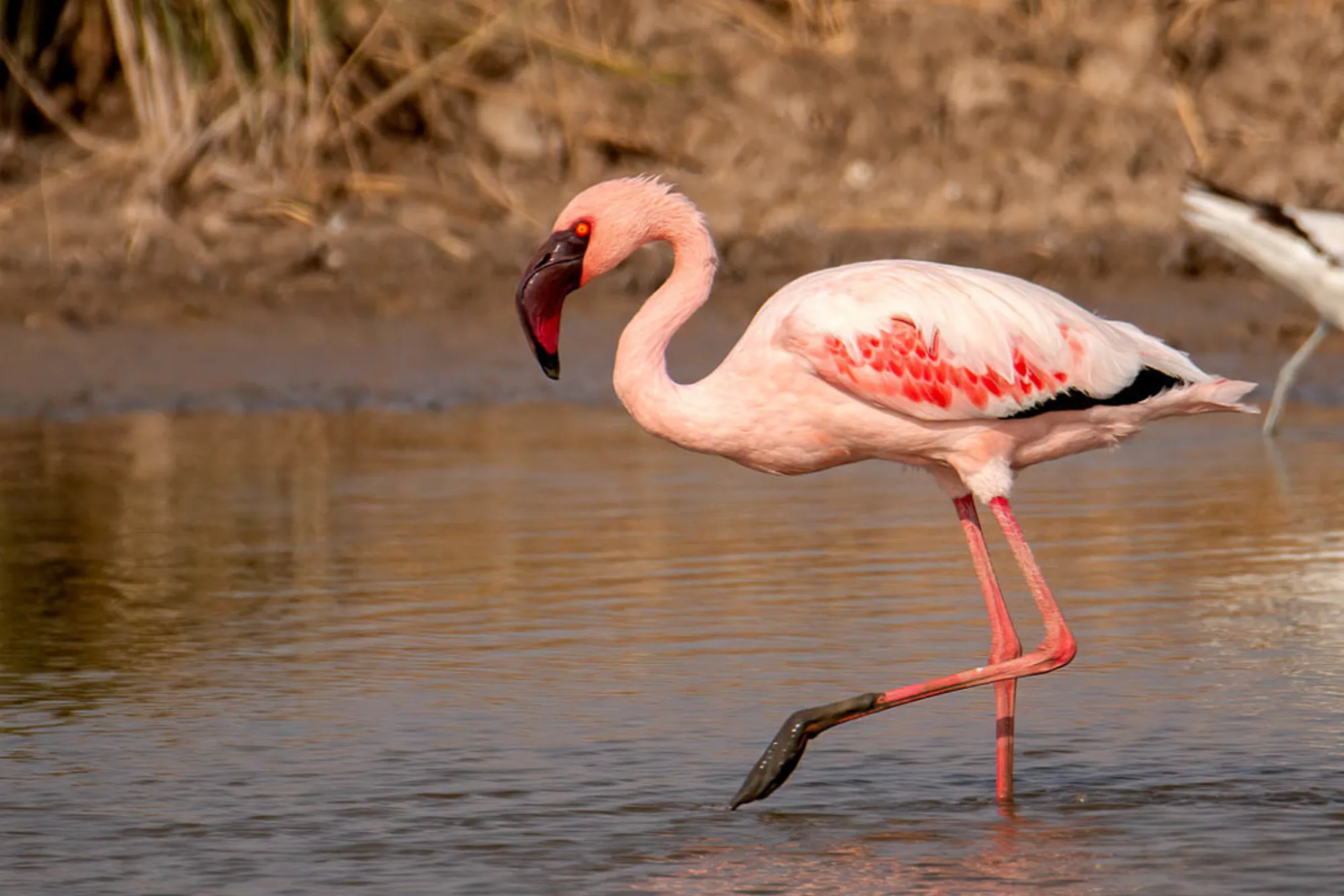
Pinkish-white feathers and a bill with extensive black make the Lesser Flamingo distinctive, especially where it can be compared with the greater flamingo. It is the smallest flamingo species, although it is still a large, tall bird, standing around 80 to 90 cm high. Size alone is less useful for identification when the two species are apart, because males and females also differ in height. Lesser Flamingos live in sub-Saharan Africa and western India, and are most common in Africa. They feed mainly on Spirulina, an alga that grows in very alkaline lakes and supplies the pigments behind their pink colour. Their bills filter tiny food from the water, including other algae and, to a lesser extent, small invertebrates.
In Africa, these birds breed principally at Lake Natron in northern Tanzania, a highly caustic lake. Other African breeding places include Etosha Pan, Makgadikgadi Pan and Kamfers Dam, while breeding in northwestern India has been recorded at the Zinzuwadia and Purabcheria salt pans. Some individuals move between Africa and India. The birds build a mud mound for their one chalky-white egg. Soon after hatching, chicks gather in crèches that can contain over 100,000 birds. A few adults guide them on foot to fresh water, sometimes travelling over 32 km.
The population is declining, and the small number of breeding sites leaves the species exposed to threats at those places. A proposed soda ash plant threatens Lake Natron, while pollution and encroaching development threaten Kamfers Dam. Suspected heavy metal poisoning has affected birds at Lake Nakuru and Lake Bogoria, and rising water levels can reduce the productivity of East African soda lakes.
Written from the English Wikipedia article Lesser flamingo (CC BY-SA 4.0).
- Records
- 48,842
- Countries
- 38
- Atlas places
- 28
- Ngorongoro Conservation Area· Tanzania
- iSimangaliso Wetland Park· South Africa
- Namib-Naukluft· Namibia
- Lake Manyara National Park· Tanzania
- Serengeti National Park· Tanzania
- Addo Elephant National Park· South Africa
- Dorob National Park· Namibia
- Queen Elizabeth National Park· Uganda
- West Coast National Park· South Africa
- Lake Nakuru National Park· Kenya
- Table Mountain National Park· South Africa
- Tsau ǁKhaeb (Sperrgebiet) National Park· Namibia
- Walvis Bay· Namibia
- Aberdare National Park· Kenya
- Etosha National Park· Namibia
- Hwange National Park· Zimbabwe
- Ai-Ais/Richtersveld Transfrontier Park· Namibia
- Amboseli National Park· Kenya
- Arusha National Park· Tanzania
- Hell's Gate National Park· Kenya
- Karoo National Park· South Africa
- Lake Mburo National Park· Uganda
- Madikwe Game Reserve· South Africa
- Pilanesberg National Park· South Africa
- Rwenzori Mountains National Park· Uganda
- Tarangire National Park· Tanzania
- uKhahlamba-Drakensberg Park· South Africa
- Zambezi National Park· Zimbabwe
These are open occurrence records, so they show where people looked for and recorded the Lesser Flamingo as much as where it lives. Cells are up to 25 km across, and every location is generalised to its cell.
Generalised encounter areas, not exact locations. Each shape is a grid cell coloured by how likely the species is there.
- Very likelySouth Africa25 km zone · high confidence · 19684 records · updated 86 days ago
- Very likelyIndia25 km zone · high confidence · 10566 records · updated 86 days ago
- Very likelyKenya25 km zone · high confidence · 4948 records · updated 86 days ago
- Very likelyNamibia25 km zone · high confidence · 4310 records · updated 86 days ago
- Very likelyTanzania25 km zone · high confidence · 4210 records · updated 86 days ago
- Very likelySpain25 km zone · high confidence · 969 records · updated 86 days ago
- Very likelyUganda25 km zone · high confidence · 759 records · updated 86 days ago
- Very likelyMadagascar25 km zone · high confidence · 512 records · updated 86 days ago
- Very likelyFrance25 km zone · high confidence · 506 records · updated 86 days ago
- Very likelyMauritania25 km zone · high confidence · 435 records · updated 86 days ago
Conservation status not assessed here yet, so every location is generalised to its grid cell.