Laysan Albatross
Phoebastria immutabilis
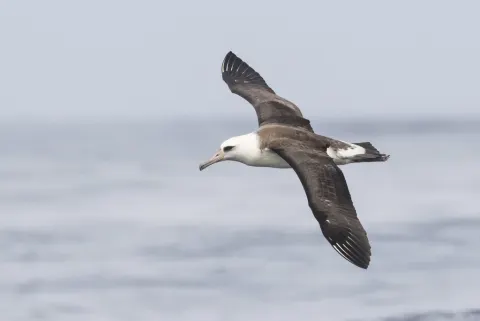
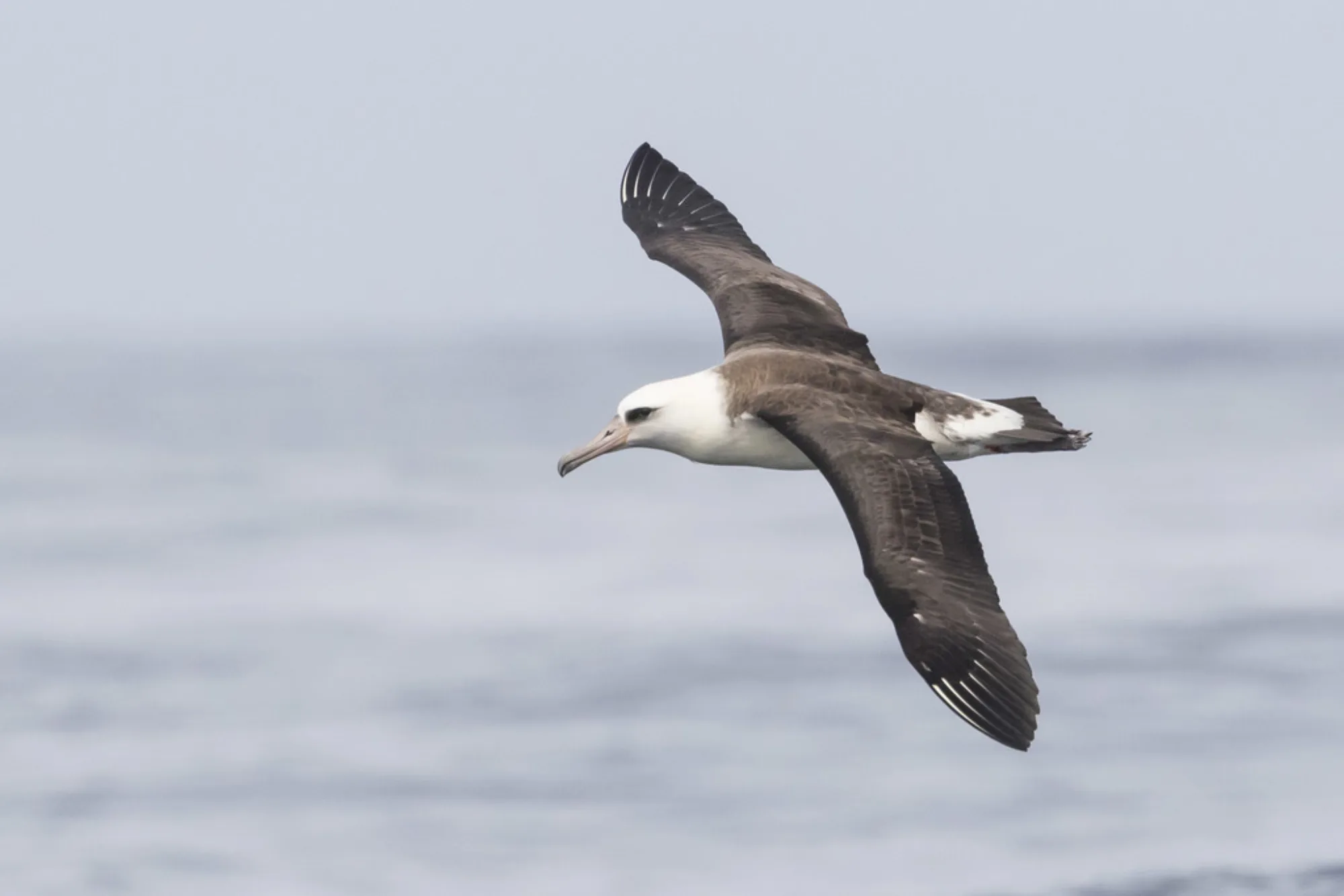
Across the North Pacific, the Laysan Albatross is a large seabird with a gull-like appearance. Its dark grey back and wings contrast with a white head and underside, while a black smudge marks the area around each eye. Adults have a pink bill with a dark tip; juveniles have a grey bill and a dark upper rump. The bird averages 81 cm in length, with a wingspan of 195 to 203 cm.
The Northwestern Hawaiian Islands hold 99.7% of the population, particularly around Midway and Laysan. The Bonin Islands, close to Japan, also support small populations, while islands off Mexico are being colonised. Beyond the breeding grounds, the birds range as far north as the Bering Sea, reaching Japan and waters south to 15°N. Usually silent, they sometimes make long mooing sounds, descending whinnies or rattles. They feed mainly on cephalopods, along with fish, crustaceans and other invertebrates.
Laysan Albatrosses nest in colonies on small islands and atolls, sometimes in huge numbers, making anything from shallow scrapes in sand to nests of vegetation. In the Hawaiian Islands, the breeding season usually runs from November to July. Both parents incubate a single egg and later go to sea to feed their chick, which takes about 160 days to fledge. Longline fisheries threaten the birds, and the species has yet to recover from extensive hunting for feathers in the early 1900s. Lead paint around buildings on Midway also killed chicks, although the atoll was declared lead-free in 2018 after buildings and soils were cleaned.
Written from the English Wikipedia article Laysan albatross (CC BY-SA 4.0).
- Records
- 25,118
- Countries
- 6
- Atlas places
- 2
These are open occurrence records, so they show where people looked for and recorded the Laysan Albatross as much as where it lives. Cells are up to 25 km across, and every location is generalised to its cell.
Generalised encounter areas, not exact locations. Each shape is a grid cell coloured by how likely the species is there.
- Very likelyUnited States25 km zone · medium confidence · 24151 records · updated 80 days ago
- Very likelyJapan25 km zone · high confidence · 427 records · updated 80 days ago
- Very likelyMexico25 km zone · medium confidence · 214 records · updated 80 days ago
- Very likelyU.S. Outlying Islands25 km zone · high confidence · 159 records · updated 80 days ago
- Very likelyRussia25 km zone · medium confidence · 99 records · updated 80 days ago
- Very likelyCanada25 km zone · high confidence · 68 records · updated 80 days ago
Conservation status not assessed here yet, so every location is generalised to its grid cell.