Striped Desert Hamster
Phodopus sungorus
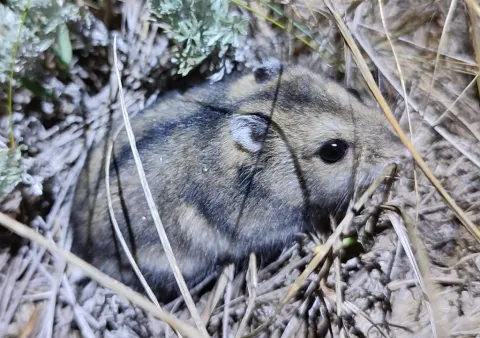
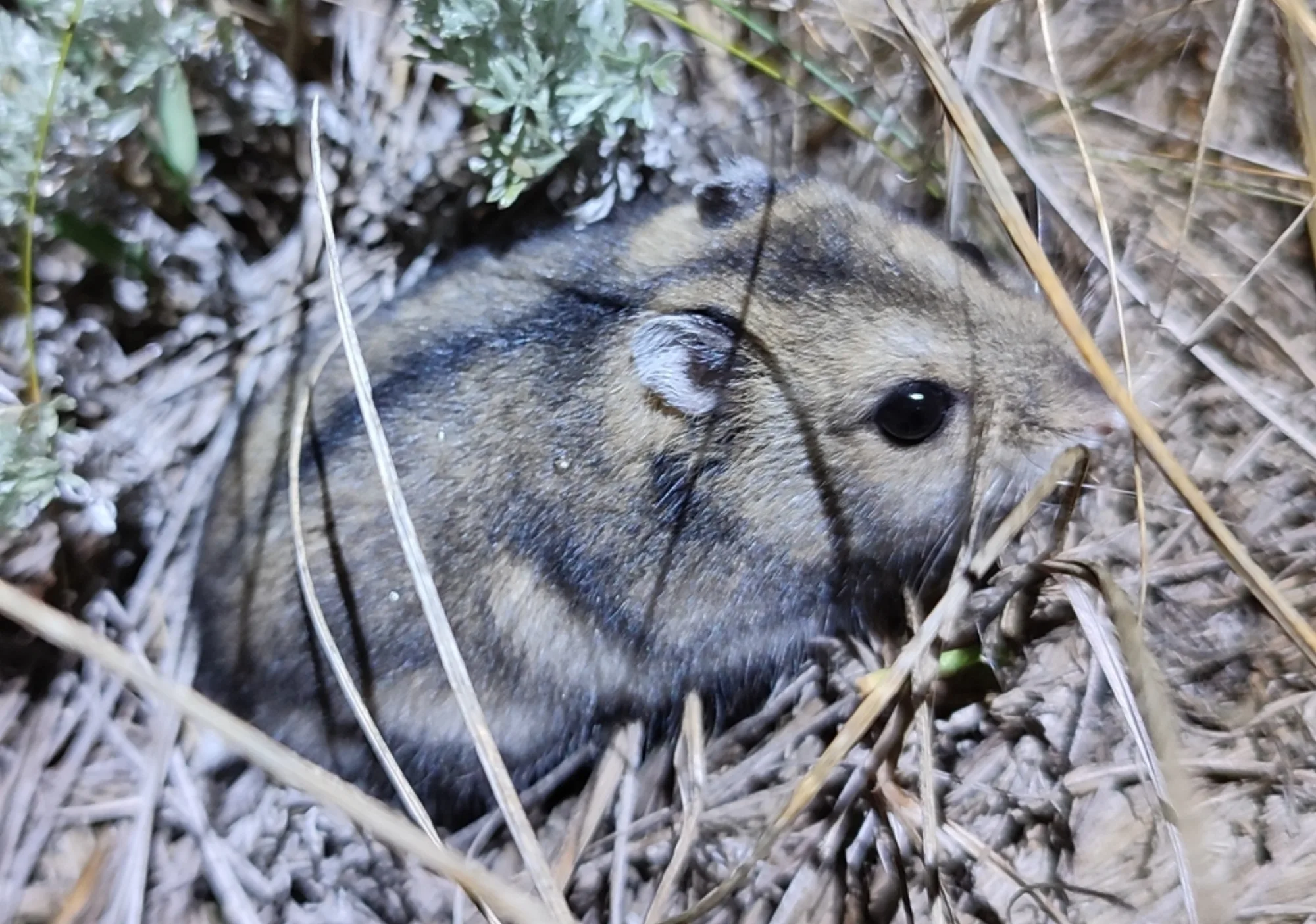
A rounded body, furry feet and a dark stripe along the back help identify the Striped Desert Hamster, Phodopus sungorus. Also called the winter white dwarf hamster, it has a head and body length of 70 to 90 mm. In summer, its back ranges from ash-grey to dark brown, sometimes with a pale brown tint, while its throat, belly, tail and limbs are white. As winter approaches and days shorten, its dark coat is almost entirely replaced by white fur. Against snow, this colour provides camouflage from predators. Its feet are furred too, protecting them from cold ground.
In the wild, this hamster occurs in Kazakhstan's wheat fields, the meadows of Mongolia and Siberia, and birch stands in Manchuria. It also inhabits Central Asian semideserts, dry steppes, wheat and alfalfa fields, and small fields in forests around Minusinsk. It digs tunnels one metre deep to burrows where it sleeps, raises young and shelters from predators. Most burrows have six entrances, and in summer the hamster lines them with moss. For winter, it closes all but one entrance and adds fur or wool it finds to help keep the burrow warm. Wild breeding takes place during the long days of spring and summer. The hamster reproduces frequently, and females can become aggressive towards males during breeding. Weasels are among its main predators, while no serious or broadly occurring threats are known. Numbers in the wild have not been recorded, although its population and distribution are described as large.
Written from the English Wikipedia article Winter white dwarf hamster (CC BY-SA 4.0).
- Records
- 0
- Countries
- 2
- Atlas places
- 1
These are open occurrence records, so they show where people looked for and recorded the Striped Desert Hamster as much as where it lives. Cells are up to 25 km across, and every location is generalised to its cell.
Generalised encounter areas, not exact locations. Each shape is a grid cell coloured by how likely the species is there.
- Very likelyCanada25 km zone · low confidence · 0 records · updated 80 days ago
- PossiblePoland25 km zone · low confidence · 0 records · updated 80 days ago
Conservation status not assessed here yet, so every location is generalised to its grid cell.