Desert Hamster
Phodopus roborovskii
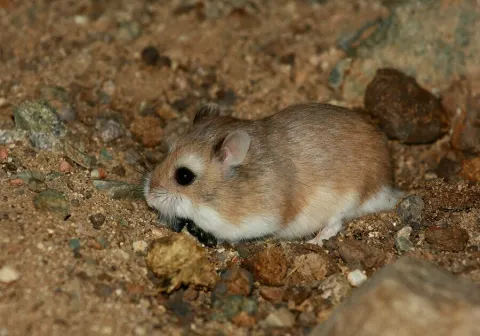
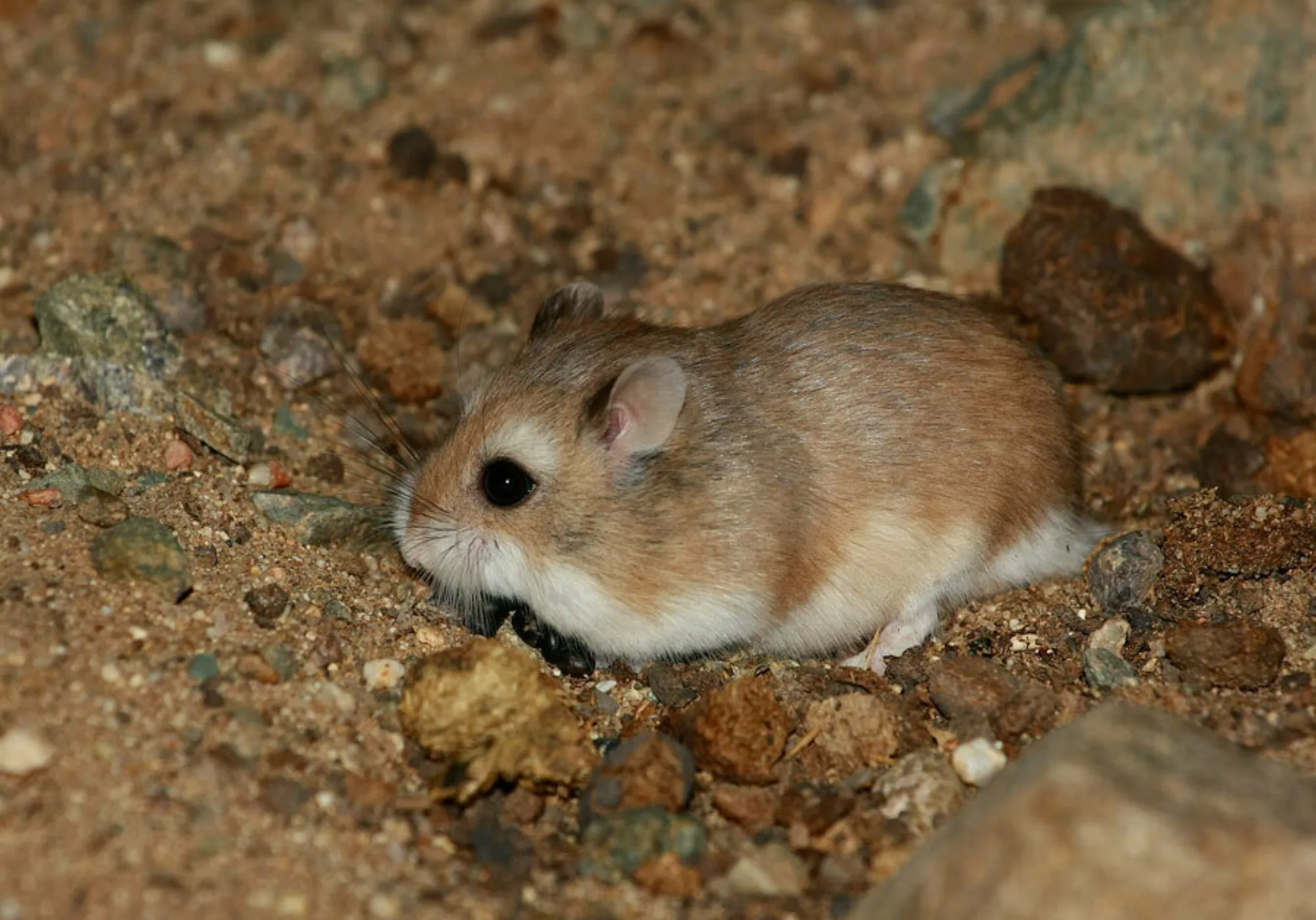
Small enough to fit among sparse desert vegetation, the Desert Hamster has sandy fur, white spots above its eyes and no stripe along its back. Adults grow to around 6.3 cm long and weigh about 16 g. Its natural colouring can also appear greyish-brown, with a white underside and white markings above the eyes.
Central Asian deserts are home to this hamster, with records from the Lake Zaysan basin in Kazakhstan, Tuva, Mongolia and Xinjiang in China. It favours loose sand with sparse vegetation and is rarely found on solid clay or among dense plants. It lives at elevations of around 1,200 to 1,450 metres, in steppe and desert. Local people have reported seeing it commonly around Yulin in China's Shaanxi province and among the dunes of the Ordos Desert.
In the wild, look for it at dawn or dusk, when it is most active. It is known for its speed and digs burrows with steep tunnels, where it stays through winter. Food gathered during warmer weather is stored in chambers underground. Its diet includes grains, vegetables, fruit and other plants, along with insects and meat when available. In Mongolia it eats beetles, earwigs and crickets, while in Tuva it feeds mainly on seeds and summer sedges. Breeding takes place between April and September, with three to four litters and three to nine young in each litter. The source describes no threats to wild populations, but notes that a gene variant in some captive-bred hamsters can cause fatal neurological symptoms.
Written from the English Wikipedia article Roborovski dwarf hamster (CC BY-SA 4.0).
- Records
- 29
- Countries
- 1
No atlas park has a record of the Desert Hamster in or around it yet.
These are open occurrence records, so they show where people looked for and recorded the Desert Hamster as much as where it lives. Cells are up to 25 km across, and every location is generalised to its cell.
Generalised encounter areas, not exact locations. Each shape is a grid cell coloured by how likely the species is there.
- Very likelyChina25 km zone · medium confidence · 29 records · updated 80 days ago
Conservation status not assessed here yet, so every location is generalised to its grid cell.