Common Porpoise
Phocoena phocoena
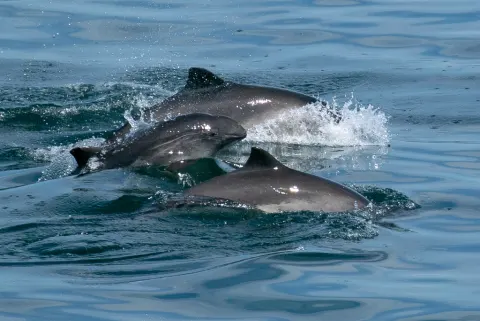
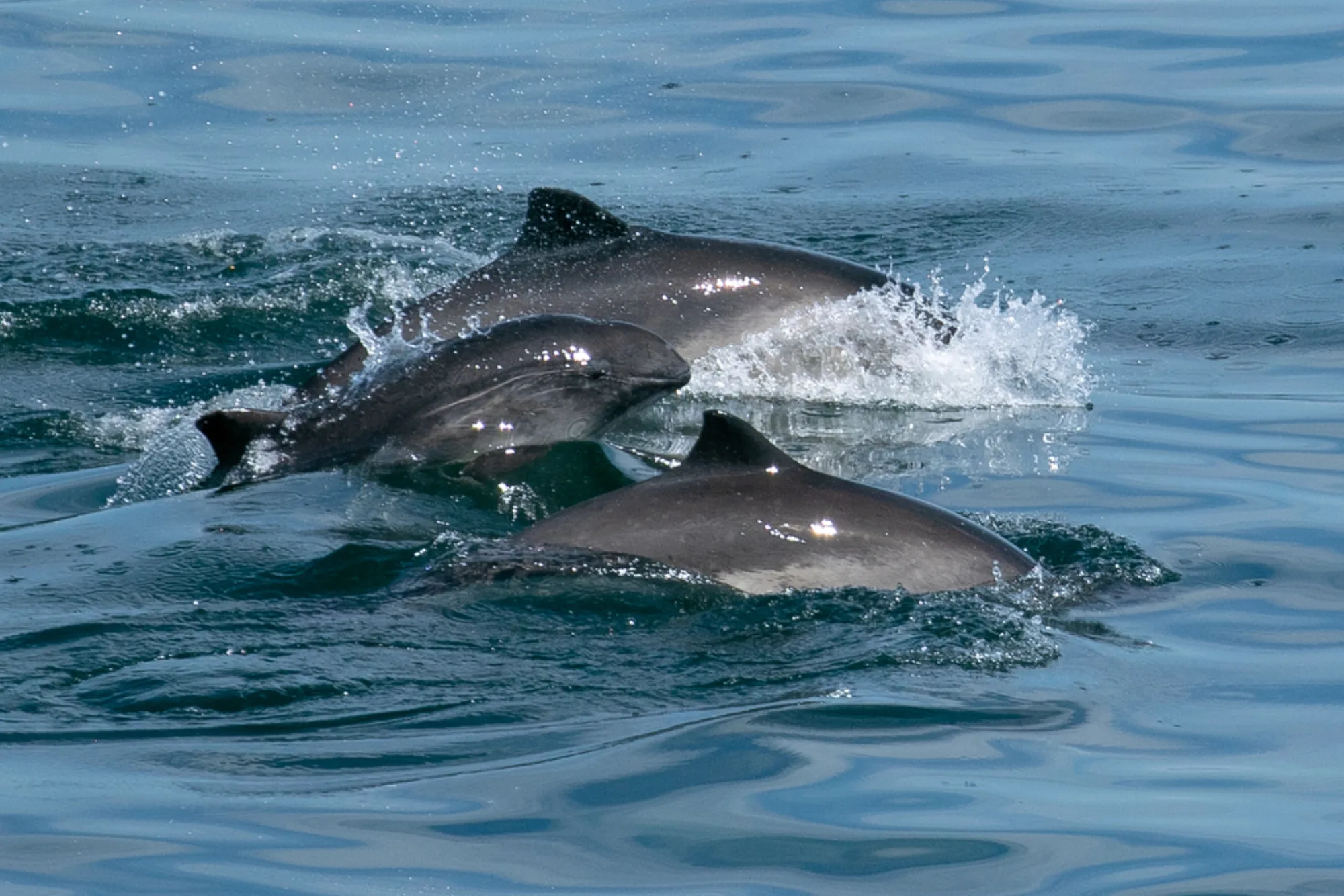
Small and robust, the Common Porpoise (Phocoena phocoena) has a triangular dorsal fin, a dark grey back and lighter, slightly speckled sides. Its underside is much whiter, with grey stripes usually running along the throat, while its beak is not clearly defined. Adults reach 1.4 to 1.9 m in length, and females are heavier than males. Sightings usually involve a single porpoise or a small group, typically with at most five animals.
This coastal animal favours cool, temperate and subarctic waters, including fjords, bays, estuaries and harbours. It ranges across the North Atlantic, North Pacific and Black Sea, and can travel far up rivers. It usually forages alone, though porpoises sometimes hunt together and herd fish. Small schooling fish such as herring, cod and sprat make up much of the diet, with squid and crustaceans eaten in some places. Porpoises often feed near the seabed in shallower water, but may hunt closer to the surface for sprat. Their clicks serve both communication and echolocation. Most calves are born in late spring and summer, after a pregnancy typically lasting 10 to 11 months.
Fishing nets are a major threat: porpoises become entangled in bottom-set gill nets, and several thousand die as incidental catch each year. Overfishing can reduce their preferred prey, while noise from shipping appears to prompt them to move away or dive deeper. Pollutants can accumulate in their fat, and food shortages may expose them to toxic effects when they draw on those reserves. White sharks, killer whales and grey seals also prey on porpoises.
Written from the English Wikipedia article Harbour porpoise (CC BY-SA 4.0).
- Records
- 90,311
- Countries
- 31
- Atlas places
- 1
These are open occurrence records, so they show where people looked for and recorded the Common Porpoise as much as where it lives. Cells are up to 25 km across, and every location is generalised to its cell.
Generalised encounter areas, not exact locations. Each shape is a grid cell coloured by how likely the species is there.
- Very likelyFrance25 km zone · high confidence · 31079 records · updated 86 days ago
- Very likelyDenmark25 km zone · high confidence · 24826 records · updated 86 days ago
- Very likelySweden25 km zone · high confidence · 13162 records · updated 86 days ago
- Very likelyGermany25 km zone · high confidence · 6327 records · updated 86 days ago
- Very likelyCanada25 km zone · high confidence · 5275 records · updated 86 days ago
- Very likelyNorway25 km zone · high confidence · 3623 records · updated 86 days ago
- Very likelyNetherlands25 km zone · medium confidence · 1573 records · updated 86 days ago
- Very likelyBelgium25 km zone · high confidence · 1483 records · updated 86 days ago
- Very likelyUnited States25 km zone · high confidence · 1336 records · updated 86 days ago
- Very likelyUnited Kingdom25 km zone · high confidence · 798 records · updated 86 days ago
Conservation status not assessed here yet, so every location is generalised to its grid cell.