New Zealand Sea Lion
Phocarctos hookeri
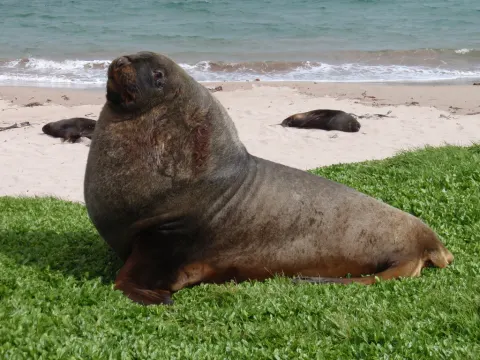
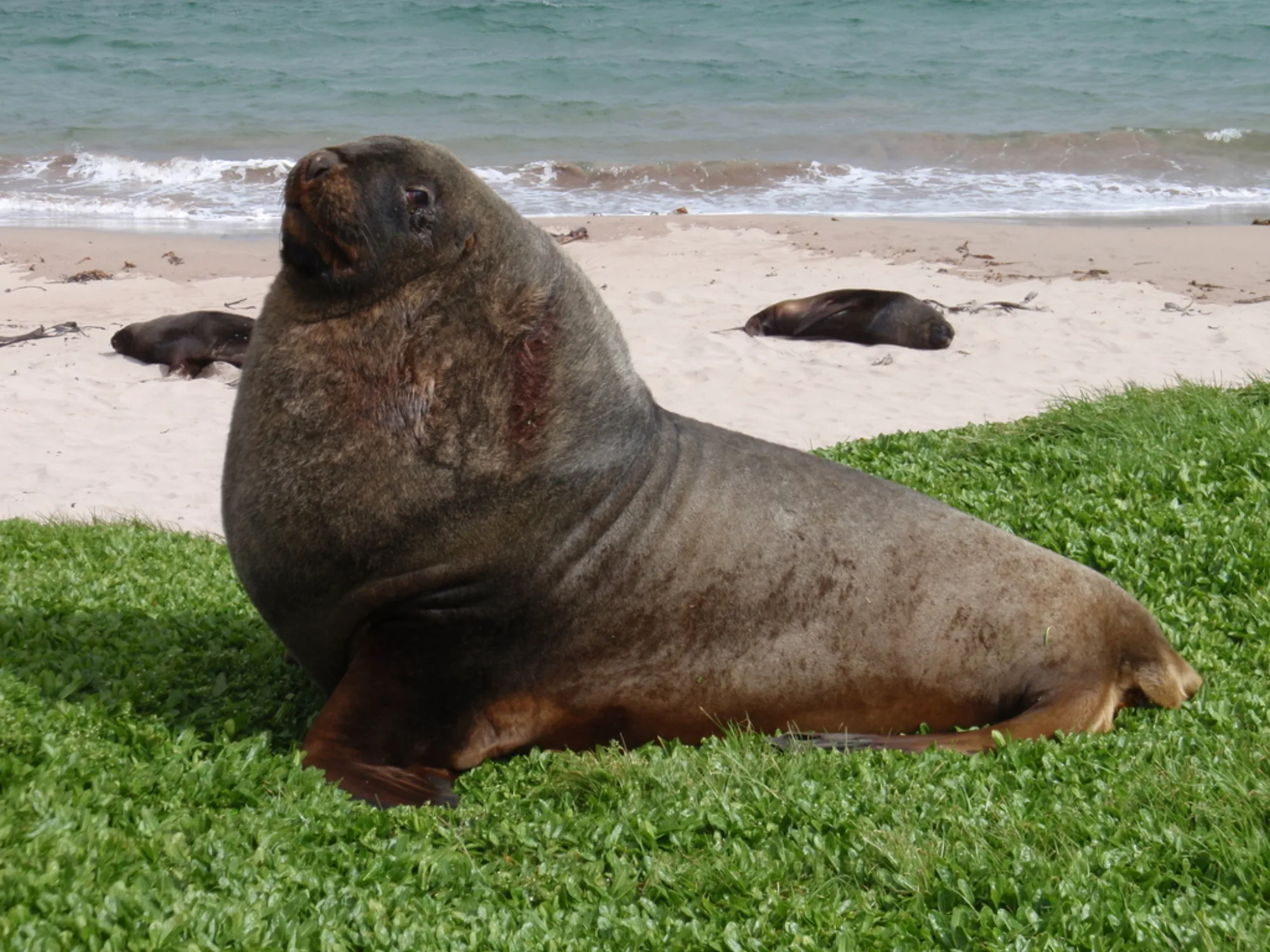
A black mane reaching the shoulders helps distinguish an adult male New Zealand Sea Lion, while females range from buff to creamy grey, with darker muzzles and flippers. Males are considerably larger, measuring 240 to 350 centimetres and weighing 320 to 450 kilograms, compared with 180 to 200 centimetres and 90 to 160 kilograms for females. Pups are born with thick, dark brown coats that later turn dark grey with cream markings.
Found only in New Zealand, these sea lions breed mainly on the subantarctic Auckland and Campbell islands, with smaller breeding populations along the South Island and Stewart Island coasts. During the breeding season, females move inland with their pups, travelling from sandy beaches into tall grass and forest. They may go as far as 2 kilometres inland, seeking shelter from storms, wind, males and potential parasites. Their diet ranges widely, from fish, rays and sharks to squid, octopus, crustaceans, seabirds and other marine mammals. What they eat varies by location, with very little overlap between prey recorded at Otago Peninsula and Campbell Island.
Hunting greatly reduced their numbers and breeding range, and fishing remains a threat: sea lions have been caught and drowned in squid trawl nets. The Auckland Islands population has shown signs of food shortage, including poor condition in mothers and low pup survival. Disease has also killed many pups, including during bacterial outbreaks on the Auckland Islands. As sea lions return to mainland areas, roads and fences obstruct their inland movements, while cars, deliberate attacks and disturbance by domestic dogs pose further dangers.
Written from the English Wikipedia article New Zealand sea lion (CC BY-SA 4.0).
- Records
- 33,815
- Countries
- 1
- Atlas places
- 2
These are open occurrence records, so they show where people looked for and recorded the New Zealand Sea Lion as much as where it lives. Cells are up to 25 km across, and every location is generalised to its cell.
Generalised encounter areas, not exact locations. Each shape is a grid cell coloured by how likely the species is there.
- Very likelyNew Zealand25 km zone · high confidence · 33815 records · updated 80 days ago
Conservation status not assessed here yet, so every location is generalised to its grid cell.