Harbor Seal
Phoca vitulina
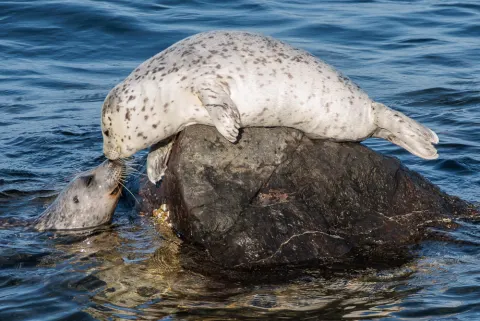
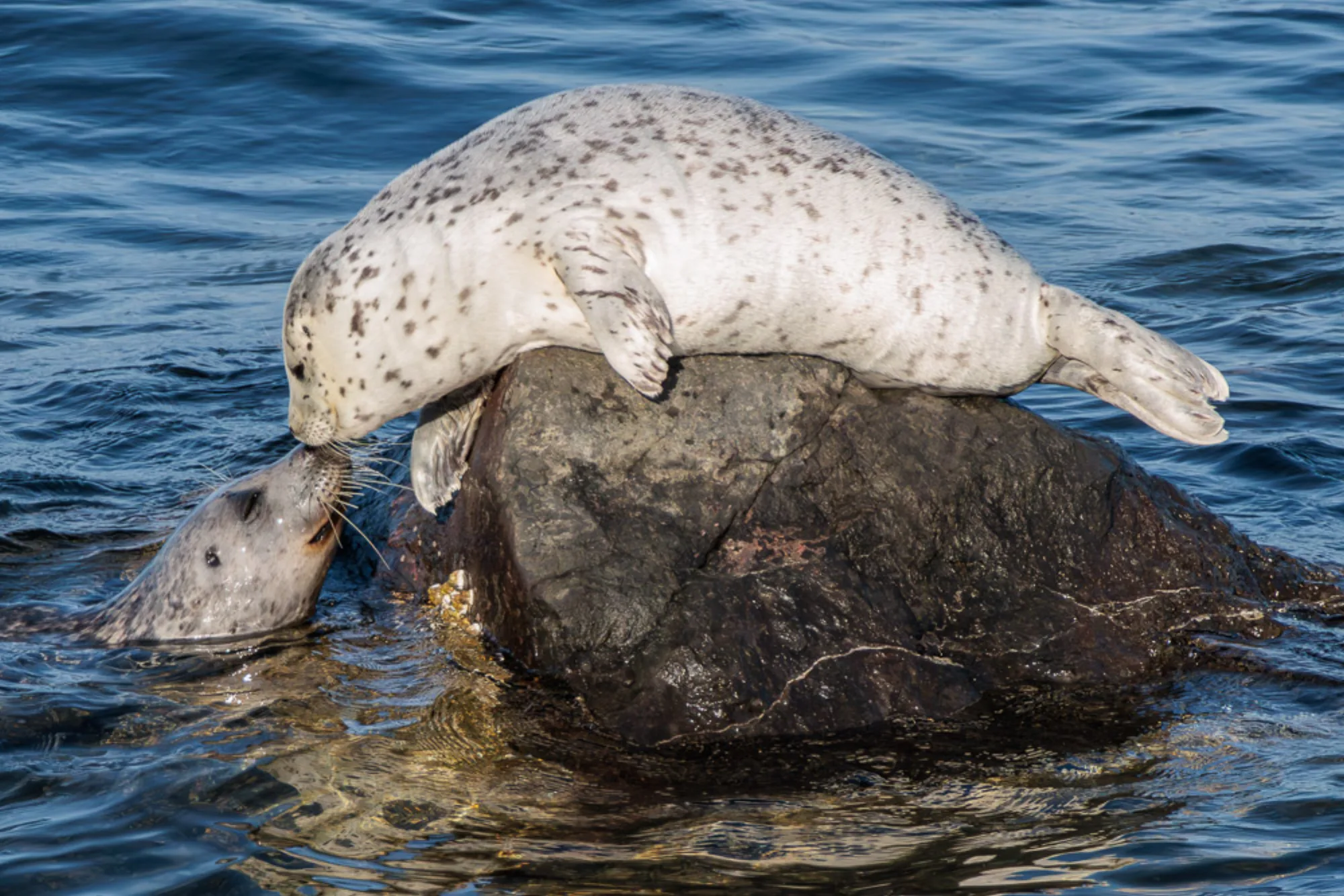
Look for the Harbor Seal resting on a rocky shore or sandy beach, often close to the water where it feeds. This true seal has a rounded head, short flippers and distinctive V-shaped nostrils. Its coat ranges from brownish black to tan or grey, with a unique pattern of light or dark spots and generally paler underparts. Adults can reach 1.85 m in length and weigh up to 168 kg, with females generally smaller than males.
Harbor Seals live along temperate and Arctic coasts of the Northern Hemisphere, including the northern Atlantic and Pacific, the Baltic Sea and the North Sea. They return to familiar resting places, using rocks, sand, mud or ice where they can shelter near feeding areas. Usually solitary in the water, they gather when resting ashore and during the breeding season. They may spend several days at sea, travelling up to 50 km to find feeding grounds. Their varied diet includes fish such as herring, anchovy and flatfish, as well as occasional crabs, shrimp and squid. In California, they also enter bays and estuaries and swim up coastal rivers.
A mother gives birth to one pup on shore and raises it alone. The pup can swim and dive within hours and grows quickly on her rich milk. Births vary by location, from February in lower latitudes to as late as July in the subarctic. Disease, deliberate killing and accidental capture in fishing nets have reduced or eliminated some local populations. Human activity can disturb seals on shore, and excessive activity near pups can cause mothers to abandon them.
Written from the English Wikipedia article Harbor seal (CC BY-SA 4.0).
- Records
- 58,008
- Countries
- 13
- Atlas places
- 4
These are open occurrence records, so they show where people looked for and recorded the Harbor Seal as much as where it lives. Cells are up to 25 km across, and every location is generalised to its cell.
Generalised encounter areas, not exact locations. Each shape is a grid cell coloured by how likely the species is there.
- Very likelyDenmark25 km zone · high confidence · 22737 records · updated 80 days ago
- Very likelyNorway25 km zone · high confidence · 10071 records · updated 80 days ago
- Very likelyUnited Kingdom25 km zone · high confidence · 7288 records · updated 80 days ago
- Very likelyFrance25 km zone · medium confidence · 5992 records · updated 80 days ago
- Very likelyIreland25 km zone · high confidence · 4851 records · updated 80 days ago
- Very likelyUnited States25 km zone · high confidence · 3635 records · updated 80 days ago
- Very likelySweden25 km zone · high confidence · 2009 records · updated 80 days ago
- Very likelyGermany25 km zone · high confidence · 974 records · updated 80 days ago
- Very likelyNetherlands25 km zone · high confidence · 235 records · updated 80 days ago
- Very likelyBelgium25 km zone · high confidence · 99 records · updated 80 days ago
Conservation status not assessed here yet, so every location is generalised to its grid cell.