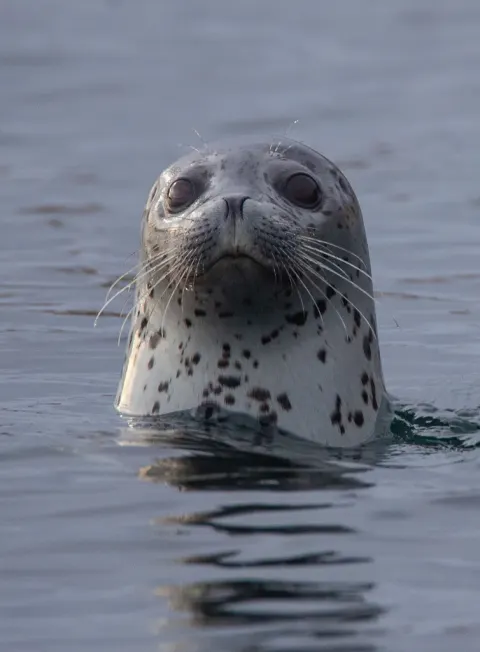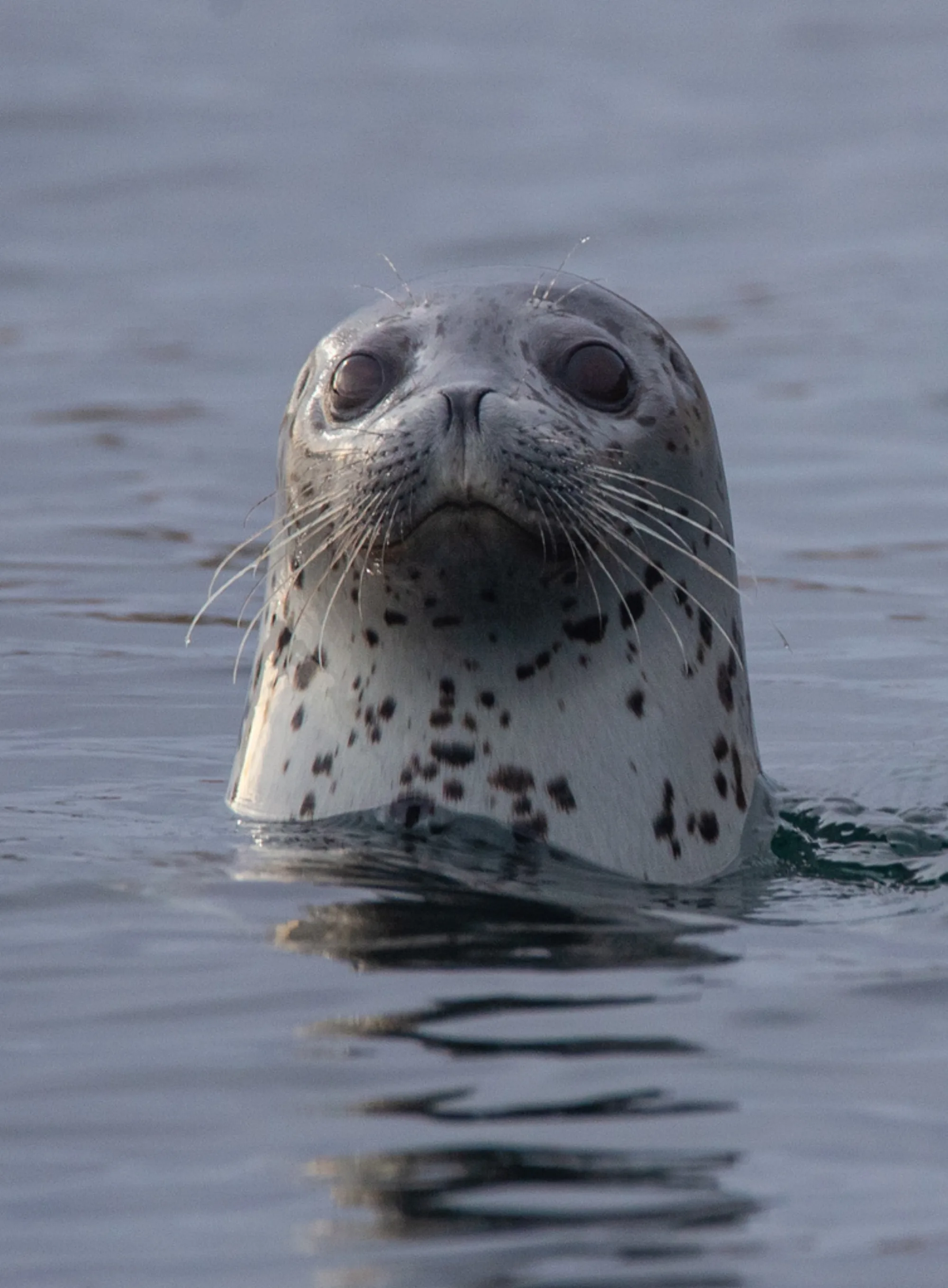
Spotted Seal
Phoca largha
Dark, irregular spots cover the Spotted Seal's pale coat, which ranges from silver to grey and white. It has a round head and a narrow, doglike snout, and adults generally measure 150 to 210 cm. It can be mistaken for the closely related harbour seal, and the two mingle where their ranges overlap. Shy and difficult to approach, spotted seals may be solitary, but gather in large groups when giving birth or moulting. They haul out on ice floes at these times, or on land when ice is absent.
Spotted seals inhabit the North Pacific and adjoining seas, mainly along continental shelves from the Beaufort and Chukchi Seas to the Bering and Okhotsk Seas and the northern Yellow Sea. They migrate south as far as the western Sea of Japan and northern Huanghai. During breeding season they often use the outer edges of ice floes, avoiding dense drift ice. In summer they live in the open ocean or along nearby shores. In Alaska, several thousand can gather on sandbars and shoals at Kasegaluk Lagoon, near Cape Espenburg and in Kuskokwim Bay.
Breeding runs from January to mid-April, with births peaking in mid-March. A male, female and pup form a family during the breeding season, and pups are weaned after six weeks. Feeding seals dive as deep as 300 m: young animals mainly eat krill and small crustaceans, while adults take fish, molluscs and crustaceans. The loss of Arctic ice through global warming has raised concern for the species. In China, marine traffic, industrial sounds and polluted seas threaten the seals, as does poaching to supply aquariums.
Written from the English Wikipedia article Spotted seal (CC BY-SA 4.0).
- Records
- 544
- Countries
- 6
No atlas park has a record of the Spotted Seal in or around it yet.
These are open occurrence records, so they show where people looked for and recorded the Spotted Seal as much as where it lives. Cells are up to 25 km across, and every location is generalised to its cell.
Generalised encounter areas, not exact locations. Each shape is a grid cell coloured by how likely the species is there.
- Very likelyUnited States25 km zone · medium confidence · 498 records · updated 80 days ago
- Very likelyRussia25 km zone · medium confidence · 43 records · updated 80 days ago
- PossibleSouth Korea25 km zone · medium confidence · 2 records · updated 80 days ago
- PossibleJapan25 km zone · medium confidence · 1 record · updated 80 days ago
- RareChina25 km zone · low confidence · 0 records · updated 80 days ago
- RareNorth Korea25 km zone · low confidence · 0 records · updated 80 days ago
Conservation status not assessed here yet, so every location is generalised to its grid cell.