Rose-breasted Grosbeak
Pheucticus ludovicianus
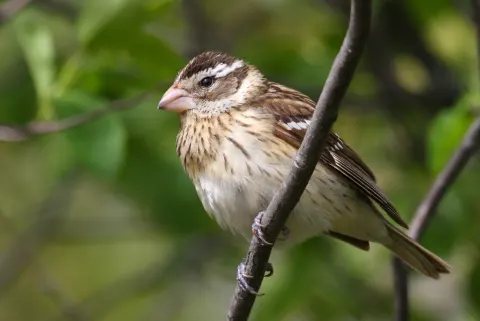
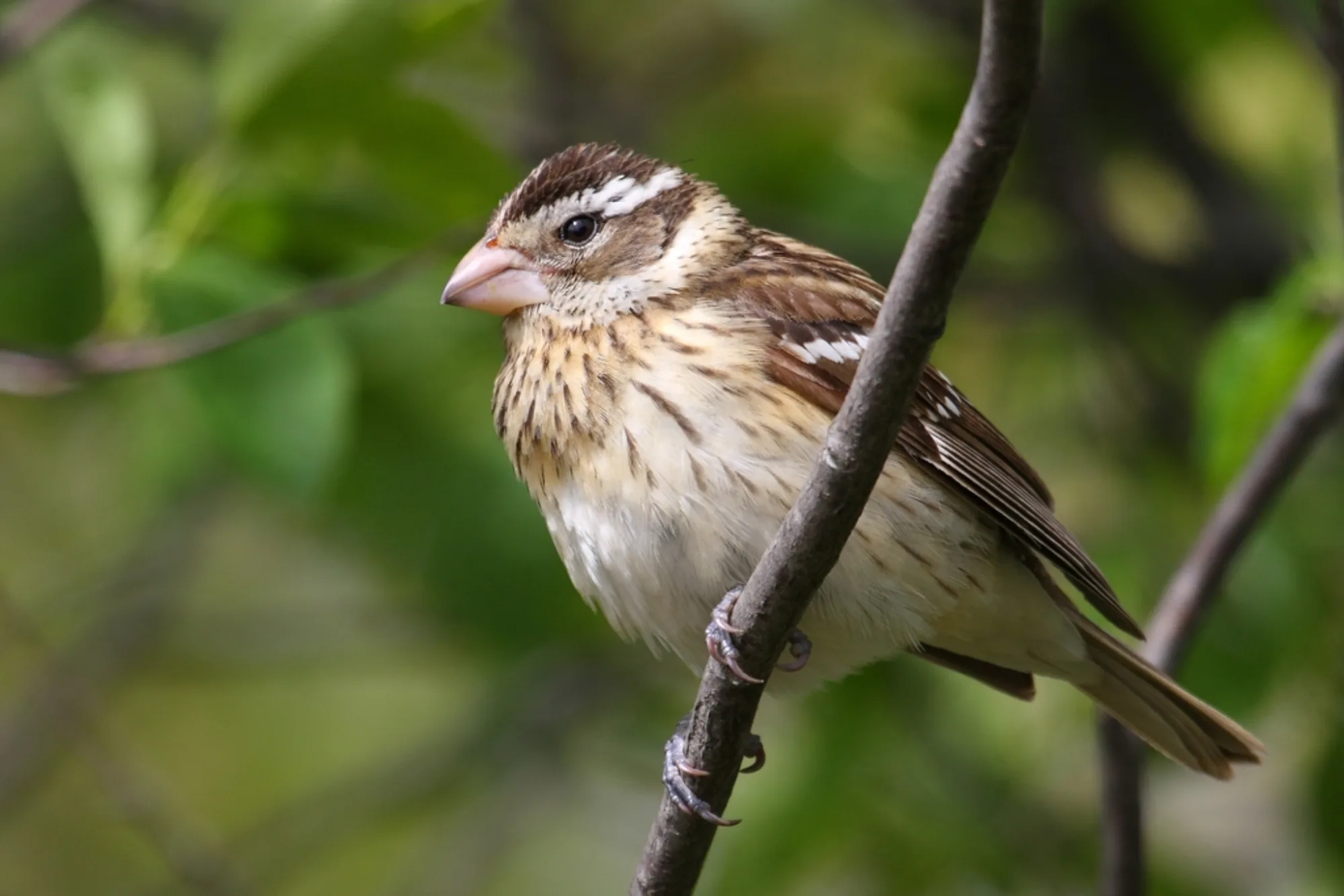
A flash of rose-red against a white breast marks the male Rose-breasted Grosbeak in breeding plumage. His head, back, wings and tail are black, with two white patches on the wings. The female looks different, with grey-brown upperparts, a white stripe above the eye and dark streaks on her pale underside. Adults measure 18 to 22 cm long, and their song is a soft, mellow warble.
Look for this large member of the cardinal family in open deciduous woods across much of Canada and the northeastern United States during the breeding season. It usually stays in the treetops, searching among shrubs and trees for insects, seeds and berries, and sometimes catches insects in flight. Birds generally travel south in late September or October, returning in late April or early May. They winter as far north as central-southern Mexico and as far south as Peru and Venezuela, including Central America and the Caribbean. There they favour open woodland, forest edges, parks, gardens and plantations, and typically travel in small groups, sometimes gathering in larger flocks.
On the breeding grounds, males tend to arrive before females, and both sexes help choose and build a nest. It is placed in woody vegetation, usually near an opening in the woodland, and made from materials such as leaves, twigs and rootlets. A clutch normally contains three or four eggs, and both parents share incubation. Young birds typically leave the nest after 9 to 13 days and become independent after approximately three weeks. Predators are the main cause of nesting failure, while collisions with buildings and cars also kill grosbeaks. Across the eastern part of its summer range, the population has declined by more than 1.5% yearly since 1966.
Written from the English Wikipedia article Rose-breasted grosbeak (CC BY-SA 4.0).
- Records
- 962,507
- Countries
- 4
No atlas park has a record of the Rose-breasted Grosbeak in or around it yet.
These are open occurrence records, so they show where people looked for and recorded the Rose-breasted Grosbeak as much as where it lives. Cells are up to 25 km across, and every location is generalised to its cell.
Generalised encounter areas, not exact locations. Each shape is a grid cell coloured by how likely the species is there.
- Very likelyUnited States25 km zone · high confidence · 759976 records · updated 80 days ago
- Very likelyCanada25 km zone · high confidence · 193925 records · updated 80 days ago
- Very likelyColombia25 km zone · high confidence · 5853 records · updated 80 days ago
- Very likelyGuatemala25 km zone · high confidence · 2753 records · updated 80 days ago
Conservation status not assessed here yet, so every location is generalised to its grid cell.