Black-bellied Pangolin
Phataginus tetradactyla
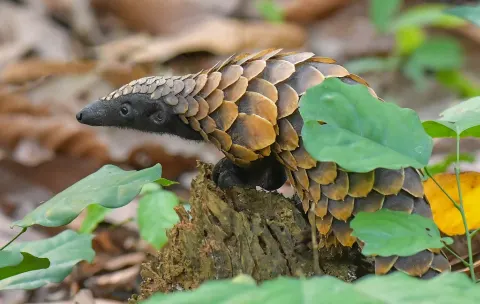
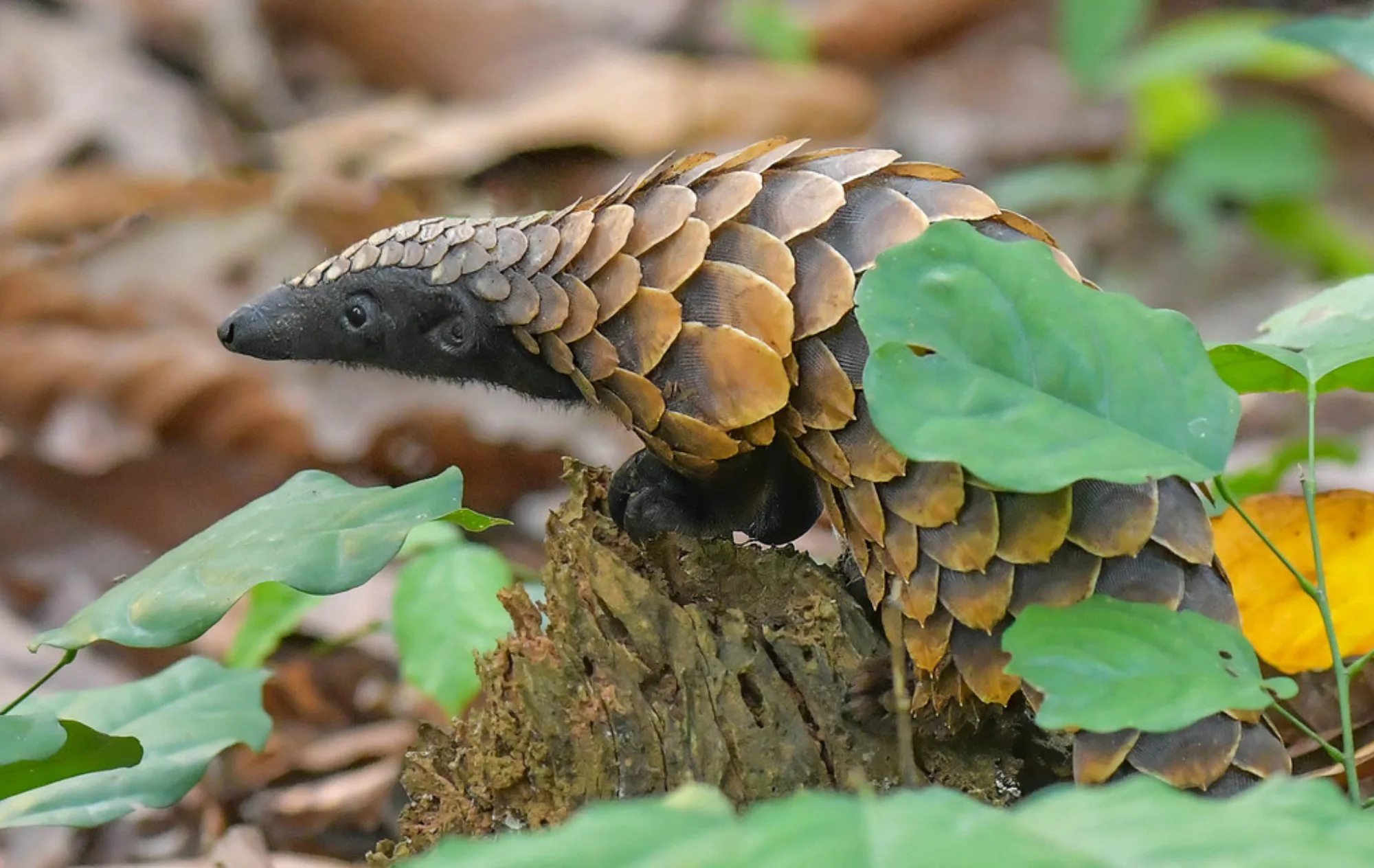
Covered in dark, artichoke-shaped scales with bright edges for camouflage, the Black-bellied Pangolin is the smallest of its kind. It is easily identified by a tail that can reach 70 cm, which is nearly twice the length of its 30 to 40 cm body. While other pangolins are active at night, this species is unique for being active during the day. It is a shy, solitary animal that spends most of its life in the forest canopy, using its strong claws and a bare, sensitive tail tip to grip branches. It is also a capable swimmer, often found near water.
Native to the tropical riverine and swamp forests of western and central Africa, these mammals range from Senegal to Uganda and south into Angola. They live primarily in the forest interior, though they sometimes inhabit agricultural lands. Their diet consists almost entirely of ants rather than termites. To feed, they tear open nests with their claws and use a long, sticky tongue to swallow prey whole, which is later ground up in a muscular stomach. Mothers give birth to a single young, which travels by riding on the mother's tail for three months.
When a leopard or python approaches, this pangolin rolls into a tight ball to hide its soft belly and expose its sharp scales. It may also release a foul-smelling fluid to deter attackers. Despite these defenses, the species faces significant pressure from humans. They are frequently hunted for the traditional medicine market and are heavily exploited for the bushmeat trade.
Written from the English Wikipedia article Long-tailed pangolin (CC BY-SA 4.0).
- Records
- 2
- Countries
- 3
- Atlas places
- 0
These are open occurrence records, so they show where people looked for and recorded the Black-bellied Pangolin as much as where it lives. Cells are up to 25 km across, and every location is generalised to its cell.
Generalised encounter areas, not exact locations. Each shape is a grid cell coloured by how likely the species is there.
- Very likelyGhana50 km zone · medium confidence · 2 records · updated 4 days ago
- PossibleCentral African Republic50 km zone · low confidence · 0 records · updated 4 days ago
- UncommonCongo - Kinshasa50 km zone · low confidence · 0 records · updated 4 days ago