Common Pheasant
Phasianus colchicus
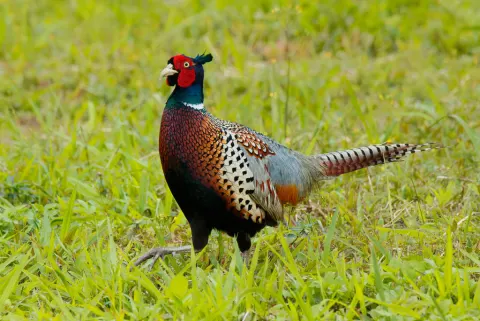
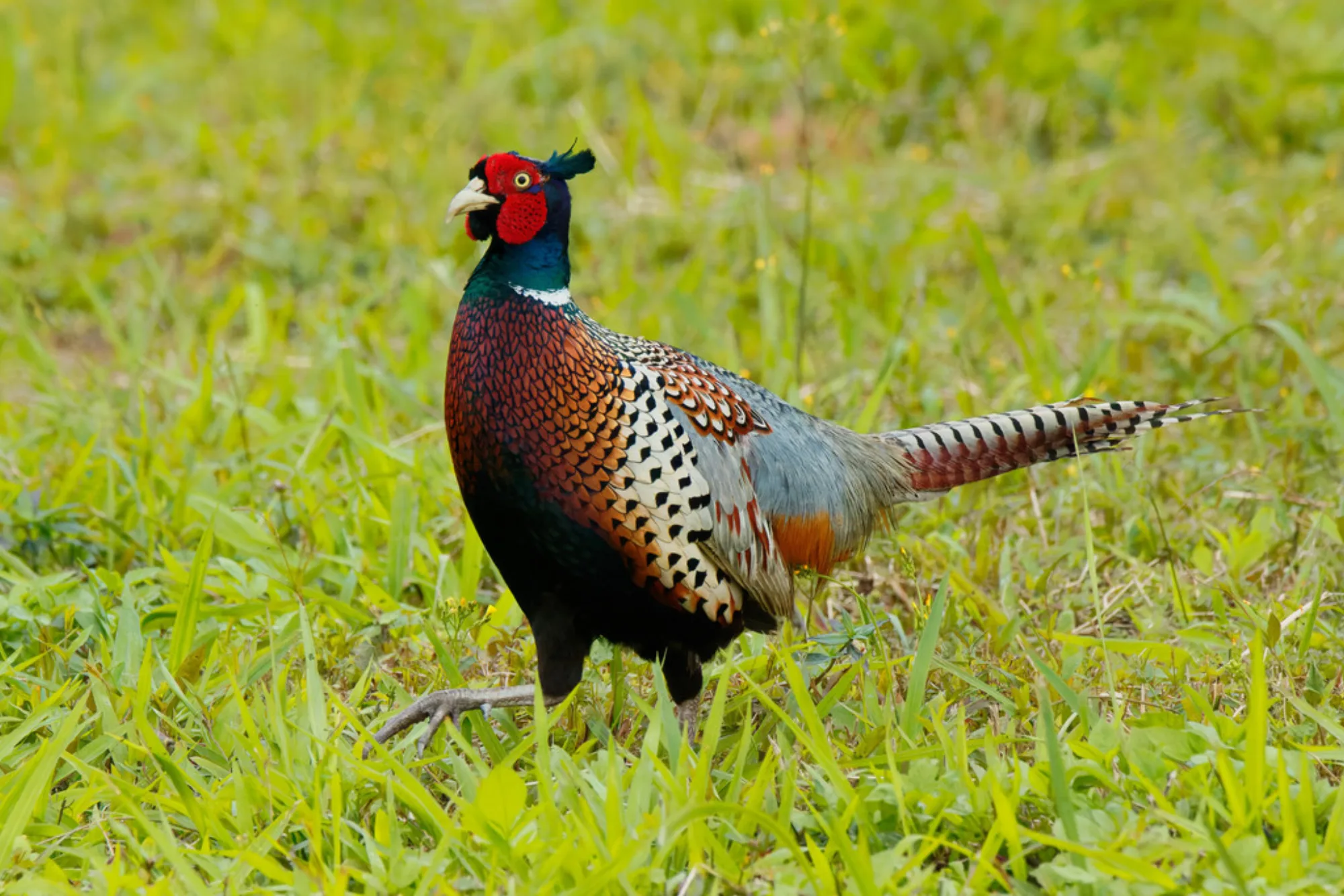
A long, barred tail and rich colour can make a male Common Pheasant (Phasianus colchicus) conspicuous, although males vary from nearly white to almost black. In one native form, the male has a bottle-green head, red facial skin and gold, copper-red and chestnut plumage with a green and purple sheen. Females and young birds are less showy, with mottled brown feathers; young males begin to develop brighter colours at about 10 weeks.
The species is native across much of Asia and in the extreme southeast of Europe, but has been introduced widely as a game bird. It lives in woodland, farmland, scrub and wetlands, and in its native habitat favours grassland near water and small groups of trees. Outside the breeding season, pheasants gather in loose flocks, while at night they roost in sheltered trees. They prefer to run, but a startled bird may burst upwards with a whir of wings and calls. Their varied diet includes seeds, grain, berries, leaves, insects, worms and slugs, as well as occasional small vertebrates.
Breeding begins in April, when a hen lays eight to fifteen brown-olive eggs in a grass-lined hollow, often beneath thick cover or a hedge. Chicks leave the nest within hours of hatching and remain close to the hen for several weeks. Hunting takes large numbers of pheasants, and many subspecies are at risk of disappearing through interbreeding with introduced birds. In agricultural parts of the United States, declines are likely linked to changing farming practices, pesticides, fragmented habitat and increased predation.
Written from the English Wikipedia article Common pheasant (CC BY-SA 4.0).
- Records
- 744,335
- Countries
- 73
- Atlas places
- 1
These are open occurrence records, so they show where people looked for and recorded the Common Pheasant as much as where it lives. Cells are up to 25 km across, and every location is generalised to its cell.
Generalised encounter areas, not exact locations. Each shape is a grid cell coloured by how likely the species is there.
- Very likelyUnited Kingdom25 km zone · high confidence · 260301 records · updated 86 days ago
- Very likelyUnited States25 km zone · high confidence · 198728 records · updated 86 days ago
- Very likelyCanada25 km zone · high confidence · 108551 records · updated 86 days ago
- Very likelyTaiwan25 km zone · high confidence · 16508 records · updated 86 days ago
- Very likelyFinland25 km zone · high confidence · 16467 records · updated 86 days ago
- Very likelyNorway25 km zone · high confidence · 11965 records · updated 86 days ago
- Very likelyBelgium25 km zone · high confidence · 11053 records · updated 86 days ago
- Very likelyCzechia25 km zone · high confidence · 10559 records · updated 86 days ago
- Very likelyFrance25 km zone · high confidence · 9690 records · updated 86 days ago
- Very likelyGermany25 km zone · high confidence · 8791 records · updated 86 days ago
Conservation status not assessed here yet, so every location is generalised to its grid cell.