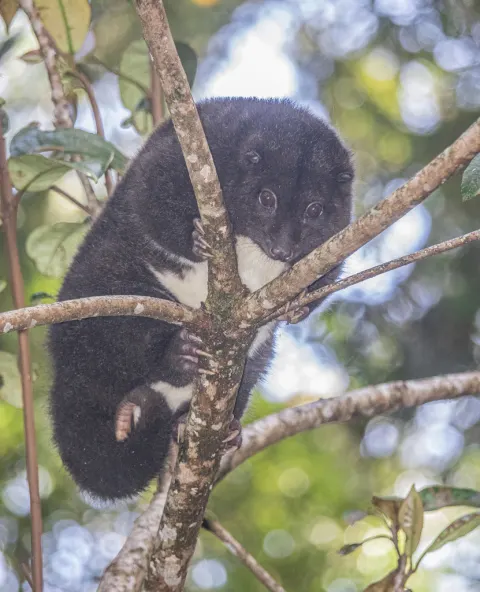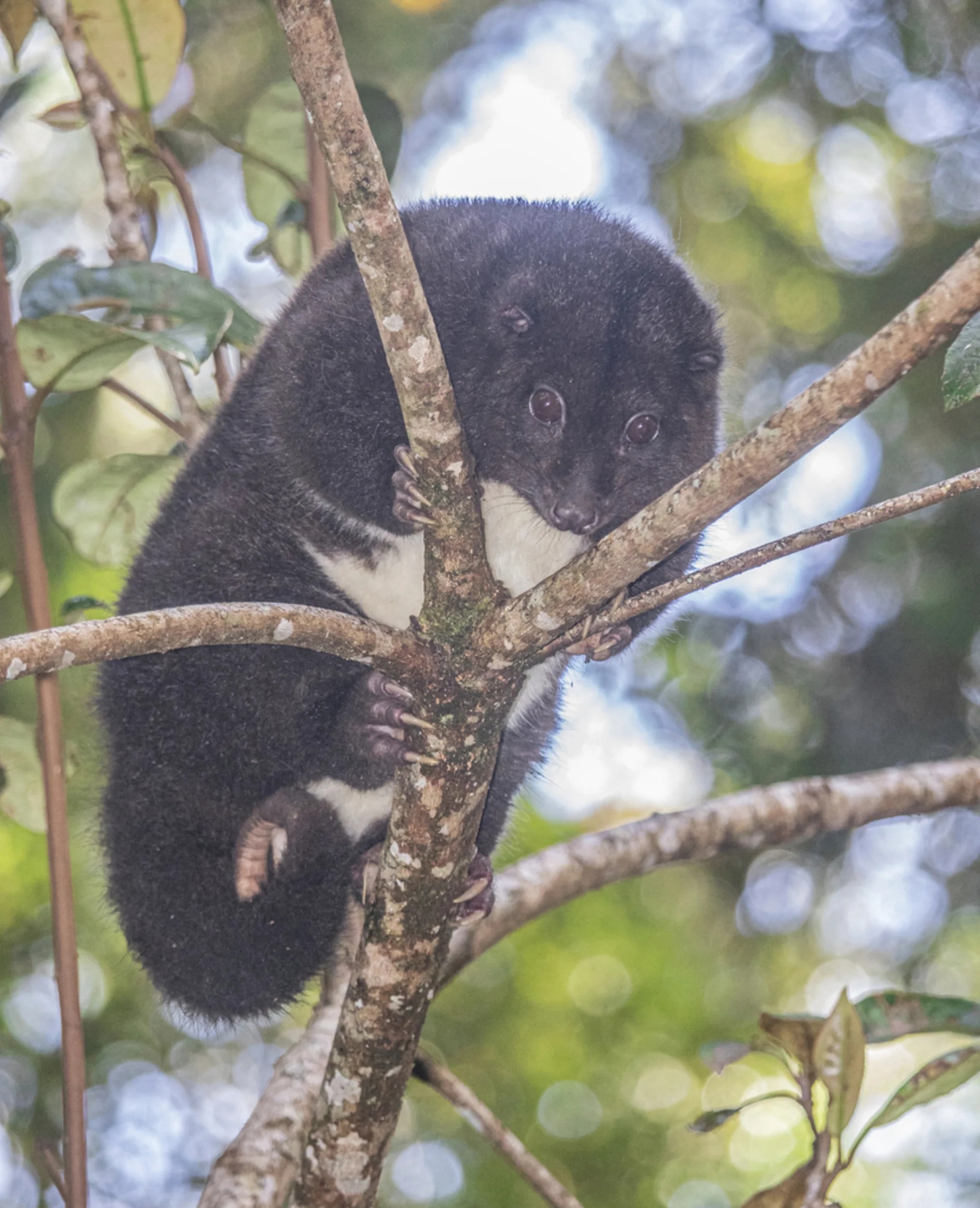
Mountain Cuscus
Phalanger carmelitae
This dark-furred marsupial inhabits the high-altitude forests of New Guinea, spanning the Huon Peninsula and the island's central mountain ranges. Known as the Mountain Cuscus, it is most frequently found in primary, undisturbed montane environments at elevations from 1,350 to 3,800 m. It is distinguishable by its dense, woolly coat, which ranges from chocolate-brown to blackish with a white underside. To identify it in the field, look for its black tail featuring a white tip and a rough, tuberculated texture. This tail distinguishes it from the similar silky cuscus, which has a smooth tail and a shorter white tip.
Primarily active at night, this arboreal animal spends its daylight hours resting within tree hollows or hidden among epiphytes and Pandanus fronds. When night falls, it spends roughly 40% of its time feeding and 25% resting, with the rest spent traveling through the canopy. Its diet consists largely of leaves, which make up 80% of its intake, supplemented by fruit, flowers, and bark. While mostly herbivorous, individuals have been known to eat birds in captivity. These animals maintain home ranges of 2 to 8 ha, with males and females utilizing more than ten different dens each year.
Breeding appears to occur year-round, as births of single young have been recorded in various months including February, April, and September. While the population is currently stable, these marsupials face pressure from local hunting for food across much of their territory. Additionally, the species is threatened by the loss of its preferred habitat as forests are cleared for subsistence agriculture. They are rarely seen in areas where the forest has been degraded or cleared, making the preservation of primary montane woodland vital for their continued presence.
Written from the English Wikipedia article Mountain cuscus (CC BY-SA 4.0).
- Records
- 0
- Countries
- 1
- Atlas places
- 0
These are open occurrence records, so they show where people looked for and recorded the Mountain Cuscus as much as where it lives. Cells are up to 25 km across, and every location is generalised to its cell.
Generalised encounter areas, not exact locations. Each shape is a grid cell coloured by how likely the species is there.
- Very likelyPapua New Guinea25 km zone · low confidence · 0 records · updated 1 day ago
Conservation status not assessed here yet, so every location is generalised to its grid cell.