Black Robin
Petroica traversi
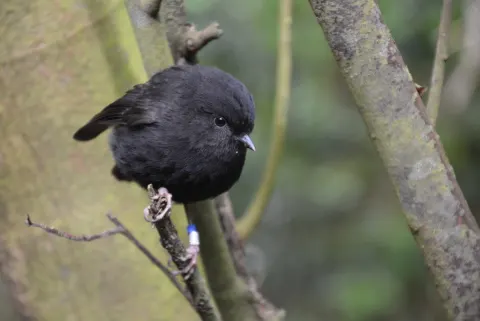
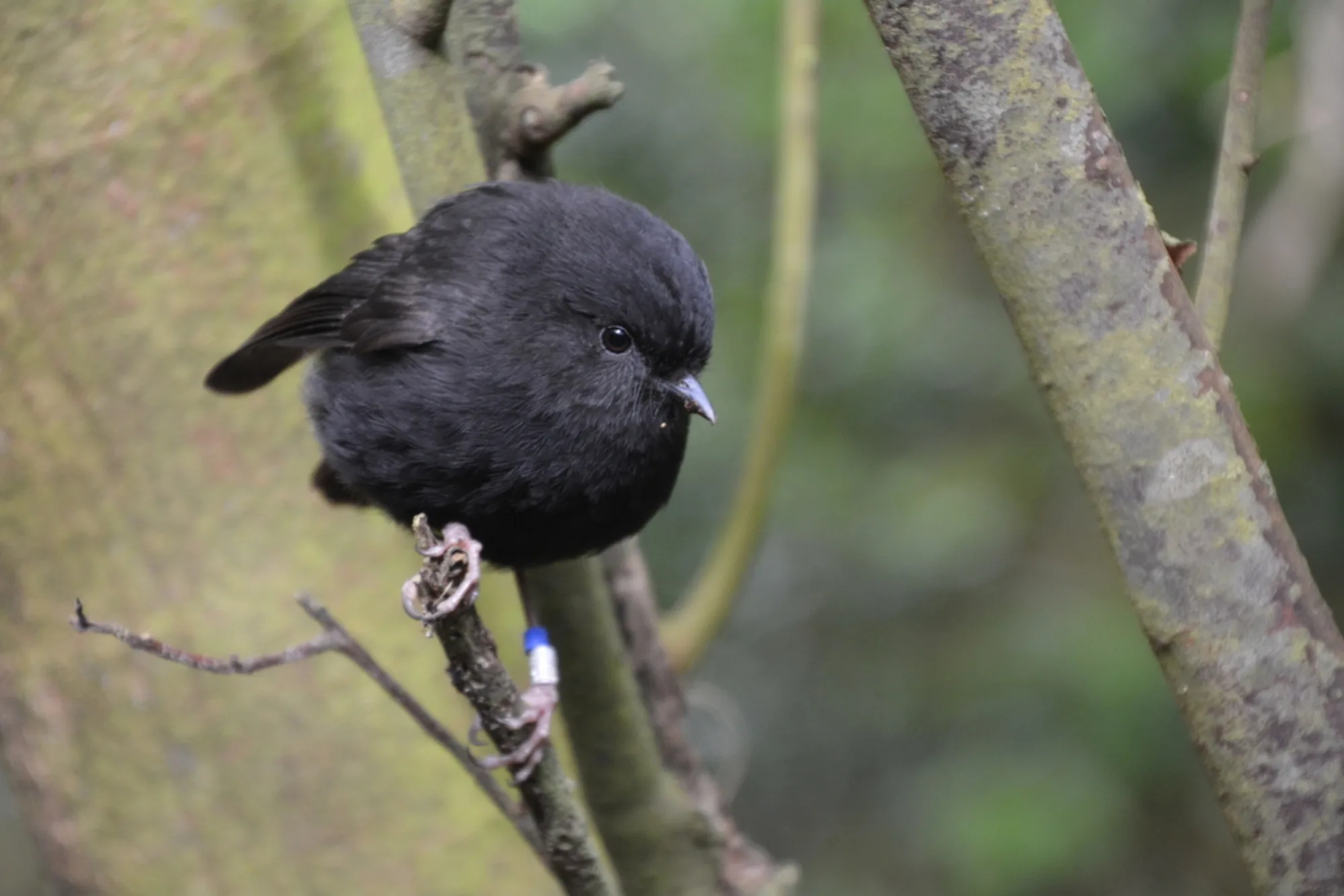
On the Chatham Islands off New Zealand's east coast, the Black Robin is a small, sparrow-sized bird with almost entirely brownish-black plumage, a black bill and dark brown eyes. It measures 10 to 15 centimetres, and its high-pitched call is a single note. The male's song consists of a short sequence of 5 to 7 notes.
Black Robins live in remnants of low-altitude scrub forest, favouring woody vegetation beneath trees such as akeake. To shelter from strong winds and rough seas, they use lower branches and flat places with deep layers of litter. They make short flights between branches and do not fly long distances. Territorial males patrol and defend their areas, while females may chase away other females. By day and night, they search the forest floor and low branches for food, including grubs, cockroaches, wētā and worms.
Breeding generally begins at two years of age, with eggs laid from early October to late December. The female builds the nest, often in a hollow tree or stump, and the male feeds her while she incubates the eggs. Both parents feed the chicks, continuing after they leave the nest until they are about 65 days old. Young birds can be exposed to predators when they spend their first day or two out of the nest on the ground. Introduced cats and rats threaten Black Robins, while introduced common starlings are the most common cause of nesting failure on Rangatira Island. All surviving birds descend from one female, Old Blue, leaving little genetic variation. Habitat restoration and predator eradication are under way to help spread the birds across several populations and reduce the risk from natural disasters.
Written from the English Wikipedia article Black robin (CC BY-SA 4.0).
- Records
- 447
- Countries
- 1
No atlas park has a record of the Black Robin in or around it yet.
These are open occurrence records, so they show where people looked for and recorded the Black Robin as much as where it lives. Cells are up to 25 km across, and every location is generalised to its cell.
Generalised encounter areas, not exact locations. Each shape is a grid cell coloured by how likely the species is there.
- Very likelyNew Zealand25 km zone · high confidence · 447 records · updated 80 days ago
Conservation status not assessed here yet, so every location is generalised to its grid cell.