Sugar Glider
Petaurus breviceps
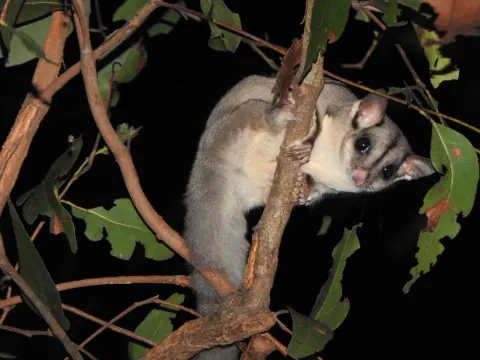
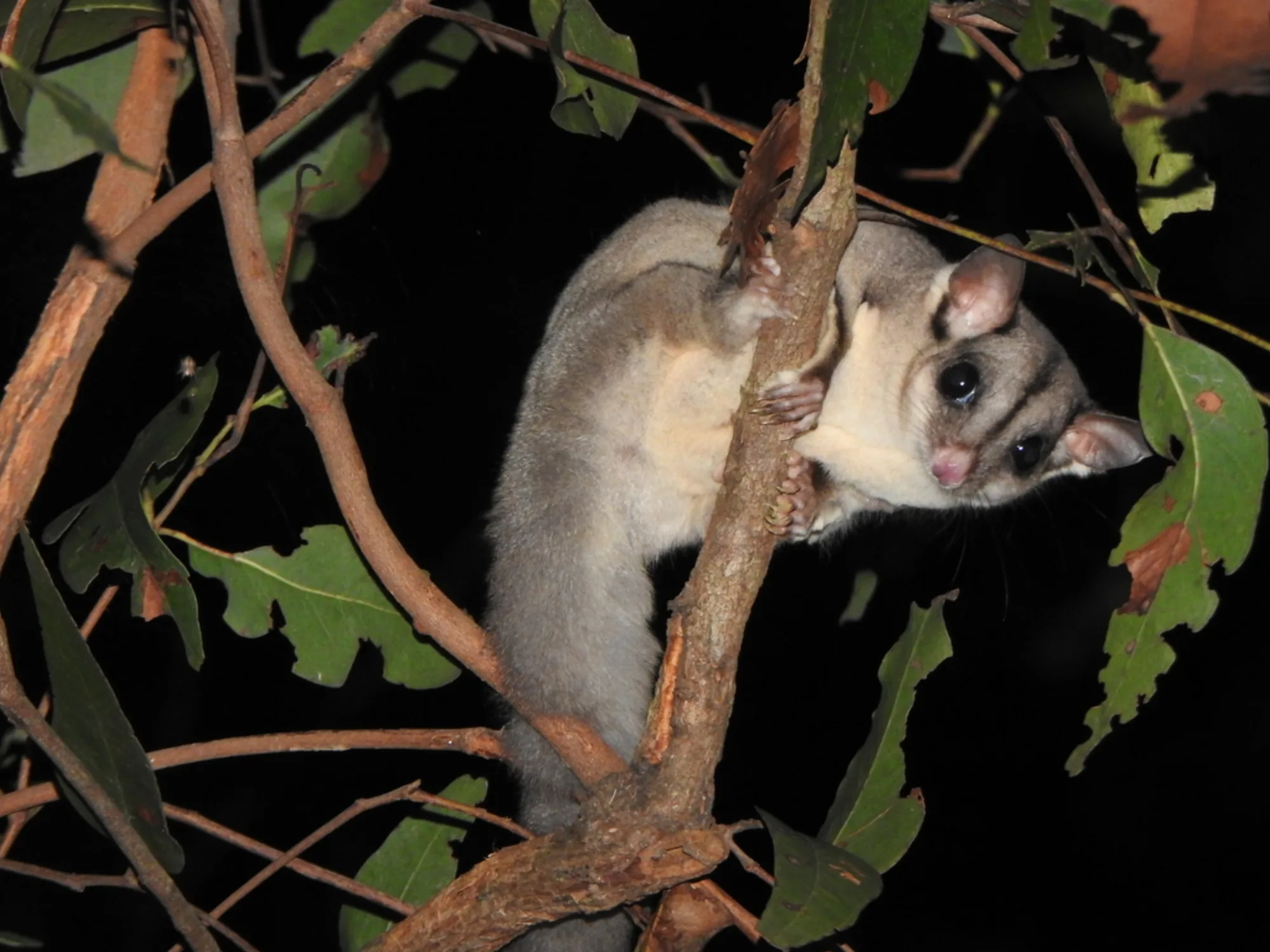
At night in the coastal forests of southeastern Australia, the Sugar Glider moves through the trees, launching itself into the air with its limbs spread. This small possum has soft, usually blue-grey fur, a cream belly, throat and chest, and a black stripe running from its nose partway down its back. Its large eyes help it see in the dark, while swivelling ears help it locate prey. Its limb membranes enable glides of 50 metres or more. It travels between trees this way and rarely comes down to the ground.
It inhabits coastal southern Queensland and much of New South Wales. During the day, it shelters in tree hollows lined with leafy twigs. Sugar gliders are social and may live in family groups of up to seven adults alongside the season's young, grooming one another and sharing nests. In cold weather they huddle together, and they can enter a short resting state called torpor to conserve energy. They forage mainly in the lower forest canopy, eating mostly insects in summer and turning to foods such as acacia gum and eucalyptus sap in winter. Nectar, pollen, native fruits, bird eggs, lizards and small birds are also on the menu when available.
In the wild, females breed once or twice a year, usually giving birth to one or two young. The young remain in the pouch for 60 days and leave the nest at around 110 days. Native owls are the main predators, and feral cats also pose a significant threat. The glider's restricted range makes it sensitive to ecological disasters, while its use of tree hollows leaves it especially vulnerable to intense fires. High light pollution may also make it harder to find food and avoid predators.
Written from the English Wikipedia article Sugar glider (CC BY-SA 4.0).
- Records
- 31,998
- Countries
- 1
- Atlas places
- 2
These are open occurrence records, so they show where people looked for and recorded the Sugar Glider as much as where it lives. Cells are up to 25 km across, and every location is generalised to its cell.
Generalised encounter areas, not exact locations. Each shape is a grid cell coloured by how likely the species is there.
- Very likelyAustralia25 km zone · high confidence · 31998 records · updated 80 days ago
Conservation status not assessed here yet, so every location is generalised to its grid cell.