Deer Mouse
Peromyscus maniculatus
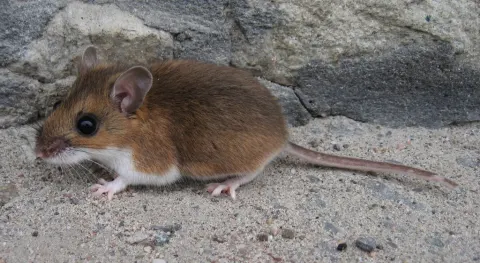
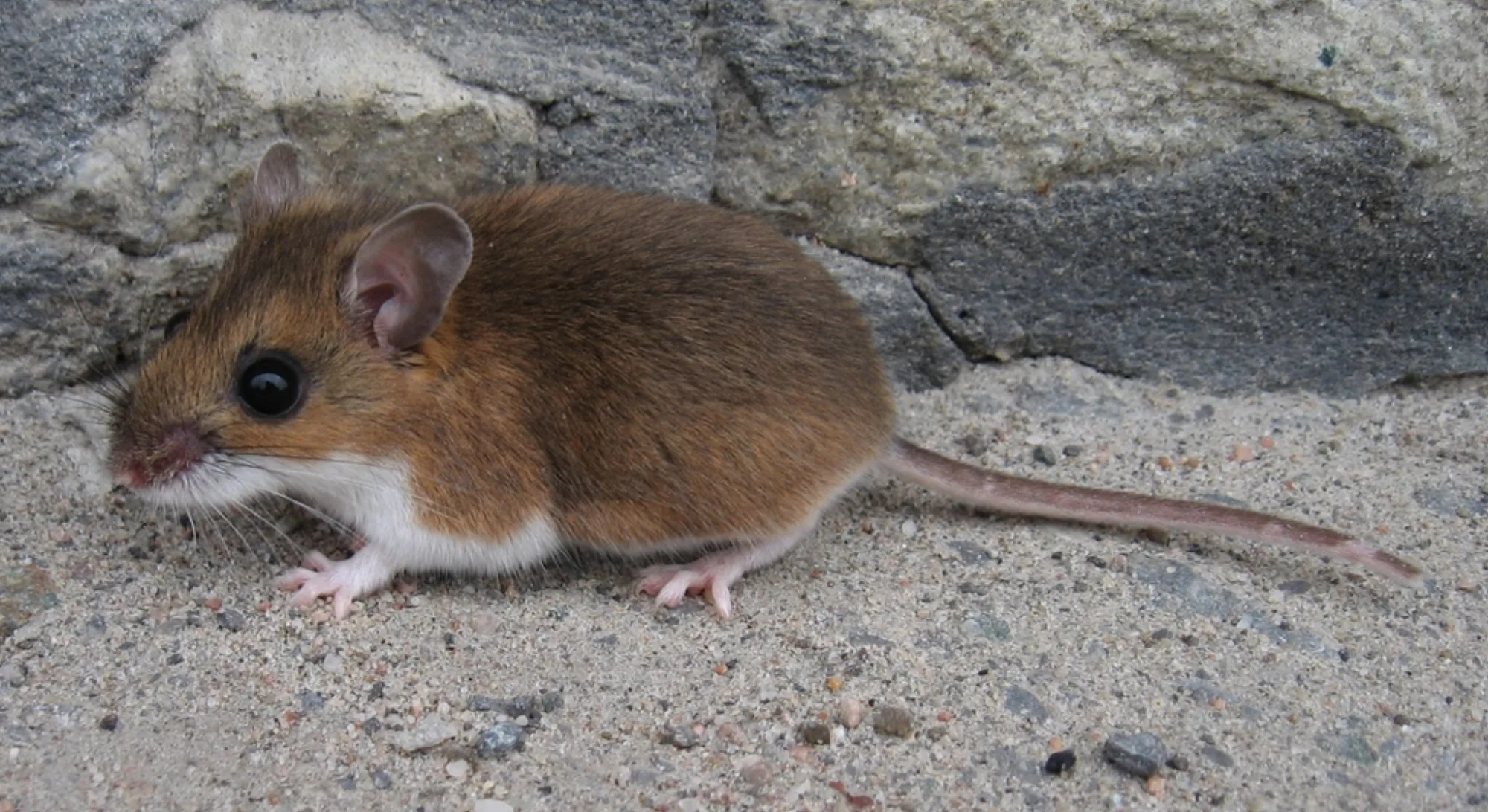
With large ears, beady eyes and a white underside, the Deer Mouse is a small rodent native to eastern North America. Its soft fur ranges from grey to brown, and its feet are white. The long tail is covered in fine hairs and has a dark and light division like the fur on its body. The body measures 8 to 10 cm, excluding the tail, although its close resemblance to the white-footed mouse can make identification difficult.
The species is widespread on the eastern side of the Mississippi River, though it is largely absent from the southeastern United States lowlands. It lives in habitats from farmland in the Midwest to coniferous and deciduous forests in northern New England. Woodland mice climb well and favour tree cover above the ground, while the prairie form moves between burrows in open areas. Mostly active at night, they spend the day in nests of plant material, often in trees or burrows. In winter, deer mice may be active on snow or beneath logs, and 10 or more may shelter together in a nest.
Deer mice eat seeds, fruit, arthropods, leaves and fungi, changing their diet with the seasons and the food available. They can breed throughout the year, although breeding usually takes place from March to October in most of their range. A typical litter has three to five young, and most females have more than one litter a year. Snakes, owls, foxes and domestic cats are among their predators, and the mice can also carry parasites.
Written from the English Wikipedia article Eastern deer mouse (CC BY-SA 4.0).
- Records
- 89,647
- Countries
- 3
- Atlas places
- 4
These are open occurrence records, so they show where people looked for and recorded the Deer Mouse as much as where it lives. Cells are up to 25 km across, and every location is generalised to its cell.
Generalised encounter areas, not exact locations. Each shape is a grid cell coloured by how likely the species is there.
- Very likelyUnited States25 km zone · high confidence · 45670 records · updated 80 days ago
- Very likelyCanada25 km zone · high confidence · 43736 records · updated 80 days ago
- Very likelyMexico25 km zone · high confidence · 241 records · updated 80 days ago
Conservation status not assessed here yet, so every location is generalised to its grid cell.