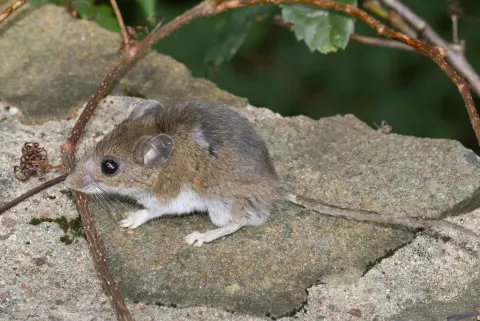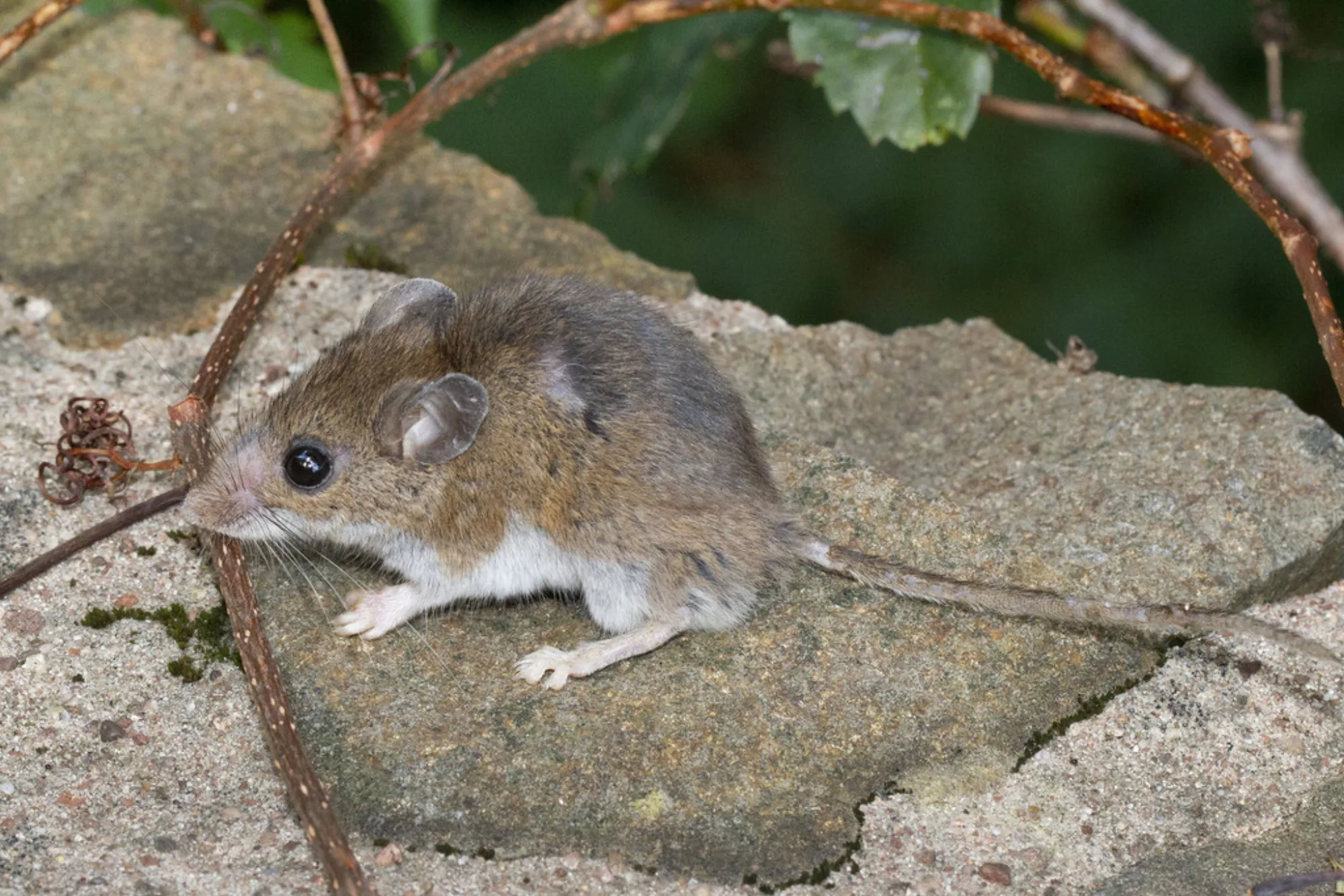
White-footed Deermouse
Peromyscus leucopus
Across North America, the White-footed Deermouse lives as far north as southern Canada, with its range reaching Mexico and the southwestern United States. In the Maritimes, it occurs only in a separate population in southern Nova Scotia. This small rodent resembles the eastern deer mouse, and adults measure 90 to 100 mm long, excluding a tail that adds another 63 to 97 mm. A young adult weighs 20 to 30 g. The mice spend considerable time in trees and bushes, and may take over an empty old bird nest and add a roof. In New York City, native populations are largely confined to small islands of urban forest, including Prospect Park and Central Park.
White-footed mice are timid and generally keep away from people, although they sometimes nest and store food inside the ground-floor walls of homes and apartments. Their varied diet includes seeds and insects, and they are particularly keen predators of spongy moth pupae. In New York City, they also feed opportunistically on food discarded by people. City populations eat considerably more fat and carbohydrates than rural ones. In northern climates, average life expectancy is 12 to 24 months. Their breeding biology has also been studied in the densely concentrated populations of urban parks, where genetic studies have found differences in reproductive processes between city and rural mice.
In New York City, dense infrastructure isolates native populations, while roads, highways and pavements restrict gene flow between urban and rural mice. Urban mice also face routine exposure to pollutants and toxins, including high concentrations of lead and mercury in park soils. Urban environments contain many pathogens, introduced through transport, traffic and trade.
Written from the English Wikipedia article White-footed mouse (CC BY-SA 4.0).
- Records
- 40,276
- Countries
- 3
- Atlas places
- 3
These are open occurrence records, so they show where people looked for and recorded the White-footed Deermouse as much as where it lives. Cells are up to 25 km across, and every location is generalised to its cell.
Generalised encounter areas, not exact locations. Each shape is a grid cell coloured by how likely the species is there.
- Very likelyUnited States25 km zone · high confidence · 39702 records · updated 80 days ago
- Very likelyMexico25 km zone · medium confidence · 399 records · updated 80 days ago
- Very likelyCanada25 km zone · medium confidence · 175 records · updated 80 days ago
Conservation status not assessed here yet, so every location is generalised to its grid cell.