European Honey Buzzard
Pernis apivorus
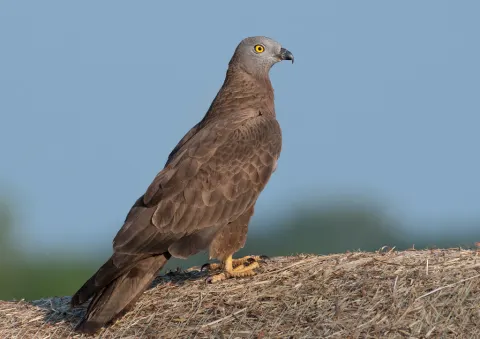
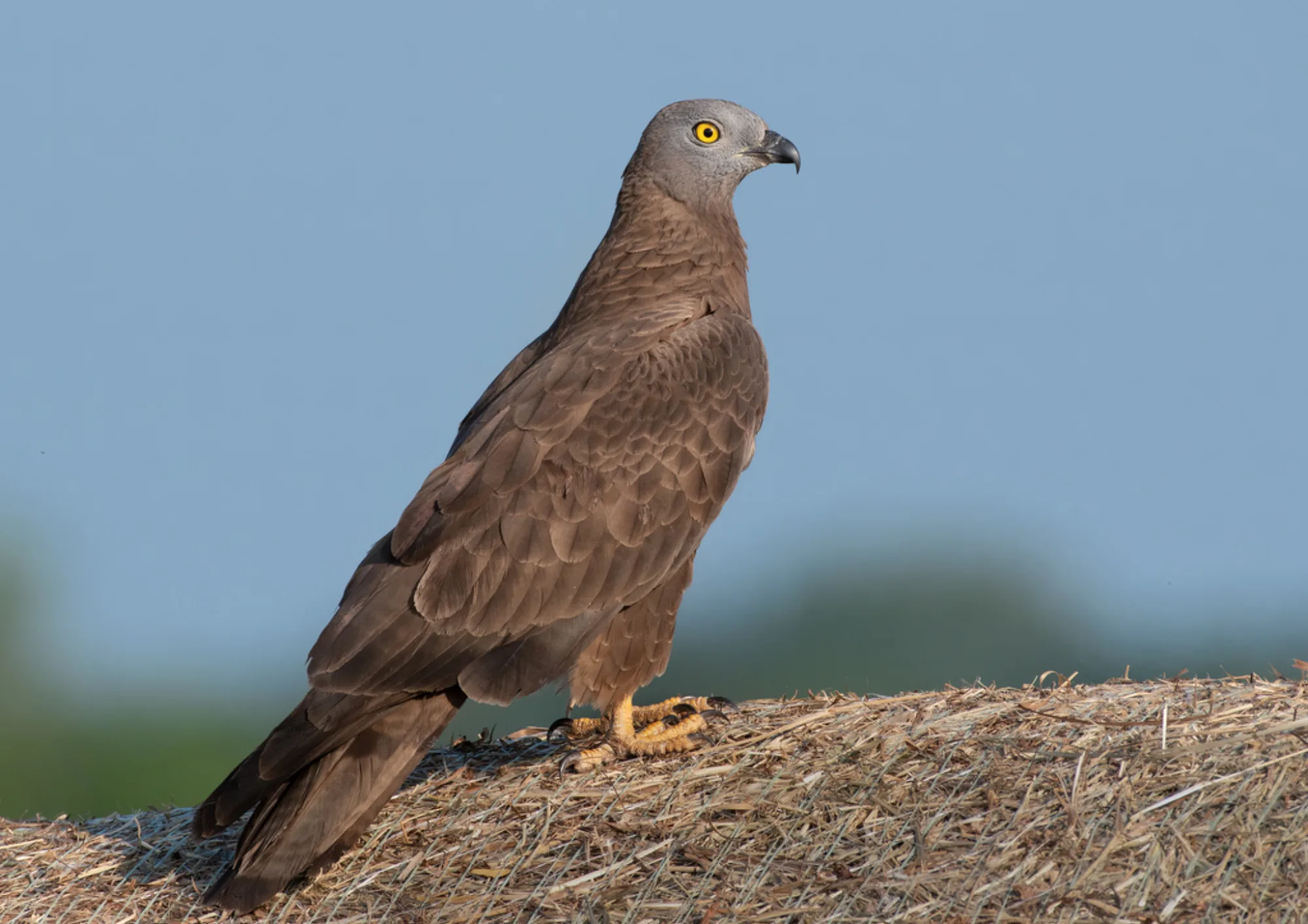
Long wings, a small head and a long neck give the European Honey Buzzard a distinctive outline in flight. It measures 52 to 60 cm long, with a wingspan of 130 to 150 cm. When soaring, it holds its wings straight and flat, sometimes with the tips pointing slightly down. Its long tail usually shows two narrow dark bars and a broader dark bar near the tip. Males have blue-grey heads, while females have brown heads and are slightly larger and darker. Listen, too, for its clear peee-lu call.
This bird of prey breeds across Europe and western Asia and spends the winter in Africa. It occurs in many habitats but generally favours woodland, including plantations of exotic trees. On migration it avoids large stretches of open water, so great numbers can be seen at narrower Mediterranean crossings, including the Gibraltar Strait, the Bosphorus and Israel. Adults use memories of landmarks such as rivers and mountain ranges to help them find their way south. In the United Kingdom it is scarce, with most breeding pairs in southeastern England, though its breeding range reaches mid Wales in the west and central Scotland in the north.
Honey buzzards spend much of their time on the forest floor, digging out wasp nests. Their main food is wasp and hornet larvae and nests, though they also take small mammals, reptiles and birds. They breed in woodland and can be difficult to notice, apart from spring displays that include wing-clapping. A typical clutch contains two eggs. Disturbance and egg theft are concerns at nests, whose locations authorities generally keep secret. Eurasian goshawks can also kill honey buzzards.
Written from the English Wikipedia article European honey buzzard (CC BY-SA 4.0).
- Records
- 229,417
- Countries
- 99
- Atlas places
- 19
- Volcanoes National Park· Rwanda
- Zambezi National Park· Zimbabwe
- Akagera National Park· Rwanda
- Kibale National Park· Uganda
- Lake Manyara National Park· Tanzania
- Ngorongoro Conservation Area· Tanzania
- Okavango Delta· Botswana
- Queen Elizabeth National Park· Uganda
- Rwenzori Mountains National Park· Uganda
- Arusha National Park· Tanzania
- Bwabwata National Park· Namibia
- Bwindi Impenetrable National Park· Uganda
- iSimangaliso Wetland Park· South Africa
- Kasanka National Park· Zambia
- Lake Nakuru National Park· Kenya
- Nairobi National Park· Kenya
- Nyungwe National Park· Rwanda
- Table Mountain National Park· South Africa
- Tarangire National Park· Tanzania
These are open occurrence records, so they show where people looked for and recorded the European Honey Buzzard as much as where it lives. Cells are up to 25 km across, and every location is generalised to its cell.
Generalised encounter areas, not exact locations. Each shape is a grid cell coloured by how likely the species is there.
- Very likelyGeorgia25 km zone · high confidence · 87402 records · updated 86 days ago
- Very likelyFrance25 km zone · high confidence · 29443 records · updated 86 days ago
- Very likelyBelgium25 km zone · high confidence · 25093 records · updated 86 days ago
- Very likelyMorocco25 km zone · high confidence · 16851 records · updated 86 days ago
- Very likelySpain25 km zone · high confidence · 15260 records · updated 86 days ago
- Very likelyIsrael25 km zone · high confidence · 12139 records · updated 86 days ago
- Very likelyNorway25 km zone · high confidence · 7223 records · updated 86 days ago
- Very likelyNetherlands25 km zone · high confidence · 5568 records · updated 86 days ago
- Very likelyPalestinian Territories25 km zone · high confidence · 3362 records · updated 86 days ago
- Very likelyPortugal25 km zone · high confidence · 3237 records · updated 86 days ago
Conservation status not assessed here yet, so every location is generalised to its grid cell.