Siberian Jay
Perisoreus infaustus
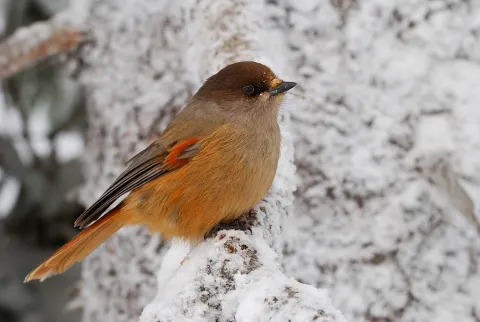
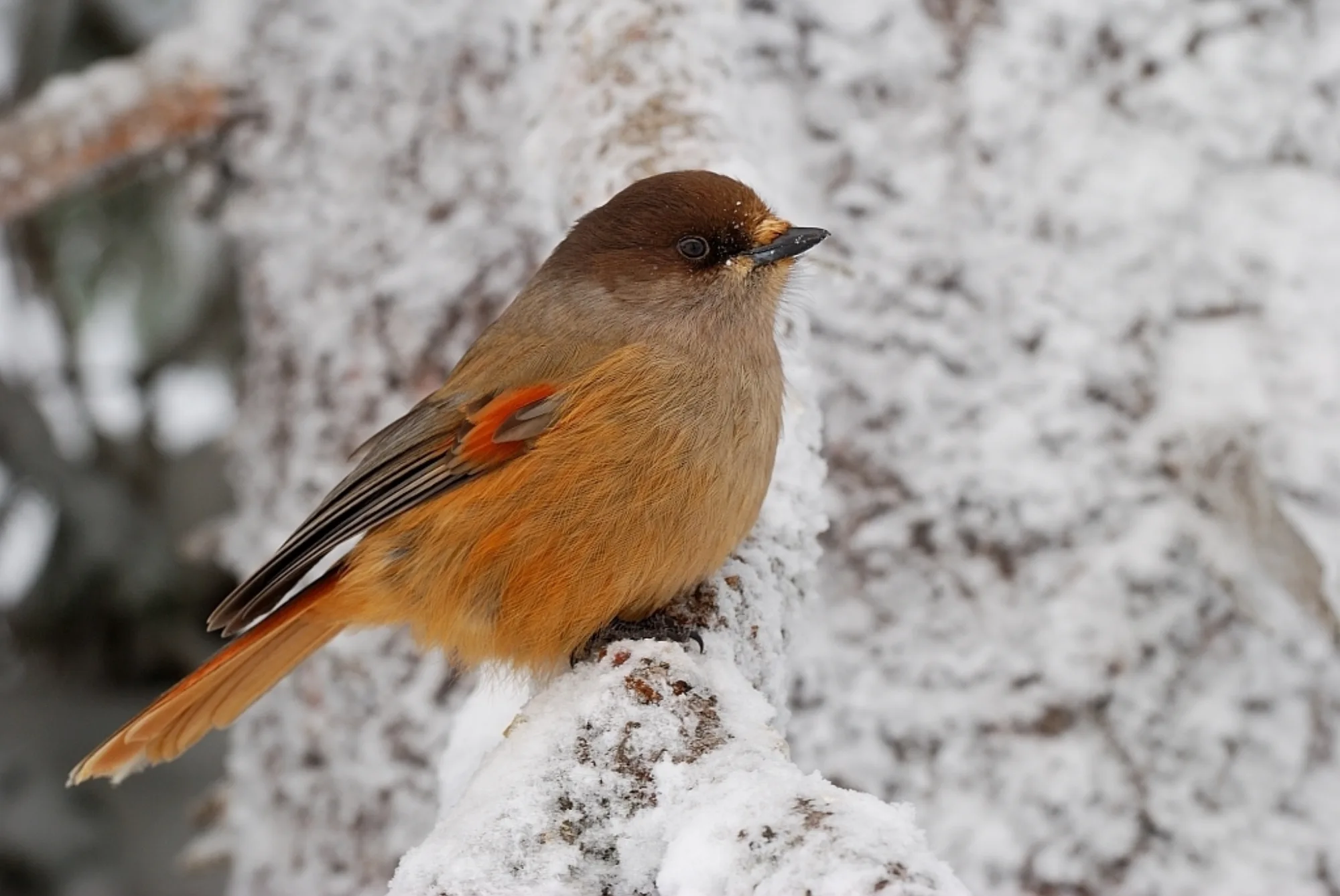
Look for the Siberian Jay in the dense coniferous forests of northern Eurasia, from Scandinavia across northern Russia and Siberia. This small jay has grey-brown plumage, a dark brown crown and a paler throat, with rusty-red patches near the wing and along the sides of the tail. Its soft, downy feathers insulate it against winter cold, while its muted colours help conceal it in the forest. Mostly silent, it can give a loud screech, and its breeding-season song includes whistles, creaks and trills. It can also mimic other birds and Eurasian red squirrels.
The jay favours mature forest with a closed canopy, especially spruce, whose dense foliage provides cover for feeding and nesting. It moves skilfully through dense woodland but is a cumbersome flyer across open ground. Small flocks gather around a breeding pair and can include their offspring and unrelated birds. The jays eat berries, seeds, insects and spiders, and will also feed on large carcasses left by mammalian predators. In autumn and winter they hide berries behind loose bark, in hanging lichen or between forked twigs, creating stores that help them survive the short winter days. A pair nests in a pine or spruce, hidden among dense foliage, and builds a new nest for each breeding attempt. The young leave the nest in mid-May to early June, then usually shelter among branches until they can fly properly.
Birds of prey, especially hawks, are the main predators of adults, while squirrels and several birds take eggs and young. In Europe, forestry, roads, settlements and agriculture degrade habitat; clearcutting has been linked to territory abandonment and lower breeding success. Forest loss and fragmentation also expose nests and leave open ground that the jays may struggle to cross.
Written from the English Wikipedia article Siberian jay (CC BY-SA 4.0).
- Records
- 56,511
- Countries
- 5
No atlas park has a record of the Siberian Jay in or around it yet.
These are open occurrence records, so they show where people looked for and recorded the Siberian Jay as much as where it lives. Cells are up to 25 km across, and every location is generalised to its cell.
Generalised encounter areas, not exact locations. Each shape is a grid cell coloured by how likely the species is there.
- Very likelyFinland25 km zone · high confidence · 41160 records · updated 80 days ago
- Very likelyNorway25 km zone · high confidence · 11618 records · updated 80 days ago
- Very likelySweden25 km zone · high confidence · 2839 records · updated 80 days ago
- Very likelyRussia25 km zone · high confidence · 830 records · updated 80 days ago
- LikelyChina25 km zone · high confidence · 64 records · updated 80 days ago
Conservation status not assessed here yet, so every location is generalised to its grid cell.