Coal Tit
Periparus ater
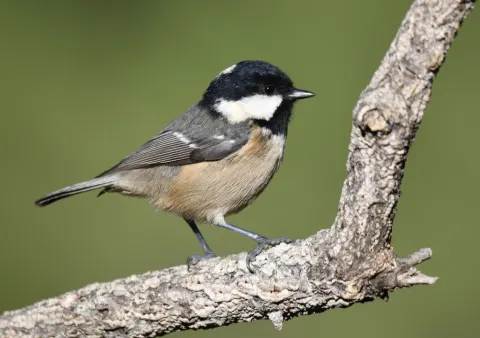
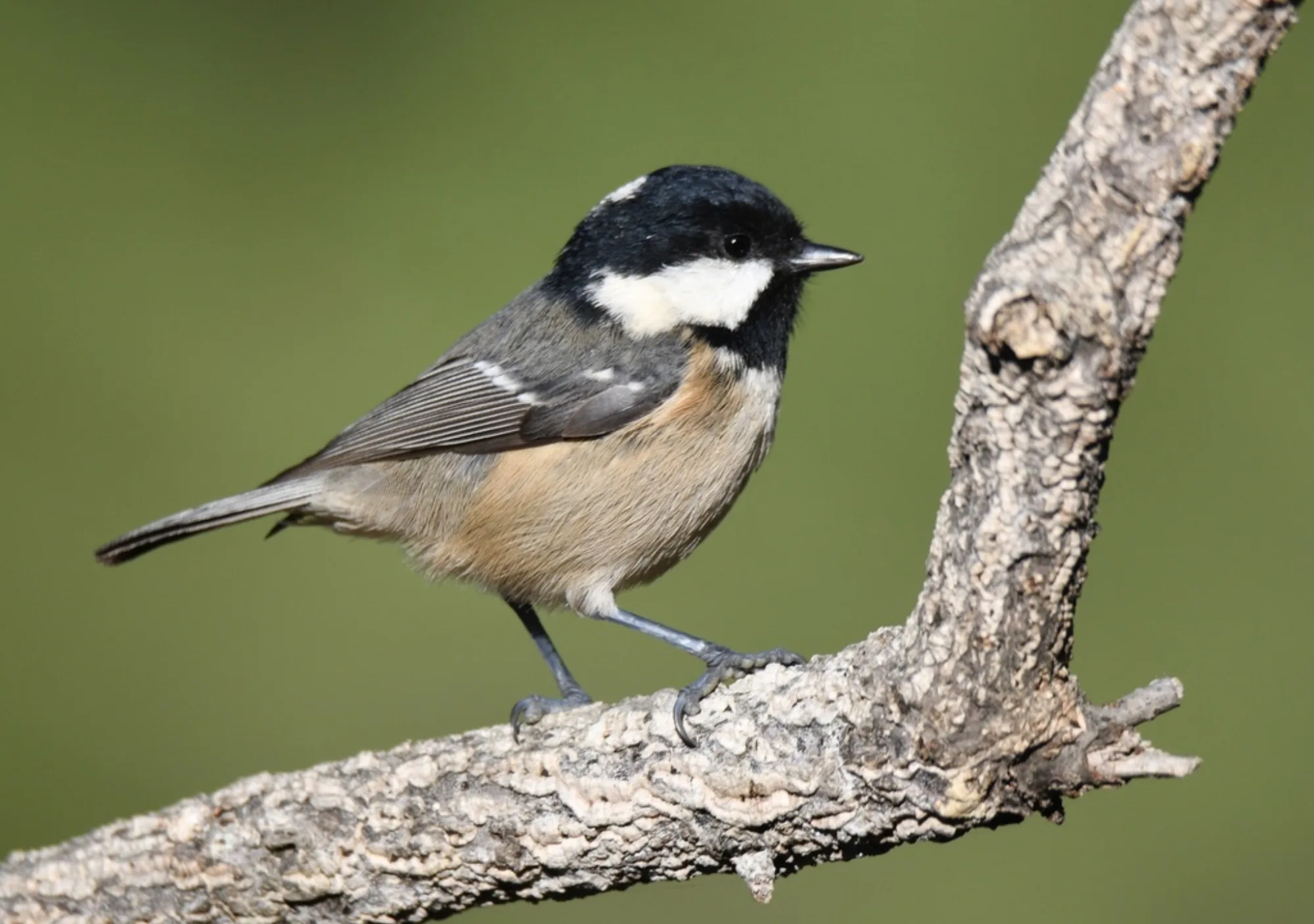
Small and restless, the Coal Tit (Periparus ater) measures 10 to 11.5 cm and has a conspicuous white patch on the back of its black head. Adults have glossy blue-black heads, throats and necks, pale sides to the face, and two white wingbars. Their whitish underparts shade into buff or reddish brown at the sides, while young birds are duller, with yellow-tinged cheeks and nape. Colour varies across the range: British birds have an olive tint to their brownish-grey backs, while Irish birds have pale yellow cheeks, breasts and bellies.
This common forest bird breeds across the temperate and subtropical Palearctic, including North Africa, and typically lives in humid conifer woods. In Bhutan, it occurs above the subtropical zone in forests of Bhutan fir, as well as forests with Himalayan hemlock and rhododendrons. Most stay in their range year-round, moving locally in especially severe weather, although Siberian birds migrate more regularly. In winter, look for small flocks with other tits, or listen for the short calls coal tits use to keep in touch while feeding. They move restlessly and can be acrobatic, sometimes hopping on a trunk like a treecreeper. Their food includes beechmast and seeds taken from fir and larch cones; they also visit gardens, particularly for sunflower seeds.
A favoured nest site is a hole in a decaying stump, usually near ground level, though holes in the ground and wall crevices are among the alternatives. The nest contains tightly packed moss, hair and grass, with a lining of rabbit fur or feathers; seven to eleven white eggs with red spots are usually laid in May. Coal tits typically breed once a year, and their nests can harbour bird fleas.
Written from the English Wikipedia article Coal tit (CC BY-SA 4.0).
- Records
- 598,375
- Countries
- 20
No atlas park has a record of the Coal Tit in or around it yet.
These are open occurrence records, so they show where people looked for and recorded the Coal Tit as much as where it lives. Cells are up to 25 km across, and every location is generalised to its cell.
Generalised encounter areas, not exact locations. Each shape is a grid cell coloured by how likely the species is there.
- Very likelyUnited Kingdom25 km zone · high confidence · 182066 records · updated 80 days ago
- Very likelyFinland25 km zone · high confidence · 118798 records · updated 80 days ago
- Very likelyNorway25 km zone · high confidence · 90462 records · updated 80 days ago
- Very likelySpain25 km zone · high confidence · 54561 records · updated 80 days ago
- Very likelyFrance25 km zone · high confidence · 43625 records · updated 80 days ago
- Very likelyPortugal25 km zone · high confidence · 32507 records · updated 80 days ago
- Very likelyBelgium25 km zone · high confidence · 16449 records · updated 80 days ago
- Very likelySweden25 km zone · high confidence · 15442 records · updated 80 days ago
- Very likelyTaiwan25 km zone · high confidence · 12735 records · updated 80 days ago
- Very likelyItaly25 km zone · high confidence · 7386 records · updated 80 days ago
Conservation status not assessed here yet, so every location is generalised to its grid cell.