Grey Partridge
Perdix perdix
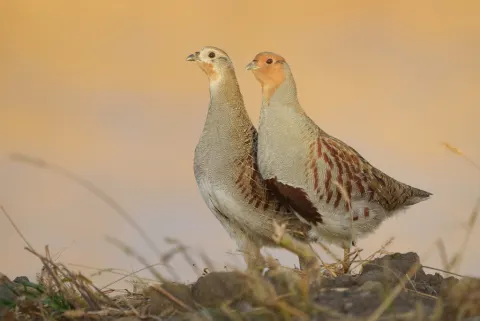
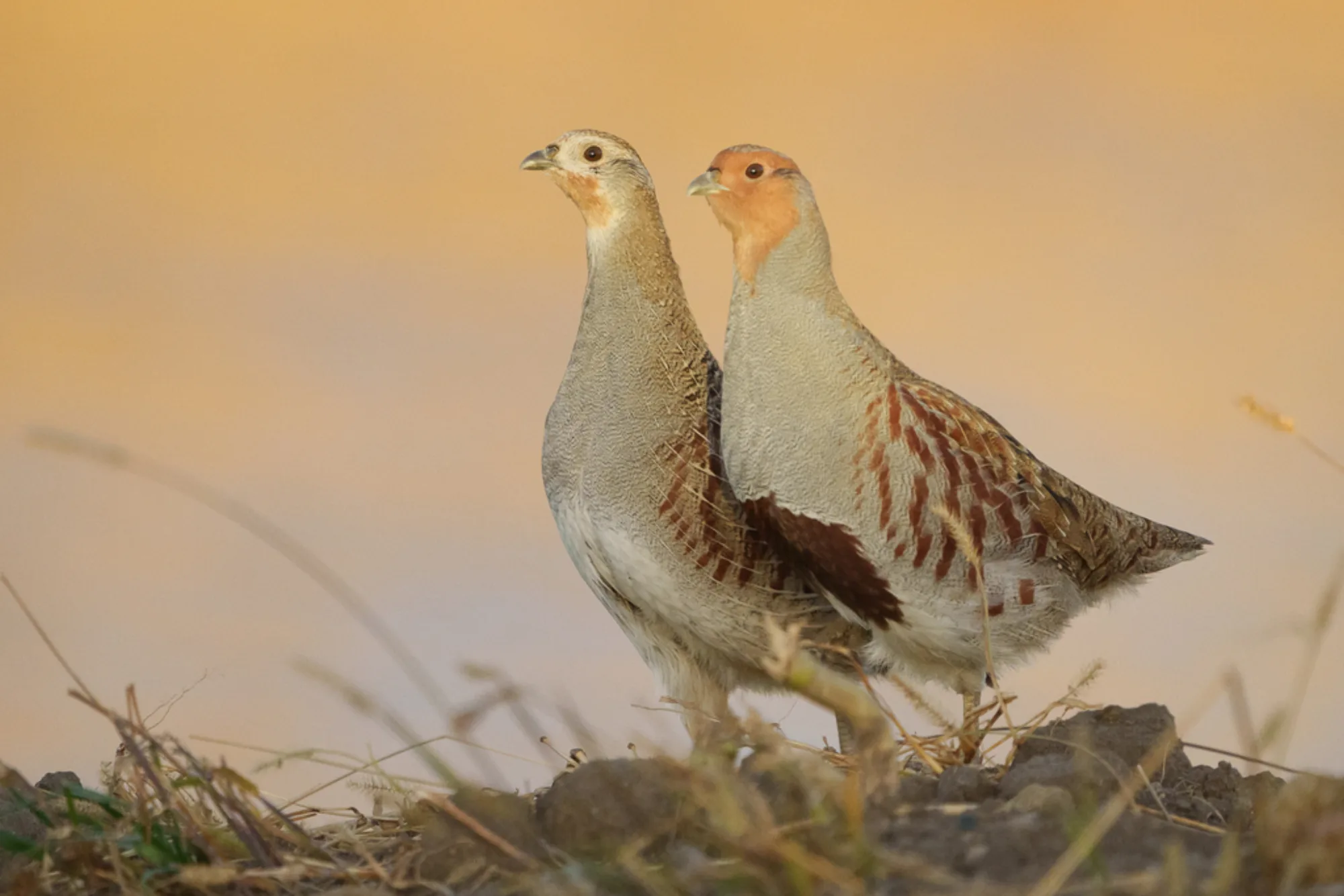
Round-bodied and brown-backed, the Grey Partridge has a grey chest and flanks, with a white belly often marked by a chestnut-brown horseshoe. Males usually have this large belly mark, while many females have one too, although theirs tends to be smaller. The sexes are similar in size and plumage, but females tend to be slightly duller. Young birds are largely yellow-brown, without the adults’ distinct face and belly patterns. A sharp, high kieerr-ik is its song; when startled, it often calls while taking a short flight on rounded wings.
A member of the pheasant family, it breeds in agricultural fields over much of Europe, with its range extending through the western Palearctic to southwestern Siberia. Introduced populations also occur in Canada and the United States, as well as in South Africa, Australia and New Zealand. The bird lives on the ground and does not migrate, gathering in flocks of up to 30 outside the breeding season. Grey Partridges eat seeds, while insects are an essential source of protein for their young. For their first 10 days, chicks can digest only insects, and their parents lead them to cereal field edges to forage. A hen nests on the ground and can produce twenty eggs; the nest is usually beside a cereal field, most often winter wheat.
Numbers have fallen sharply in some intensively cultivated areas, including the United Kingdom, where breeding habitat has been lost and insecticides have reduced the insects the birds need for food. In Ireland, the bird is now almost entirely restricted to a reserve at Lough Boora in County Offaly, where a conservation project has raised its numbers to around 900.
Written from the English Wikipedia article Grey partridge (CC BY-SA 4.0).
- Records
- 124,701
- Countries
- 15
- Atlas places
- 1
These are open occurrence records, so they show where people looked for and recorded the Grey Partridge as much as where it lives. Cells are up to 25 km across, and every location is generalised to its cell.
Generalised encounter areas, not exact locations. Each shape is a grid cell coloured by how likely the species is there.
- Very likelyBelgium25 km zone · high confidence · 31025 records · updated 80 days ago
- Very likelyCanada25 km zone · high confidence · 26694 records · updated 80 days ago
- Very likelyUnited Kingdom25 km zone · high confidence · 23526 records · updated 80 days ago
- Very likelyFrance25 km zone · high confidence · 12387 records · updated 80 days ago
- Very likelyUnited States25 km zone · high confidence · 11952 records · updated 80 days ago
- Very likelyFinland25 km zone · high confidence · 8193 records · updated 80 days ago
- Very likelyNetherlands25 km zone · high confidence · 6816 records · updated 80 days ago
- Very likelyAustria25 km zone · high confidence · 1999 records · updated 80 days ago
- Very likelyCzechia25 km zone · high confidence · 538 records · updated 80 days ago
- Very likelyDenmark25 km zone · high confidence · 375 records · updated 80 days ago
Conservation status not assessed here yet, so every location is generalised to its grid cell.