Perch
Perca fluviatilis
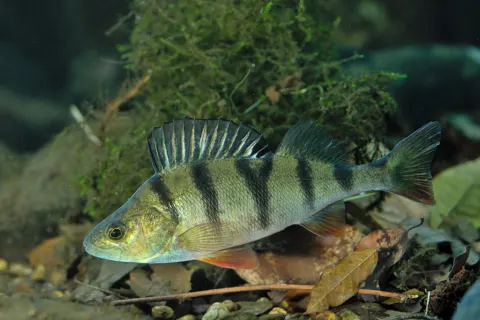
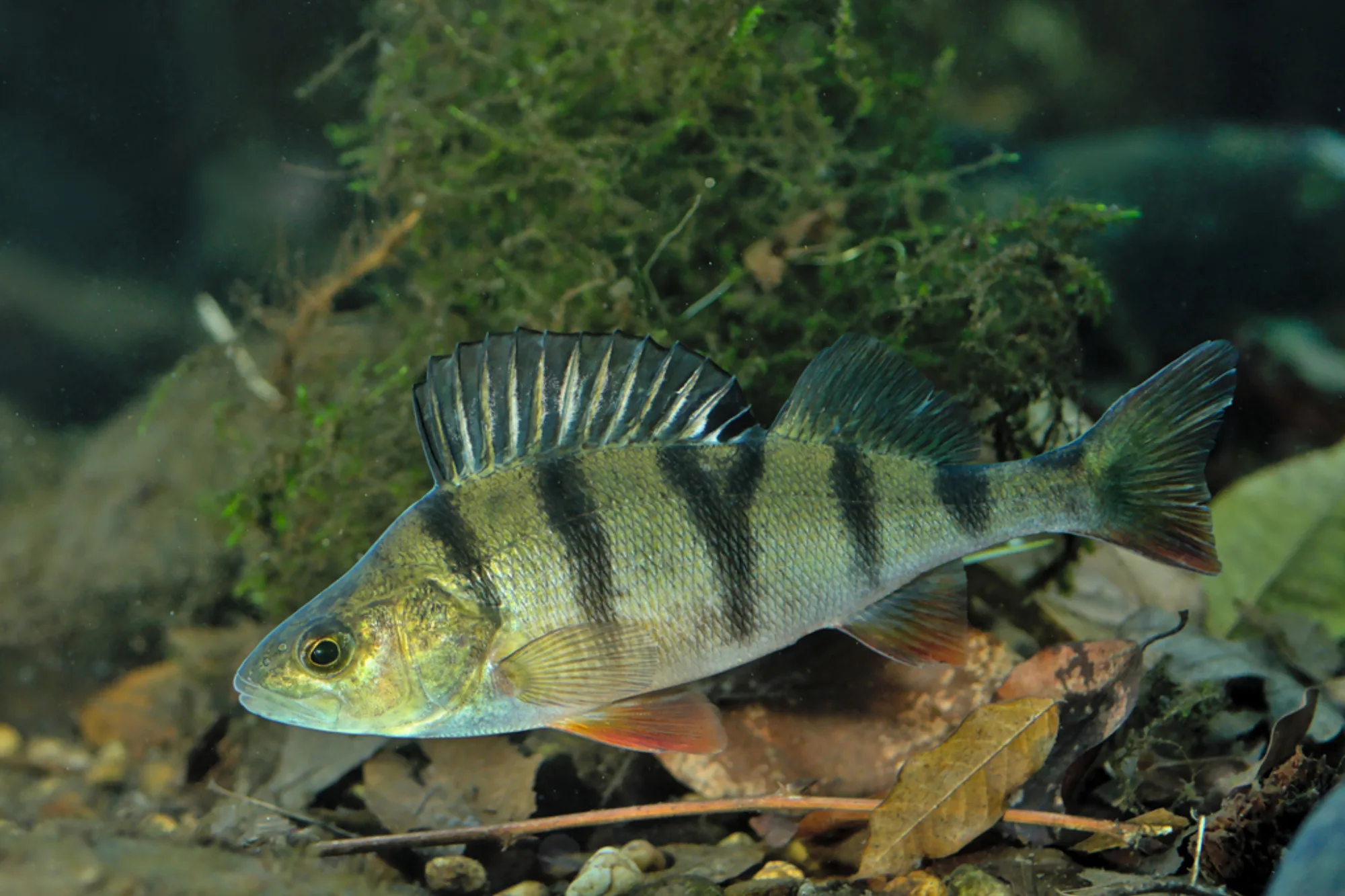
Greenish sides crossed by five to eight dark bars help distinguish the Perch, a freshwater predator found naturally across Europe and North Asia. Its lower fins and tail are red, and larger individuals develop a hump between the head and dorsal fin. Size varies greatly between waters, but the maximum recorded length is 60 cm, and some perch live for up to 22 years. Its native range extends across Europe's freshwater basins, except the Iberian Peninsula, and east to Siberia's Kolyma River. It also occurs in some brackish Baltic waters and has been introduced to Australia, New Zealand and South Africa. Look for it in slow rivers, ponds and lakes, especially relatively shallow lakes or those where light reaches deep into the water. Perch generally avoid cold and fast-flowing water, though some enter such places without breeding there.
Young perch eat zooplankton, small animals living on the bottom and other perch fry, while adults take invertebrates and fish, including sticklebacks, roach and minnows. In parts of the Baltic Sea, perch are abundant and grow large on a diet of Baltic herring. In the Northern Hemisphere, spawning takes place between February and July, with males arriving at the breeding areas first. Females lay white ribbons of eggs on water plants or submerged branches, and the eggs hatch after 8 to 16 days. The young initially live in open water and eat plankton, moving closer to shore and the bottom during their first summer. Perch face predators including ospreys, cormorants, kingfishers, northern pike and Eurasian otters, and are also caught for food and sport. Juveniles can carry parasites, though the account gives no indication of their effect on populations.
Written from the English Wikipedia article European perch (CC BY-SA 4.0).
- Records
- 402,803
- Countries
- 8
No atlas park has a record of the Perch in or around it yet.
These are open occurrence records, so they show where people looked for and recorded the Perch as much as where it lives. Cells are up to 25 km across, and every location is generalised to its cell.
Generalised encounter areas, not exact locations. Each shape is a grid cell coloured by how likely the species is there.
- Very likelySweden25 km zone · high confidence · 337203 records · updated 80 days ago
- Very likelyFrance25 km zone · high confidence · 44598 records · updated 80 days ago
- Very likelyNetherlands25 km zone · high confidence · 6627 records · updated 80 days ago
- Very likelyNorway25 km zone · high confidence · 3799 records · updated 80 days ago
- Very likelyLuxembourg25 km zone · high confidence · 3286 records · updated 80 days ago
- Very likelyBelgium25 km zone · high confidence · 2863 records · updated 80 days ago
- Very likelyAustralia25 km zone · high confidence · 2814 records · updated 80 days ago
- Very likelyGermany25 km zone · high confidence · 1613 records · updated 80 days ago
Conservation status not assessed here yet, so every location is generalised to its grid cell.