Yellow Perch
Perca flavescens
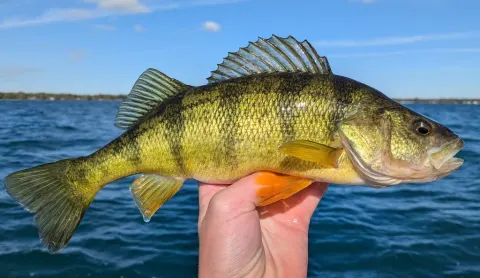
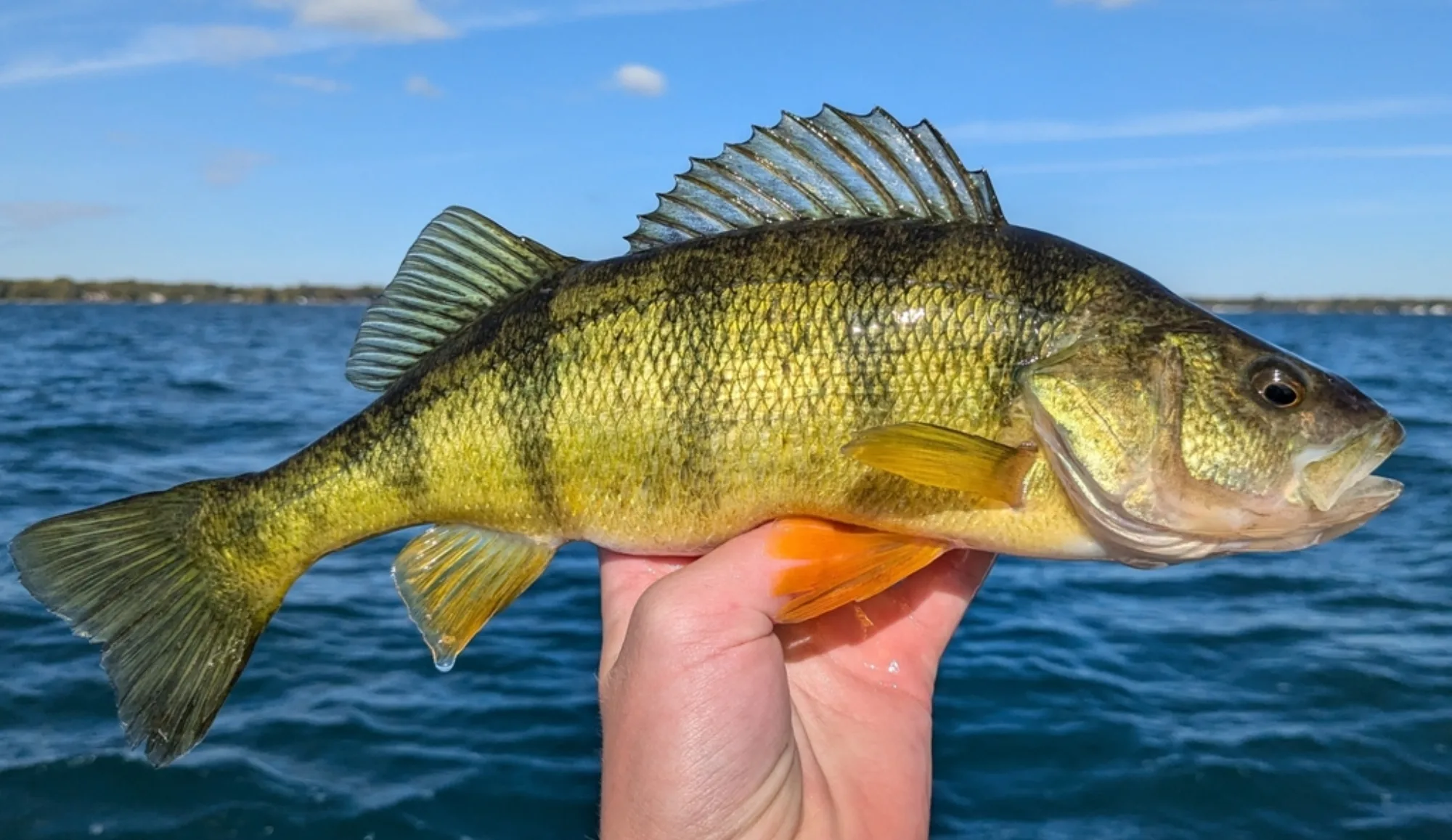
Yellow Perch bring a pattern of dark bars to the shallow waters of central North America. These freshwater fish have long, flattened bodies, with green, olive or golden-brown backs and 6 to 8 vertical bars across yellowish sides. A dark blotch usually marks the first dorsal fin, while the belly is white or yellow. Adults generally measure 10 to 25 cm, and young fish are paler, sometimes almost white.
Their native range includes the Great Lakes basin, parts of Canada from Nova Scotia to the Prairie provinces, and much of the northeastern United States. They have also been introduced elsewhere in the United States and Canada, as well as in China and Japan. Look for them near shore in lakes, among reeds, aquatic weeds, submerged branches and pier posts. They also inhabit slow rivers and streams, ponds, wetlands and brackish water. Most often they gather in schools, dispersing as daylight fades and coming together again in the morning. Older, larger fish sometimes travel alone. They are generally active by day, with feeding at its greatest just before dark. Young perch eat zooplankton before shifting to larger invertebrates; older fish take aquatic invertebrates, fish eggs, crayfish and young fish.
In spring, large schools gather in shallow lake water or slow tributary streams to spawn, often at night or early in the morning. Their jelly-like egg strands are commonly draped over weeds or submerged branches, and the adults provide no parental care. Predatory fish and water birds eat yellow perch, while some fisheries have been affected by intense harvesting. Disease can also take a toll: viral hemorrhagic septicemia caused a large die-off in Lake Erie in 2006.
Written from the English Wikipedia article Yellow perch (CC BY-SA 4.0).
- Records
- 39,814
- Countries
- 2
No atlas park has a record of the Yellow Perch in or around it yet.
These are open occurrence records, so they show where people looked for and recorded the Yellow Perch as much as where it lives. Cells are up to 25 km across, and every location is generalised to its cell.
Generalised encounter areas, not exact locations. Each shape is a grid cell coloured by how likely the species is there.
- Very likelyUnited States25 km zone · high confidence · 39090 records · updated 80 days ago
- Very likelyCanada25 km zone · high confidence · 724 records · updated 80 days ago
Conservation status not assessed here yet, so every location is generalised to its grid cell.