Long-nosed Bandicoot
Perameles nasuta
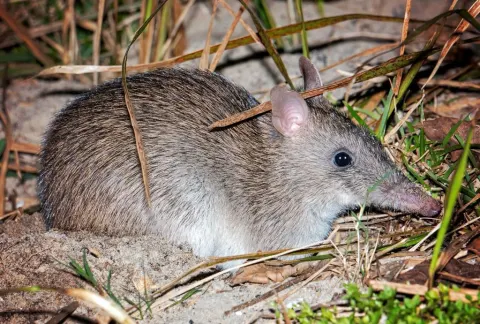
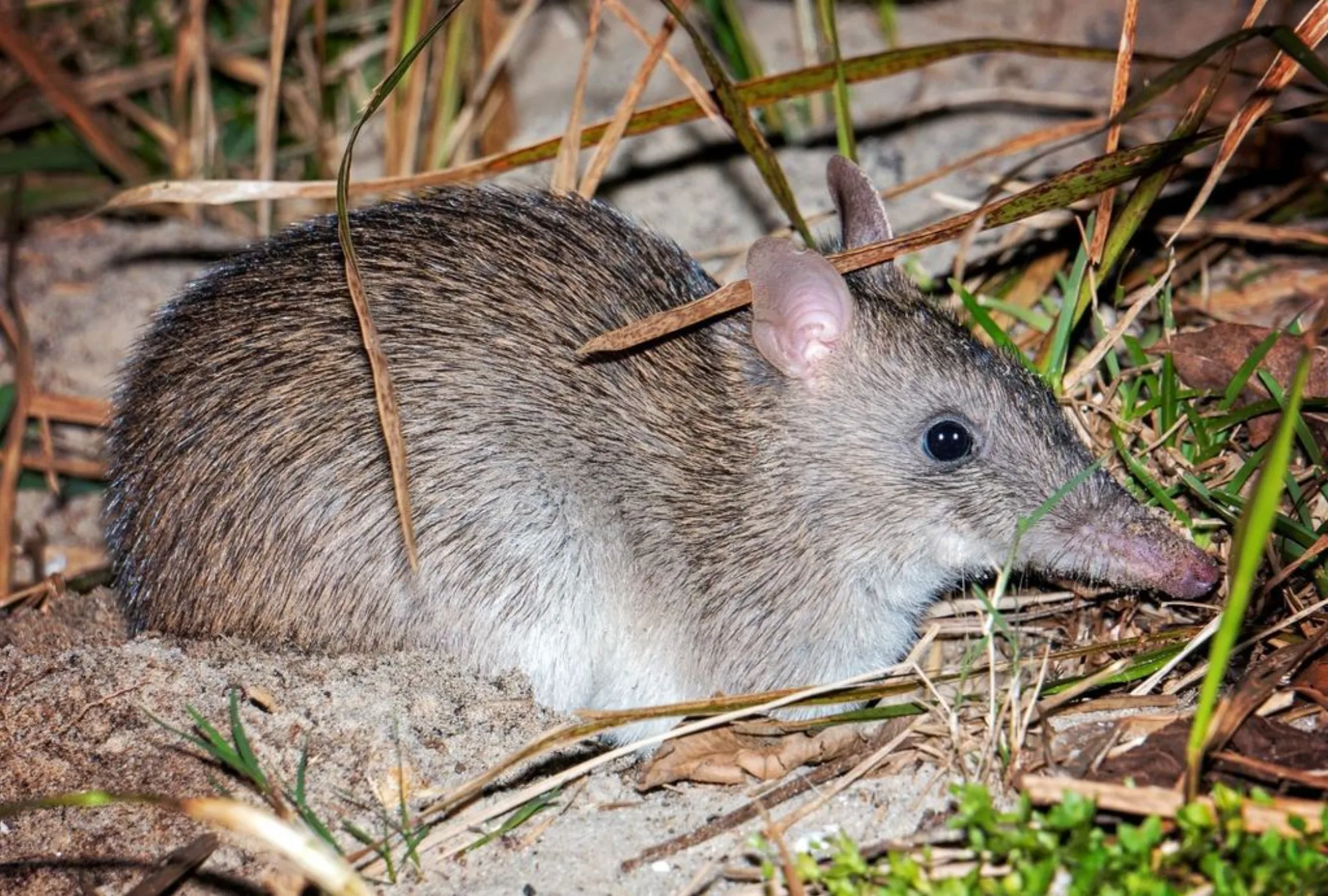
With its long, prominent nose and small, pointed ears held upright, the Long-nosed Bandicoot has a distinctive profile and a hunched posture. This sandy-brown or greyish marsupial has a short tail and a body length of around 40 centimetres, including a 14-centimetre tail. It weighs around 1.5 kilograms and has three long, clawed toes on each front foot.
Its range follows eastern Australia from Cape York Peninsula in Queensland through New South Wales to Victoria, taking in rainforest, moist gullies and grassy woodlands. It favours a mix of open grassy places for feeding and sheltered undergrowth where it can retreat and nest, and it commonly visits gardens close to the national parks of Garigal and Ku-ring-gai Chase. Active at night and solitary outside mating and parenting, it spends much of its time digging for food. Insects, including beetles and their larvae, are on the menu alongside plants and fungi, while invertebrates make up most of its diet throughout the year. Its digging can leave distinctive conical holes in the ground, and it is often found near compost heaps. When disturbed, it gives a high-pitched squeak.
Gestation lasts 12.5 days, and the young then spend a further 50 to 54 days in their mother's pouch before weaning. Introduced red foxes commonly prey on long-nosed bandicoots, and greater sooty owls also hunt them. The species has declined in some southern areas and disappeared from much of Sydney in the 1960s, although it remains on the outskirts and in two small inner-city populations. Around Dulwich Hill, little remnant habitat remains, but the bandicoots appear to have adapted to feeding in more urban surroundings.
Written from the English Wikipedia article Long-nosed bandicoot (CC BY-SA 4.0).
- Records
- 46,239
- Countries
- 1
- Atlas places
- 4
These are open occurrence records, so they show where people looked for and recorded the Long-nosed Bandicoot as much as where it lives. Cells are up to 25 km across, and every location is generalised to its cell.
Generalised encounter areas, not exact locations. Each shape is a grid cell coloured by how likely the species is there.
- Very likelyAustralia25 km zone · high confidence · 46239 records · updated 80 days ago
Conservation status not assessed here yet, so every location is generalised to its grid cell.