Eastern Barred Bandicoot
Perameles gunnii
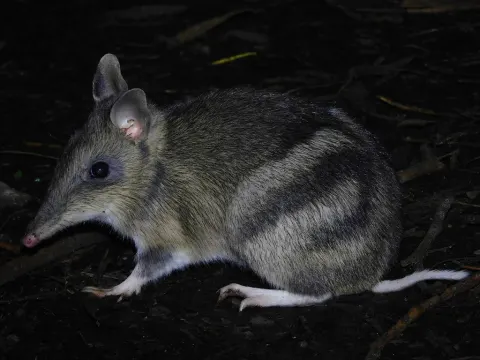
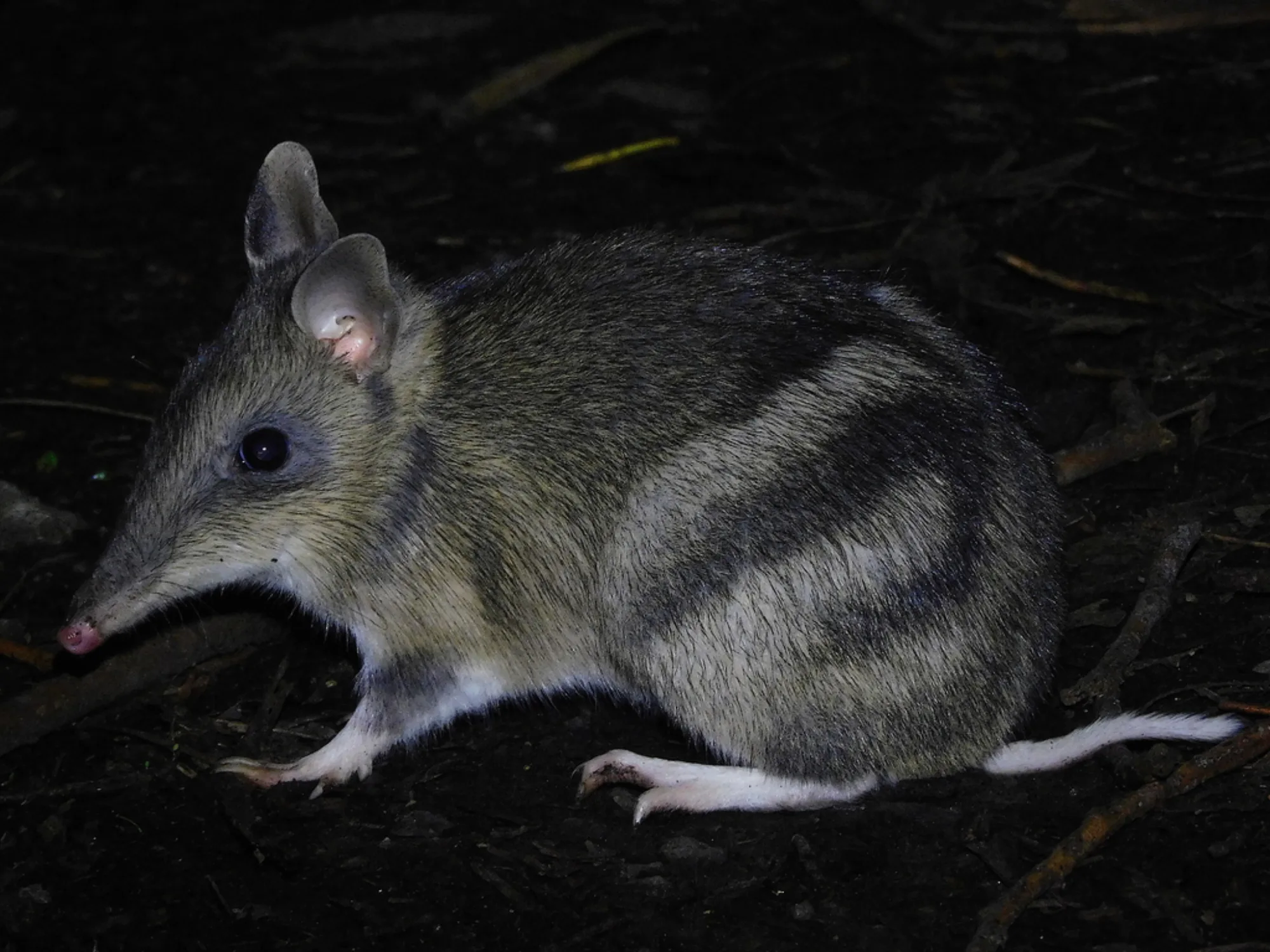
At dusk, the Eastern Barred Bandicoot leaves its nest to search for food. This rabbit-sized marsupial is native to Tasmania and mainland Victoria in southeastern Australia. It weighs less than 2 kg, has a short tail and carries three to four whitish bars across its rump. Adults in Tasmania are somewhat larger on average than those in Victoria. The animal is nocturnal and lives alone, resting during the day in a nest lined with grass. Males use larger home ranges than females and associate with them to mate.
On its nightly searches, the bandicoot probes deep into the soil with its long nose, then digs when it finds food. Its invertebrate diet includes crickets, beetles and earthworms. Females can produce up to five young in a litter, although two to three is the average. After weaning at 55 days, juveniles continue to depend on their mothers and forage alongside them until day 86. Females can have up to five litters a year in ideal conditions, but breeding decreases in summer and stops during drought.
The species once ranged across Tasmania and the basalt plains of southwest Victoria. Tasmania has large areas of suitable habitat and lacks the red fox, the bandicoot's main predator, and the animal is more widespread there than on the mainland. In Victoria, introduced foxes and cats, together with clearing land for farming, have harmed the population. Captive breeding and reintroduction programmes support its recovery there. In Westernport, releases have succeeded on Churchill, French and Phillip islands, while conservation fences help keep feral cats and red foxes away from populations.
Written from the English Wikipedia article Eastern barred bandicoot (CC BY-SA 4.0).
- Records
- 3,487
- Countries
- 1
- Atlas places
- 3
These are open occurrence records, so they show where people looked for and recorded the Eastern Barred Bandicoot as much as where it lives. Cells are up to 25 km across, and every location is generalised to its cell.
Generalised encounter areas, not exact locations. Each shape is a grid cell coloured by how likely the species is there.
- Very likelyAustralia25 km zone · high confidence · 3487 records · updated 80 days ago
Conservation status not assessed here yet, so every location is generalised to its grid cell.