Melon-headed Whale
Peponocephala electra
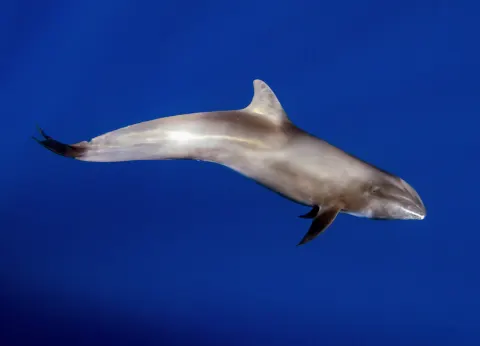
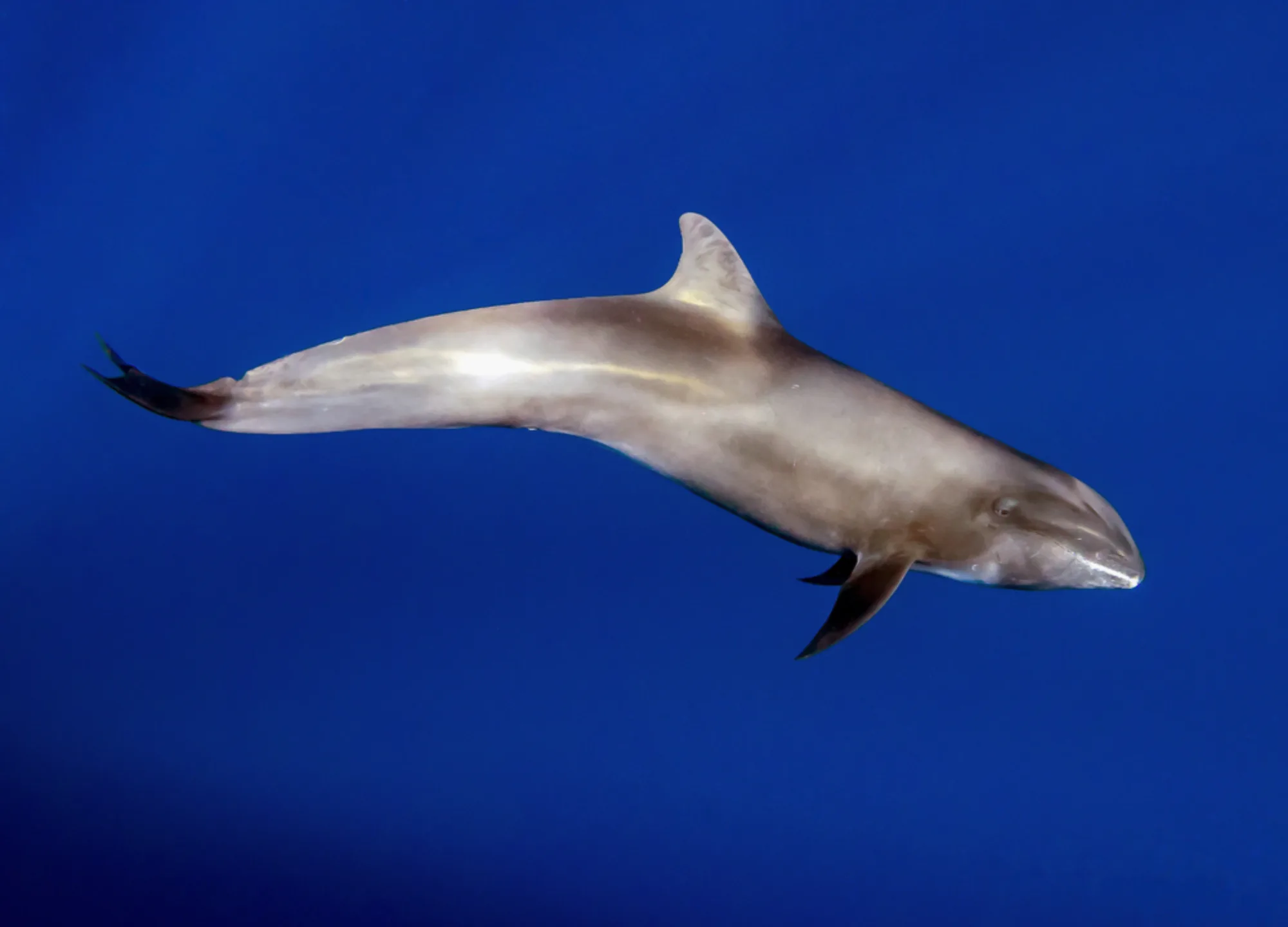
Fast-moving groups of Melon-headed Whales can throw up clouds of spray as they surface, sometimes leaping clear of the water in quick succession. This oceanic dolphin has a sturdy, dark grey body, a tapered head without an obvious beak and a tall, curved dorsal fin. In good light, a darker face mask and a dark cape dipping below the fin may be visible. Adults grow up to 2.75 m long and weigh up to 225 kg. Similar-looking pygmy killer whales have rounder heads and flipper tips, although poor sea conditions or light can make the two difficult to tell apart.
Melon-headed Whales inhabit deep tropical and subtropical waters worldwide, but are rarely encountered at sea. They can come close to shore around oceanic islands, and Hawaii, the Maldives, the Philippines and the eastern Caribbean are among the best places to look. They usually travel in groups of 100 to 500, sometimes gathering in much larger herds. Near islands, they may rest at the surface in the morning, with tail slapping, spyhopping and social calls increasing in the afternoon. They feed at night, mainly on squid and small fish. Females give birth to one calf every 3 to 4 years, following a pregnancy of approximately 12 months.
Fishing gear can injure or kill these whales, and some are taken for bait or food. They also strand in large groups; two mass stranding events have been linked to sonar used in naval activities and oil and gas exploration. Pollution is another threat, with some contaminants accumulating in their blubber and potentially affecting health and reproduction.
Written from the English Wikipedia article Melon-headed whale (CC BY-SA 4.0).
- Records
- 135
- Countries
- 19
- Atlas places
- 1
These are open occurrence records, so they show where people looked for and recorded the Melon-headed Whale as much as where it lives. Cells are up to 25 km across, and every location is generalised to its cell.
Generalised encounter areas, not exact locations. Each shape is a grid cell coloured by how likely the species is there.
- Very likelyAustralia25 km zone · medium confidence · 47 records · updated 80 days ago
- Very likelyUnited States25 km zone · medium confidence · 31 records · updated 80 days ago
- Very likelyUnited Kingdom25 km zone · medium confidence · 7 records · updated 80 days ago
- Very likelyGuadeloupe25 km zone · medium confidence · 6 records · updated 80 days ago
- LikelyRéunion25 km zone · medium confidence · 8 records · updated 80 days ago
- LikelyMayotte25 km zone · medium confidence · 7 records · updated 80 days ago
- LikelyJapan25 km zone · medium confidence · 4 records · updated 80 days ago
- LikelyTaiwan25 km zone · medium confidence · 4 records · updated 80 days ago
- LikelyMartinique25 km zone · medium confidence · 3 records · updated 80 days ago
- PossibleFrench Polynesia25 km zone · medium confidence · 7 records · updated 80 days ago
Conservation status not assessed here yet, so every location is generalised to its grid cell.