Chinese Softshell Turtle
Pelodiscus sinensis
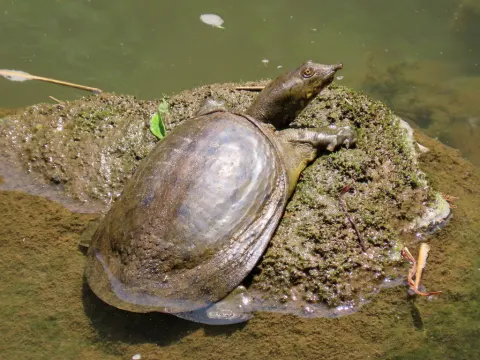
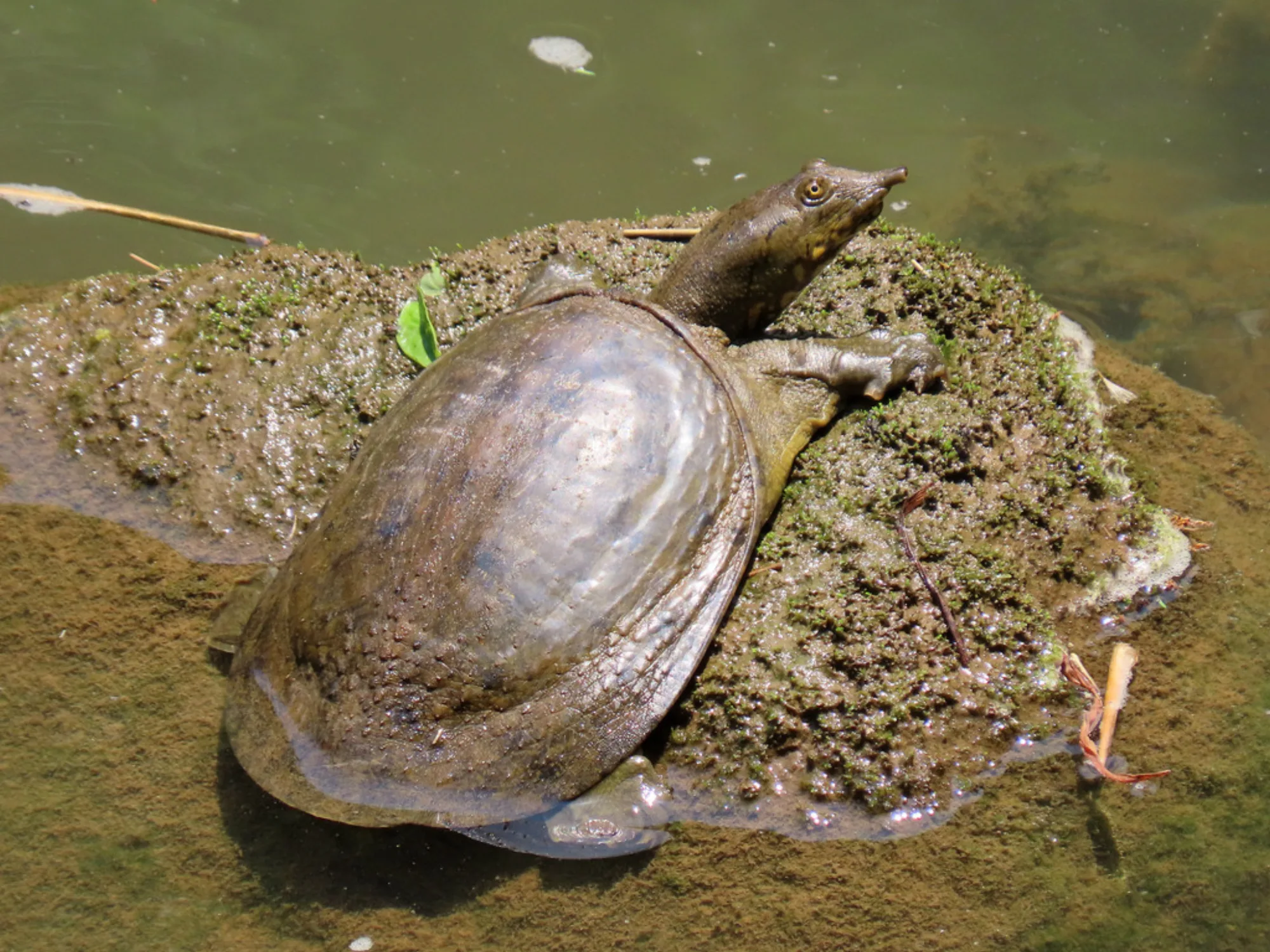
An olive shell, sometimes marked with dark blotches, helps give the Chinese Softshell Turtle its distinctive appearance. Unlike a hard, scaled shell, its covering is leathery and flexible, especially around the edges. Its head has dark flecks and lines spreading out from the eyes, while its feet are webbed for swimming. Females can reach 33 cm in shell length, while the smaller males reach 27 cm and have longer tails.
Native to mainland China and Taiwan, this turtle also has introduced populations elsewhere, following escapes. Its exact native range is difficult to establish because people have long used it for food and medicine and carried it as they migrated. It lives in fresh and brackish water, including slow-moving rivers, lakes, ponds, canals and creeks in China. In Hawaii, it can also be found in marshes and drainage ditches. In shallow water it can breathe through its long snout, and when resting it may lie buried in sand or mud, raising its head to breathe or seize prey. Its diet is mostly animal matter, with fish, crustaceans, molluscs and insects among the remains found in its stomach, along with seeds of marsh plants.
Females lay 8 to 30 eggs per clutch and may produce 2 to 5 clutches a year. The eggs hatch after about 60 days, although the time varies with temperature. Disease, habitat loss and collection for food threaten the Chinese Softshell Turtle. It is also raised in large numbers for food, and farming and releases have been associated with hybridisation that threatens its gene pool.
Written from the English Wikipedia article Chinese softshell turtle (CC BY-SA 4.0).
- Records
- 189
- Countries
- 16
No atlas park has a record of the Chinese Softshell Turtle in or around it yet.
These are open occurrence records, so they show where people looked for and recorded the Chinese Softshell Turtle as much as where it lives. Cells are up to 25 km across, and every location is generalised to its cell.
Generalised encounter areas, not exact locations. Each shape is a grid cell coloured by how likely the species is there.
- Very likelyTaiwan25 km zone · medium confidence · 122 records · updated 81 days ago
- Very likelyUnited States25 km zone · medium confidence · 28 records · updated 81 days ago
- Very likelyJapan25 km zone · medium confidence · 21 records · updated 81 days ago
- LikelyChina25 km zone · medium confidence · 9 records · updated 81 days ago
- LikelyGermany25 km zone · medium confidence · 3 records · updated 81 days ago
- LikelyVietnam25 km zone · medium confidence · 3 records · updated 81 days ago
- LikelyPhilippines25 km zone · medium confidence · 2 records · updated 81 days ago
- LikelyFrance25 km zone · medium confidence · 1 record · updated 81 days ago
- PossibleRomania25 km zone · low confidence · 0 records · updated 81 days ago
- PossibleSouth Korea25 km zone · low confidence · 0 records · updated 81 days ago
Conservation status not assessed here yet, so every location is generalised to its grid cell.