Asian Giant Softshell Turtle
Pelochelys cantorii
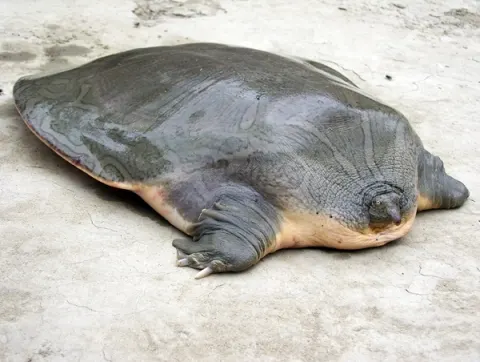
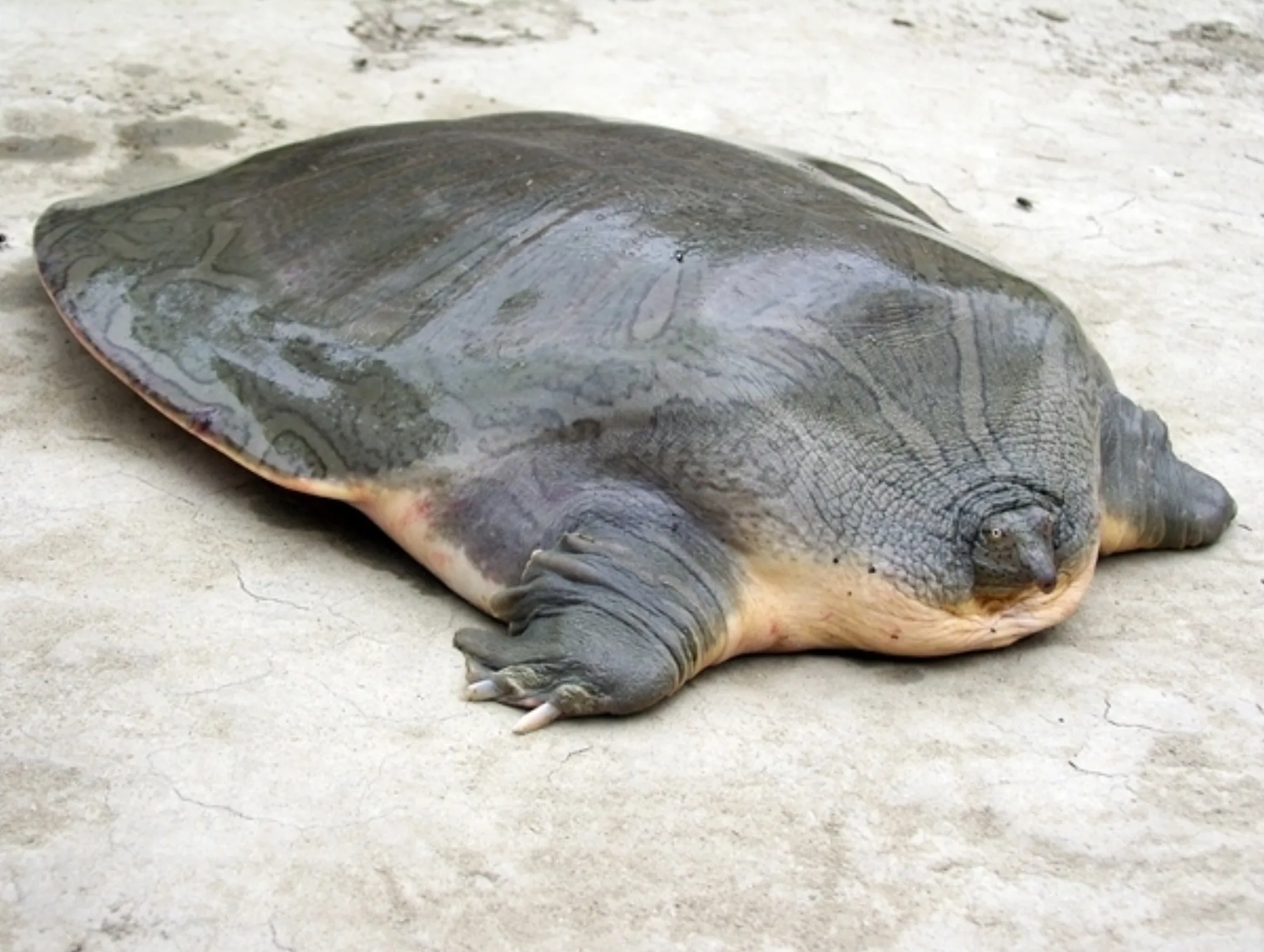
Recognisable by its broad head and small eyes positioned near the tip of a snout, the Asian giant softshell turtle is a unique freshwater reptile. Its smooth, olive-colored shell is soft and leathery, lacking any scales. While some historical accounts suggested these turtles could reach 1.8 metres in length, a more realistic carapace length is between 70 to 100 cm. Young individuals often display dark spots on their heads and shells, accented by yellow around the edges. This species is found across Southeast Asia, inhabiting slow-moving inland rivers and streams in countries including Thailand, Vietnam, and Indonesia. Evidence suggests their presence also extends to coastal regions.
This predator spends 95% of its existence buried and motionless under the sand with only its mouth and eyes visible. From this position, it acts as an ambush hunter, primarily eating fish, mollusks, and crustaceans, though it occasionally consumes aquatic plants. The turtle is so sedentary that it only rises to the surface to breathe twice each day. During February or March, it visits riverbanks to lay between 20 and 28 eggs.
Survival is difficult for this species as it has vanished from much of its former territory. Habitat destruction is a primary cause for these disappearances. In the Philippines, the turtle faces additional pressure from the presence of invasive Chinese softshell turtles. Because the two species look similar, local people sometimes catch the native Asian giant softshell turtle by mistake. Although it is a protected species and trading it is illegal under Philippine law, these accidental captures remain a significant issue for its conservation.
Written from the English Wikipedia article Asian giant softshell turtle (CC BY-SA 4.0).
- Records
- 1
- Countries
- 1
- Atlas places
- 0
These are open occurrence records, so they show where people looked for and recorded the Asian Giant Softshell Turtle as much as where it lives. Cells are up to 25 km across, and every location is generalised to its cell.
Generalised encounter areas, not exact locations. Each shape is a grid cell coloured by how likely the species is there.
- Very likelyIndia50 km zone · medium confidence · 1 record · updated 1 day ago