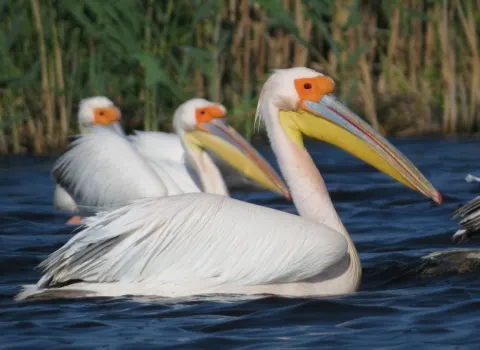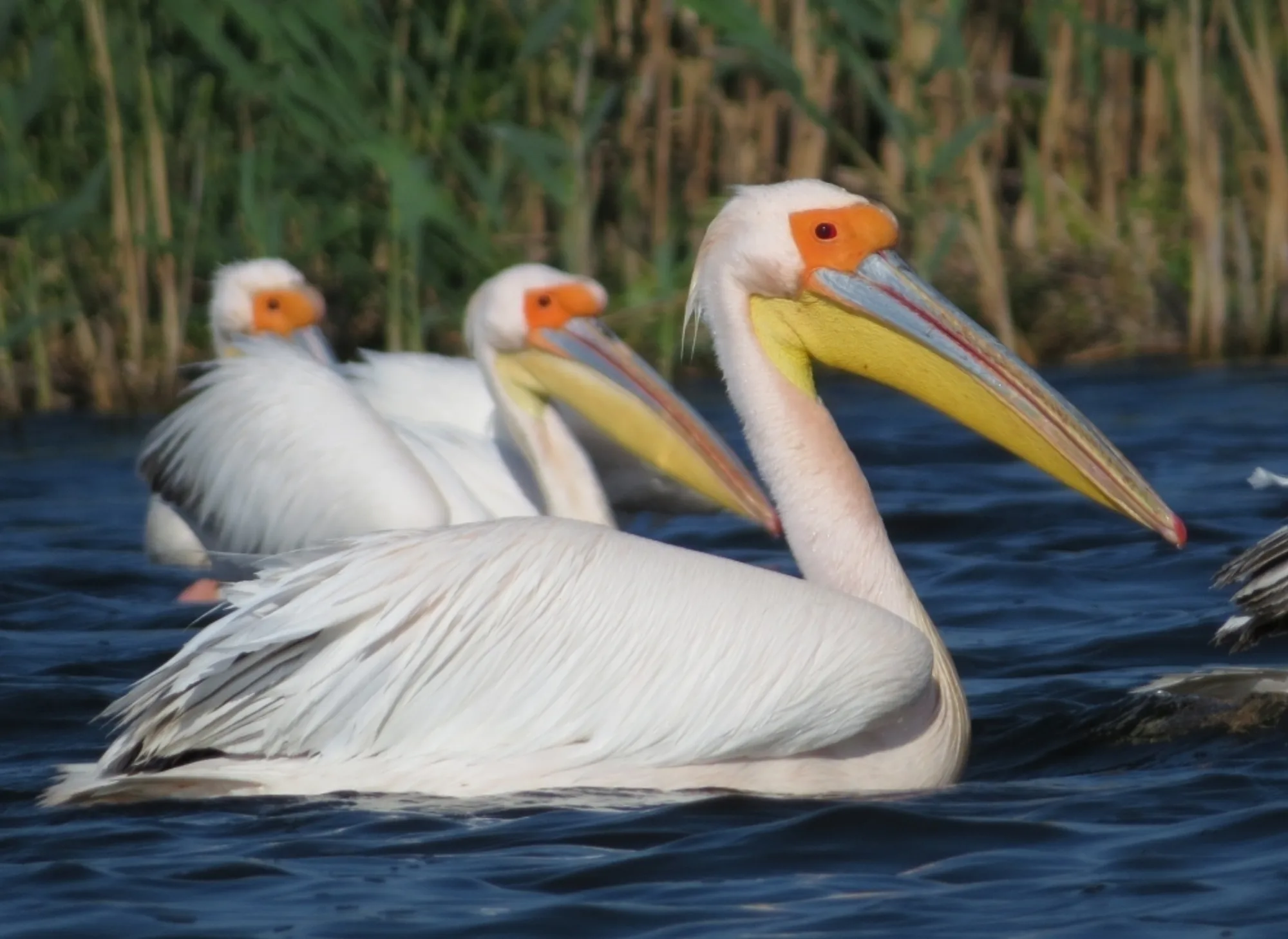
Great White Pelican
Pelecanus onocrotalus
A huge bird with a long pink and yellow bill, the Great White Pelican measures 140 to 180 cm in length and has a wingspan of 226 to 360 cm. Adults are mostly white, with black flight feathers and a faint pink tinge on the neck. In flight, they hold their heads close to their bodies, alternating slow wingbeats with glides. Sociable birds, they often travel in large flocks, sometimes in lines, circles or V formations.
The species breeds across southeastern Europe, Asia and Africa, favouring swamps and shallow lakes. In Eurasia, look for it on lakes, deltas, lagoons and marshes, often near dense reed beds used for nesting. African populations live year-round in scattered areas south of the Sahara, mainly around freshwater and alkaline lakes. Migratory birds arrive at the Danube Delta between late March and early April, then leave after breeding between September and late November.
Fish make up most of the diet, and the birds leave their roosts early in the morning to feed. They often fish together in shallow water, where groups can corral fish, then use their bill pouches to scoop them up. Large numbers breed in colonies, and most nest in ground scrapes furnished with feathers, sticks, grass and other material. Both parents care for the chicks, which leave the nest at 65 to 75 days old. Overfishing can force adults to travel farther for food or abandon breeding colonies when food is scarce. Human disturbance can also leave chicks exposed to predators, while pollution and the loss of feeding and breeding habitat contribute to declines.
Written from the English Wikipedia article Great white pelican (CC BY-SA 4.0).
- Records
- 82,240
- Countries
- 85
- Atlas places
- 28
- iSimangaliso Wetland Park· South Africa
- Ngorongoro Conservation Area· Tanzania
- Lake Manyara National Park· Tanzania
- Queen Elizabeth National Park· Uganda
- Table Mountain National Park· South Africa
- West Coast National Park· South Africa
- Chobe National Park· Botswana
- Dorob National Park· Namibia
- Namib-Naukluft· Namibia
- Zambezi National Park· Zimbabwe
- Aberdare National Park· Kenya
- Hwange National Park· Zimbabwe
- Lake Nakuru National Park· Kenya
- Okavango Delta· Botswana
- Tarangire National Park· Tanzania
- Volcanoes National Park· Rwanda
- Walvis Bay· Namibia
- Amboseli National Park· Kenya
- Bwabwata National Park· Namibia
- Gonarezhou National Park· Zimbabwe
- Hardap Game Park· Namibia
- Hell's Gate National Park· Kenya
- Kruger National Park· South Africa
- Liuwa Plain National Park· Zambia
- Murchison Falls National Park· Uganda
- Nairobi National Park· Kenya
- Nyungwe National Park· Rwanda
- South Luangwa National Park· Zambia
These are open occurrence records, so they show where people looked for and recorded the Great White Pelican as much as where it lives. Cells are up to 25 km across, and every location is generalised to its cell.
Generalised encounter areas, not exact locations. Each shape is a grid cell coloured by how likely the species is there.
- Very likelySouth Africa25 km zone · high confidence · 18795 records · updated 86 days ago
- Very likelyIsrael25 km zone · high confidence · 11232 records · updated 86 days ago
- Very likelyIndia25 km zone · high confidence · 10729 records · updated 86 days ago
- Very likelyKenya25 km zone · high confidence · 6088 records · updated 86 days ago
- Very likelyNamibia25 km zone · high confidence · 4216 records · updated 86 days ago
- Very likelyJordan25 km zone · high confidence · 4107 records · updated 86 days ago
- Very likelyTürkiye25 km zone · high confidence · 2825 records · updated 86 days ago
- Very likelyGreece25 km zone · high confidence · 2752 records · updated 86 days ago
- Very likelyBulgaria25 km zone · high confidence · 2368 records · updated 86 days ago
- Very likelyTanzania25 km zone · high confidence · 2295 records · updated 86 days ago
Conservation status not assessed here yet, so every location is generalised to its grid cell.