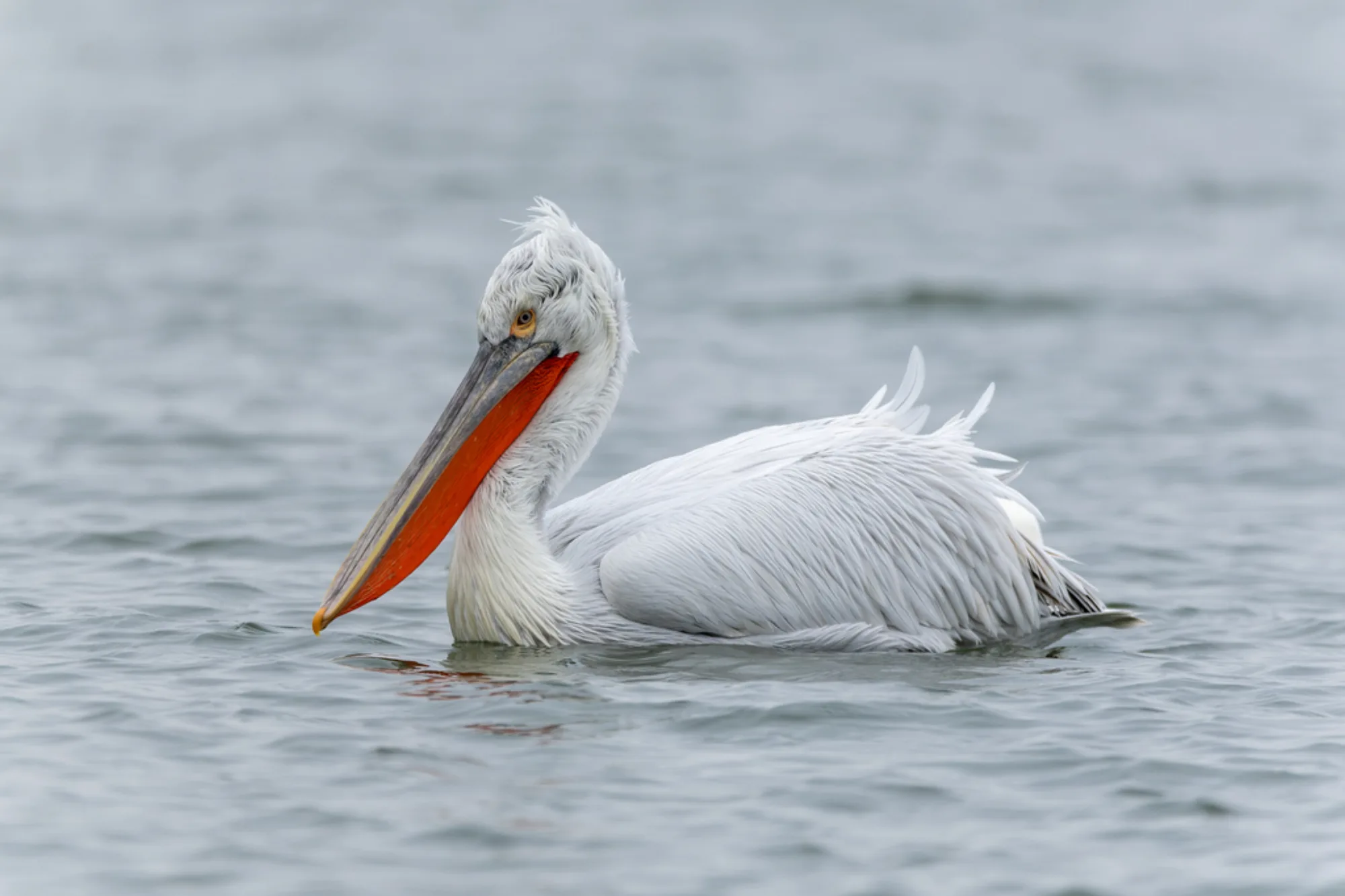
Dalmatian Pelican
Pelecanus crispus
With its immense bill, shaggy curls and silvery-white feathers, the Dalmatian Pelican is bigger than any other pelican and among the heaviest birds that can fly. Its wingspan typically reaches 2.7 to 3.2 metres, and its dark grey legs help distinguish it from relatives with pinkish legs. In the breeding season, the bill pouch turns vivid orange-red, while the plumage can look greyer or creamier in winter. In flight, look for slow, powerful wingbeats and groups gliding together above lakes and wetlands.
From southeastern Europe through Central Asia to the Indian subcontinent, the species lives on open wetlands including lakes, rivers, deltas and floodplains. Many European birds stay near their breeding grounds or move short distances in winter, while Asian populations make longer migrations. Fish make up most of its diet, and it often feeds at dawn and dusk, swimming upright and dipping its head to catch prey near the surface. Sometimes groups drive fish towards shallow water, and in autumn the birds also scavenge fish in drying wetlands. Pelicans usually return to traditional breeding sites, making rough nests of vegetation on islands or floating mats. Both parents incubate the eggs, and feed their chicks regurgitated fish.
Wetland drainage and conversion of land have reduced habitat, while poaching and shooting also threaten the birds. Power lines can cause fatal electrocution, and disturbance at nests can leave eggs and chicks exposed when adults temporarily abandon them. In Greece, recreational boating has disrupted feeding, sometimes causing starvation and deaths.
Written from the English Wikipedia article Dalmatian pelican (CC BY-SA 4.0).
- Records
- 33,447
- Countries
- 38
- Atlas places
- 1
These are open occurrence records, so they show where people looked for and recorded the Dalmatian Pelican as much as where it lives. Cells are up to 25 km across, and every location is generalised to its cell.
Generalised encounter areas, not exact locations. Each shape is a grid cell coloured by how likely the species is there.
- Very likelyIndia25 km zone · high confidence · 8763 records · updated 86 days ago
- Very likelyGreece25 km zone · high confidence · 8440 records · updated 86 days ago
- Very likelyTürkiye25 km zone · high confidence · 4287 records · updated 86 days ago
- Very likelyBulgaria25 km zone · high confidence · 3666 records · updated 86 days ago
- Very likelyRomania25 km zone · high confidence · 1697 records · updated 86 days ago
- Very likelyIran25 km zone · high confidence · 1172 records · updated 86 days ago
- Very likelyAlbania25 km zone · high confidence · 1039 records · updated 86 days ago
- Very likelyAzerbaijan25 km zone · high confidence · 623 records · updated 86 days ago
- Very likelyKazakhstan25 km zone · high confidence · 597 records · updated 86 days ago
- Very likelyTaiwan25 km zone · high confidence · 571 records · updated 86 days ago
Conservation status not assessed here yet, so every location is generalised to its grid cell.