Australian Pelican
Pelecanus conspicillatus
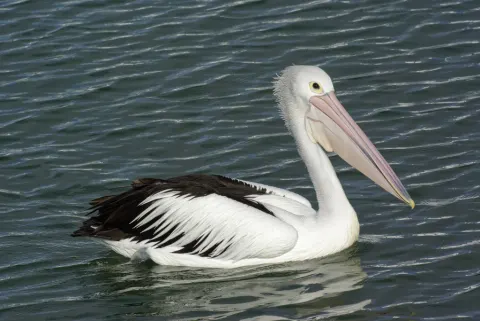
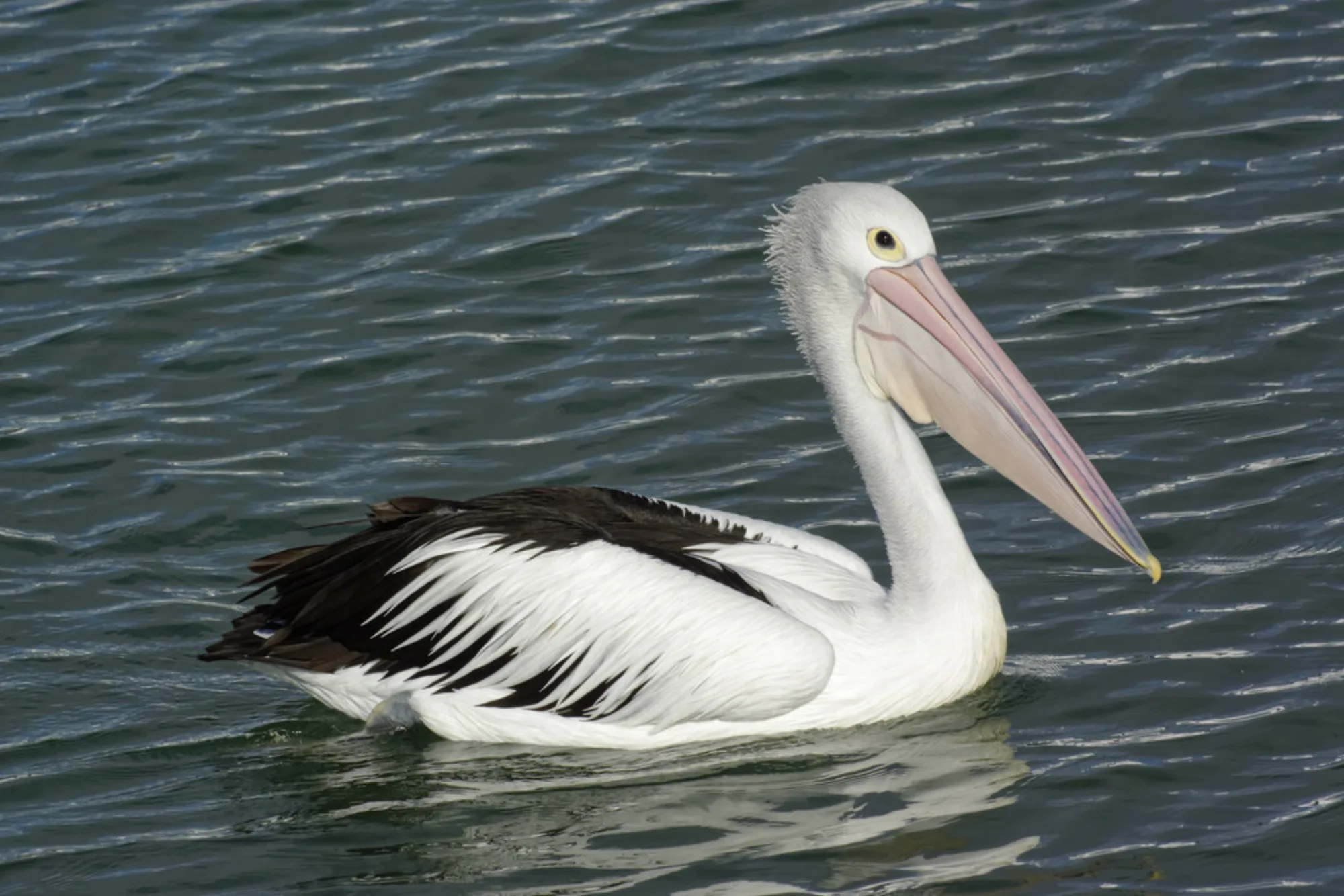
With its mostly white plumage, black wings and enormous pink bill, the Australian Pelican is a conspicuous waterbird. Its wingspan stretches from 2.3 to 2.6 m, and its bill has been recorded as the longest of any living bird. Young birds resemble adults, although brown replaces the black in their plumage and the white patch on the upper wing is smaller.
The species ranges across inland and coastal waters in Australia and New Guinea, and is also found in Fiji and parts of Indonesia. It favours open water without dense aquatic vegetation, from lakes, rivers and coastal lagoons to reservoirs and flooded areas in arid country. Pelicans may rest on beaches, sandbars, reefs and jetties, and will use artificial waters where there is no regular boating. Their movements have no fixed schedule: they follow food supplies, often moving after drought, and are sometimes carried to new places by wind.
Fish are the main food, and groups drive them into shallow water before catching them with their bills. Pelicans also feed alone, taking insects, crustaceans and other birds, as well as scavenging for scraps when opportunities arise. Breeding takes place in colonies on islands or in sheltered areas near lakes or the sea, with timing varying by region and rainfall. Nests are usually shallow hollows in earth or sand, sometimes lined with grass, and a clutch typically contains two eggs. Chicks grow grey down soon after hatching and fledge at around three months. Nesting birds are sensitive to human disturbance, and breeding pelicans appear to prefer places with relatively little disturbance.
Written from the English Wikipedia article Australian pelican (CC BY-SA 4.0).
- Records
- 373,983
- Countries
- 1
- Atlas places
- 3
These are open occurrence records, so they show where people looked for and recorded the Australian Pelican as much as where it lives. Cells are up to 25 km across, and every location is generalised to its cell.
Generalised encounter areas, not exact locations. Each shape is a grid cell coloured by how likely the species is there.
- Very likelyAustralia25 km zone · high confidence · 373983 records · updated 80 days ago
Conservation status not assessed here yet, so every location is generalised to its grid cell.