South African Spring Hare
Pedetes capensis
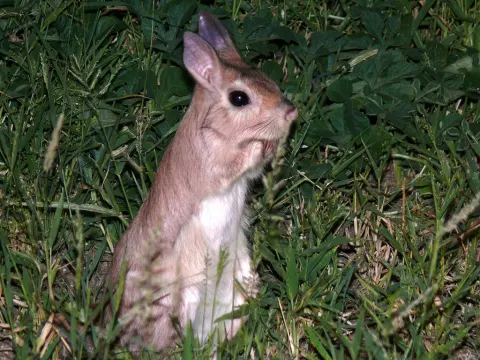
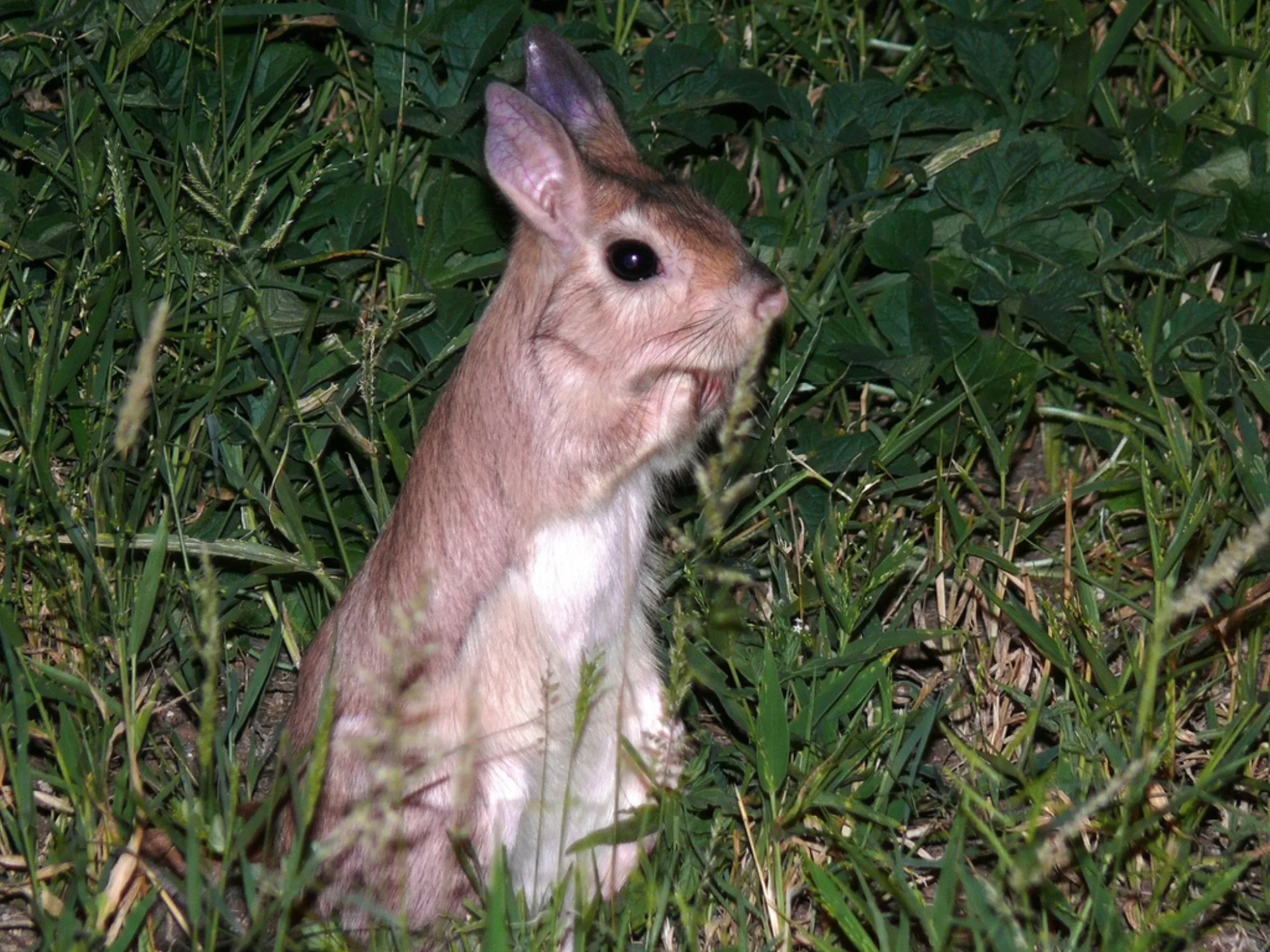
At night on the sandy plains of southern Africa, the South African Spring Hare emerges from its burrow to feed. Despite its name, this medium-sized animal is a rodent, not a hare. Its long hind legs, short front legs and long tail give it the look of a small kangaroo. Large eyes and ears add to its distinctive shape, while its soft fur is reddish-brown above and off-white underneath, with a black-tipped tail. An adult can measure 80 cm from head to tail and has an average weight of 2.5 to 3.5 kg. Springhares use their tails for balance and have been reported to leap 2 m.
They live across semi-arid southern Africa, favouring sandy plains and pans with short grass. During the day they shelter underground in burrows dug into well-drained sand, often near a tree or shrub. A burrow usually has several entrances, some marked by a mound of sand and others hidden without one. While feeding, springhares stay close to an entrance and return to their own burrows if disturbed. They eat roots, stems, leaves and seeds, sometimes taking insects or carrion, and may gather in groups of up to nine to feed. Breeding takes place throughout the year, with females giving birth about three times a year, usually to one furred young in a burrow. The youngster relies entirely on its mother's milk and stays underground for approximately seven weeks. Predators include humans, and springhares are traditionally hunted by San and baTswana people; at least 21 species prey on them in the Kalahari.
Written from the English Wikipedia article South African springhare (CC BY-SA 4.0).
- Records
- 27
- Countries
- 5
- Atlas places
- 6
These are open occurrence records, so they show where people looked for and recorded the South African Spring Hare as much as where it lives. Cells are up to 25 km across, and every location is generalised to its cell.
Generalised encounter areas, not exact locations. Each shape is a grid cell coloured by how likely the species is there.
- Very likelySouth Africa25 km zone · medium confidence · 17 records · updated 80 days ago
- Very likelyUnited States25 km zone · medium confidence · 5 records · updated 80 days ago
- LikelyNamibia25 km zone · medium confidence · 3 records · updated 80 days ago
- LikelyZimbabwe25 km zone · medium confidence · 2 records · updated 80 days ago
- UncommonBotswana25 km zone · low confidence · 0 records · updated 80 days ago
Conservation status not assessed here yet, so every location is generalised to its grid cell.