Indigo Bunting
Passerina cyanea
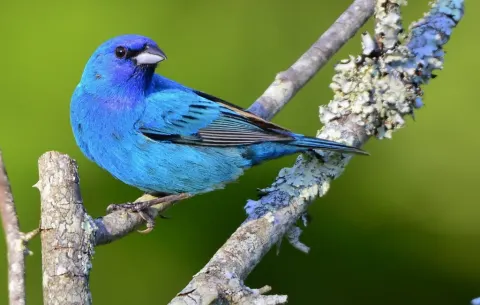
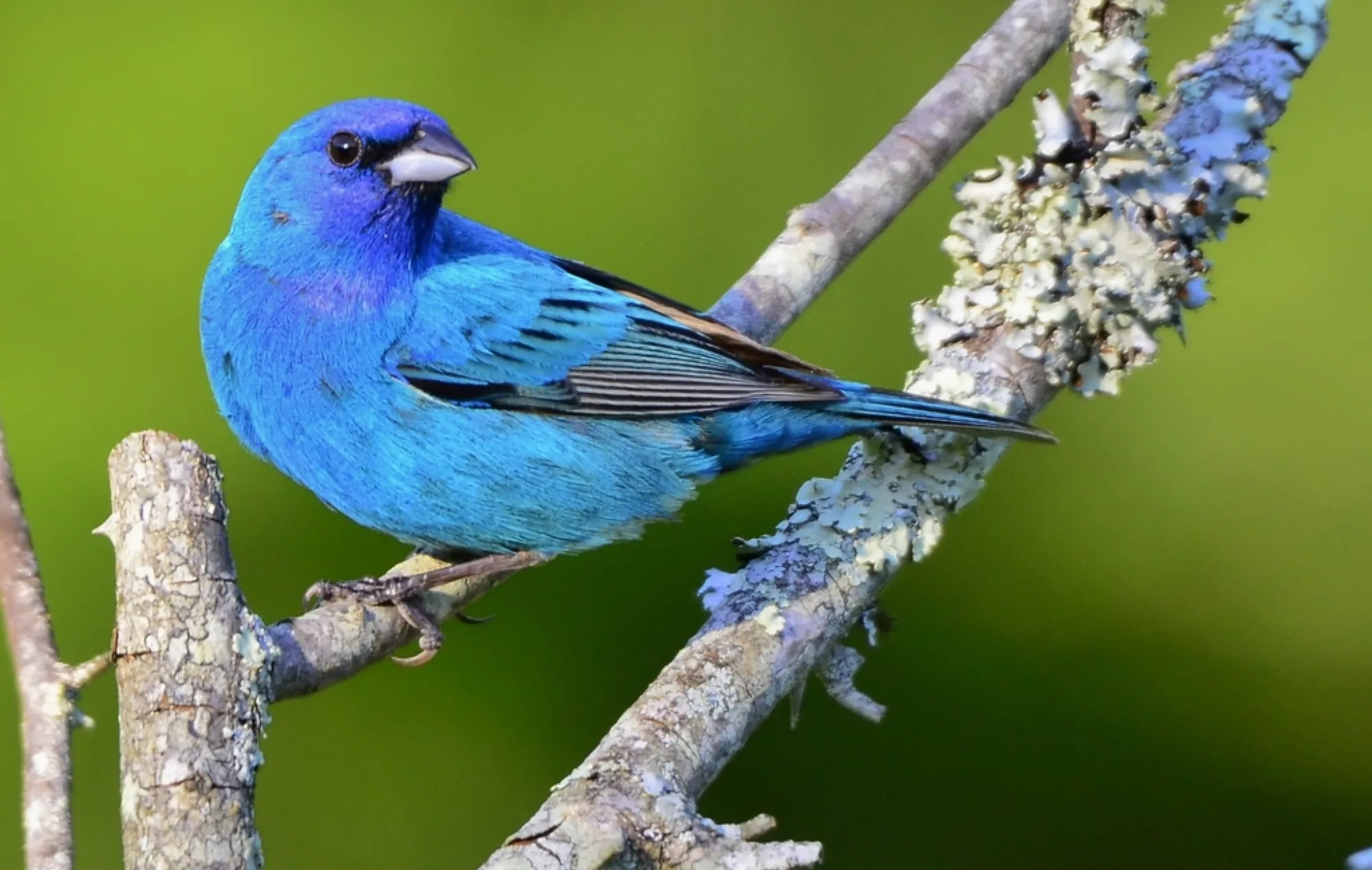
In summer, a male Indigo Bunting can stand out against a brushy forest edge, with a mostly blue body, an indigo head and dark wings edged in blue. Females are brown above and lighter below, while males look mostly brown in autumn and winter. About the size of a small sparrow, this songbird measures 11.5 to 15 cm long. Listen for the male's high-pitched, buzzing song, delivered from a post, wire or the top of a bush.
During the breeding season, Indigo Buntings range from southern Canada to northern Florida, reaching eastern Texas and southern Nevada in the west. They use farmland, brushy forest edges, open deciduous woods and regrowing woodland. In winter, they range from southern Florida and central Mexico to northern South America, including the West Indies and Central America. They often migrate at night, using stars to navigate. Look for birds feeding on the ground, in trees or in shrubs: they usually feed alone during breeding season but often gather in flocks in winter. Their summer food includes insects, spiders, berries and seeds, while grass seeds are a winter staple.
The female builds a nest in a dense shrub or low tree, using plant material held together with spider web and lining it with soft grass or deer hair. She incubates the eggs alone, and most pairs raise two broods a year. Nest predators include raccoons, domestic cats, blue jays and eastern racers. Brown-headed cowbirds also lay eggs in bunting nests, and bunting chicks have lower survival when they must compete with a cowbird chick for food.
Written from the English Wikipedia article Indigo bunting (CC BY-SA 4.0).
- Records
- 1,252,232
- Countries
- 3
- Atlas places
- 1
These are open occurrence records, so they show where people looked for and recorded the Indigo Bunting as much as where it lives. Cells are up to 25 km across, and every location is generalised to its cell.
Generalised encounter areas, not exact locations. Each shape is a grid cell coloured by how likely the species is there.
- Very likelyUnited States25 km zone · high confidence · 1209775 records · updated 80 days ago
- Very likelyCanada25 km zone · high confidence · 42457 records · updated 80 days ago
Conservation status not assessed here yet, so every location is generalised to its grid cell.