Painted Bunting
Passerina ciris
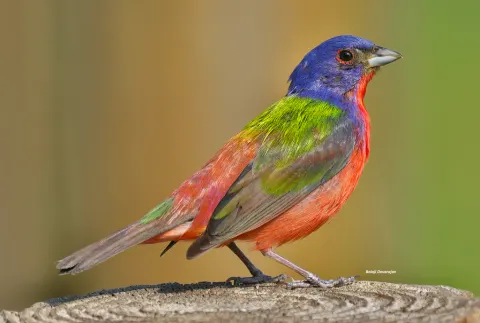
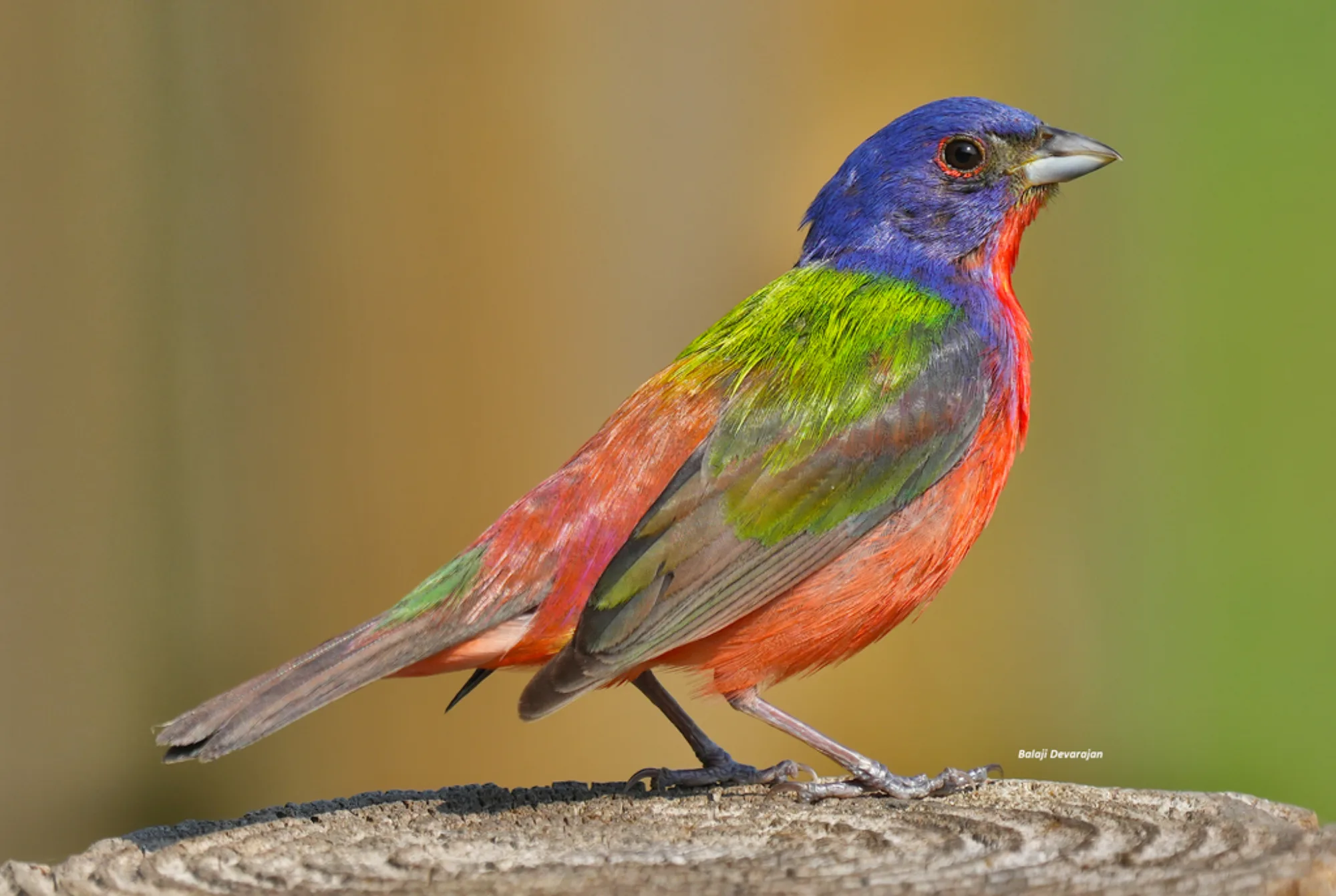
A dark blue head, green back and red rump and underparts make the male Painted Bunting easy to recognise, although finding one can be harder: it often hides in foliage even while singing. Females and young birds are green to yellow-green, colours that help conceal them; the adult female is a brighter green than similar songbirds. Males acquire their bright plumage in their second year, and young males are hard to distinguish from females. Adults measure 12 to 14 cm long.
Native to North America, the bird breeds in two separate regions, including parts of the southern United States and northern Mexico. Its winter range includes Cuba, the Bahamas and South Florida, as well as both Mexican coasts and much of Central America. Look for it in thickets, brush and woodland edges, as well as densely planted gardens and suburban areas. In spring, males sing from exposed perches, but these shy birds are often difficult to observe. They feed by hopping along the ground and pausing to look around. Seeds dominate their winter diet, while breeding birds seek small invertebrates, including spiders, snails, grasshoppers and caterpillars.
Females build concealed nests in low, dense vegetation, weaving them into the surrounding growth. A brood usually contains three or four eggs, and the female alone cares for the young. Cowbirds often parasitise the nests, while snakes prey on eggs, young and females tending them. Habitat loss to development is a principal cause of population decline, particularly in eastern coastal thickets and woodland edges and in riverside habitats used during migration and winter. In Central America, birds may still be trapped for sale overseas.
Written from the English Wikipedia article Painted bunting (CC BY-SA 4.0).
- Records
- 335,835
- Countries
- 6
- Atlas places
- 1
These are open occurrence records, so they show where people looked for and recorded the Painted Bunting as much as where it lives. Cells are up to 25 km across, and every location is generalised to its cell.
Generalised encounter areas, not exact locations. Each shape is a grid cell coloured by how likely the species is there.
- Very likelyUnited States25 km zone · high confidence · 310830 records · updated 80 days ago
- Very likelyMexico25 km zone · high confidence · 18209 records · updated 80 days ago
- Very likelyCosta Rica25 km zone · high confidence · 3565 records · updated 80 days ago
- Very likelyGuatemala25 km zone · high confidence · 1404 records · updated 80 days ago
- Very likelyBahamas25 km zone · high confidence · 988 records · updated 80 days ago
- Very likelyNicaragua25 km zone · high confidence · 839 records · updated 80 days ago
Conservation status not assessed here yet, so every location is generalised to its grid cell.