Blue Grosbeak
Passerina caerulea
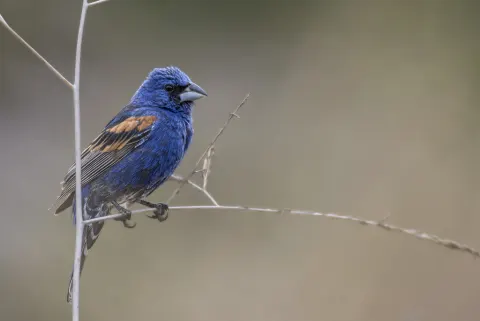
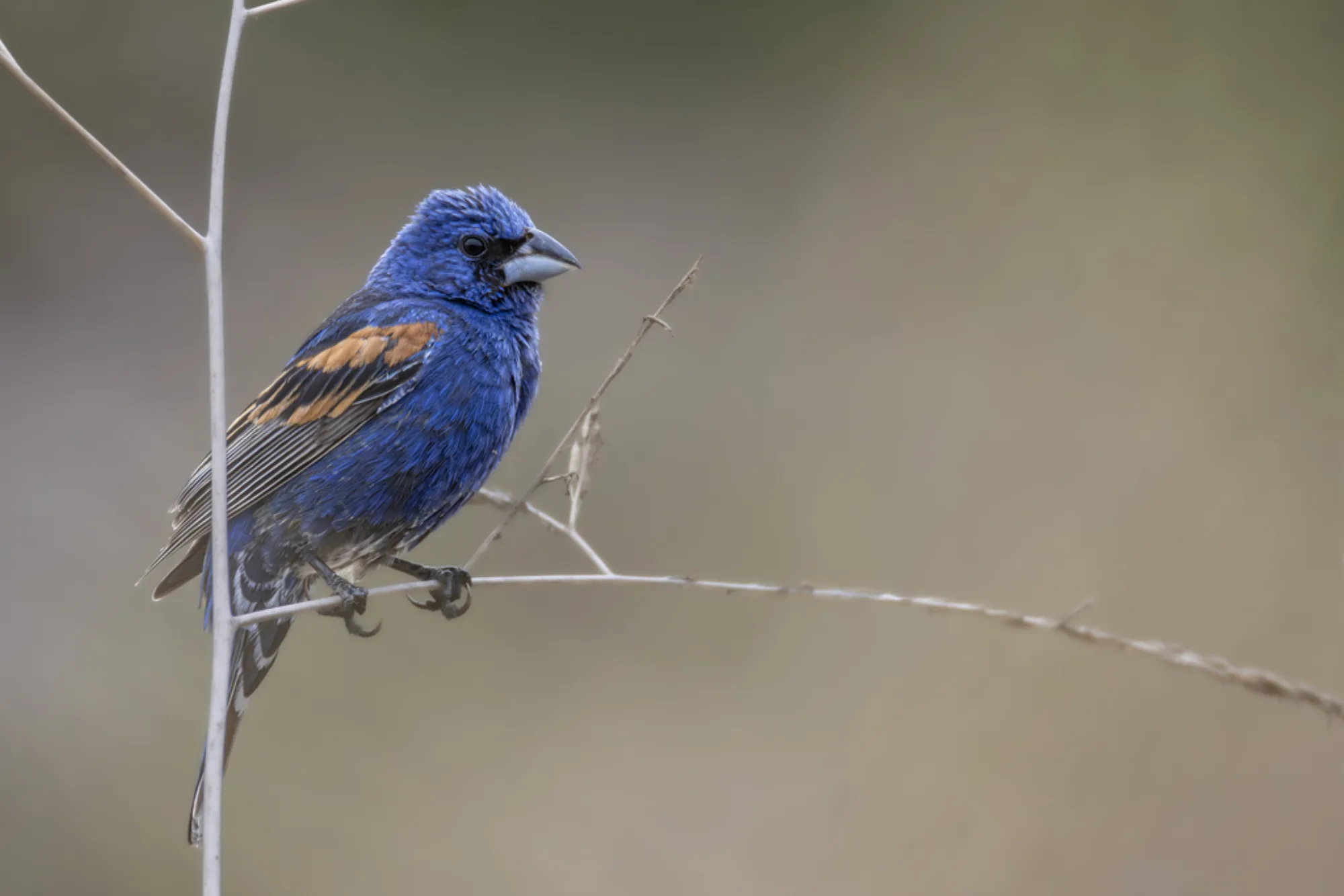
Deep blue plumage and a large, deep bill make the male Blue Grosbeak a distinctive bird. Its wings carry black and brown, including two brown bars. The female is mostly brown, with scattered blue feathers on her upperparts and two brown wing bars. Both sexes have the large bill and double wing bars that, along with their larger size, distinguish them from the indigo bunting. A medium-sized member of the cardinal family, the Blue Grosbeak measures 14 to 19 cm in length, with a wingspan of 26 to 29 cm.
This mainly migratory bird breeds across much of northern Mexico and the southern half of the United States, then moves south to Central America for winter. A very small number migrate as far as northern South America, and the southernmost record comes from eastern Ecuador. The species is uncommon within its range, though it now nests regularly across large parts of the United States Midwest and Northeast. Over the past century or two, its range has spread north, probably helped by human clearing of forests. Look for partly open places with scattered trees, as well as riverside woodland, scrub, thickets, woodland edges and overgrown fields. Cultivated land and hedgerows are also among the habitats it uses.
Blue Grosbeaks forage mainly on the ground, eating mostly insects alongside snails, spiders, seeds, grains and wild fruit. They nest in low trees, bushes or tangled vegetation, often near the edge of an open area. The nest is usually about 1 to 2.5 m above the ground.
Written from the English Wikipedia article Blue grosbeak (CC BY-SA 4.0).
- Records
- 508,881
- Countries
- 4
- Atlas places
- 2
These are open occurrence records, so they show where people looked for and recorded the Blue Grosbeak as much as where it lives. Cells are up to 25 km across, and every location is generalised to its cell.
Generalised encounter areas, not exact locations. Each shape is a grid cell coloured by how likely the species is there.
- Very likelyUnited States25 km zone · high confidence · 486607 records · updated 80 days ago
- Very likelyMexico25 km zone · high confidence · 17560 records · updated 80 days ago
- Very likelyCosta Rica25 km zone · high confidence · 3314 records · updated 80 days ago
- Very likelyBelize25 km zone · high confidence · 1400 records · updated 80 days ago
Conservation status not assessed here yet, so every location is generalised to its grid cell.