Eurasian Tree Sparrow
Passer montanus
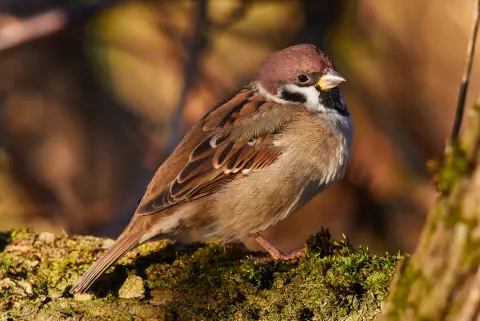
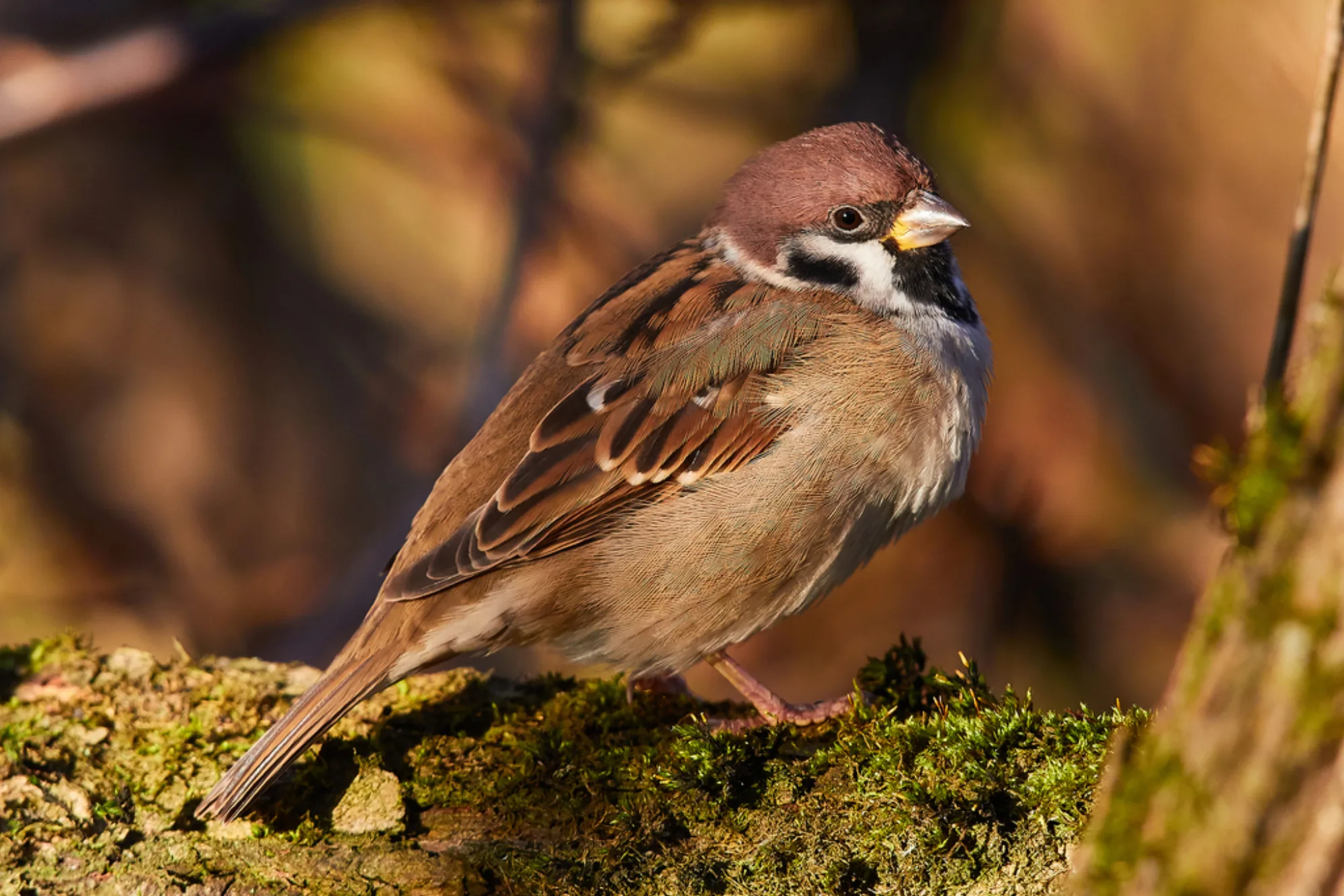
Look for a chestnut crown and a black patch on each white cheek to recognise the Eurasian Tree Sparrow. Its light brown back is streaked with black, and two narrow white bars mark each brown wing. Males and females look alike, while young birds have duller colours. Smaller than a house sparrow, it measures 12.5 to 14 cm in length and has a wingspan of about 21 cm.
The species breeds across much of temperate Europe and Asia, extending through Southeast Asia to Java and Bali. Most stay within their range year round, although the northernmost breeding populations move south for winter. In Europe, look for it in open countryside with small patches of woodland, along slow watercourses with pollarded willows, or near coastal cliffs. In eastern Asia, it is common in towns and cities. It feeds on the ground in flocks, sometimes with house sparrows, finches or buntings, gathering seeds and spilled grain.
During the breeding season, adults also collect invertebrates, including insects and spiders, and feed their young mainly animal food. Pairs nest alone or in loose colonies, using cavities in old trees or buildings, nest boxes and sometimes the abandoned nests of larger birds. Their untidy nests are made from materials such as grass and wool and lined with feathers. A typical clutch contains five or six eggs, and both parents incubate them for 12 to 13 days. Populations have fallen in much of western Europe, with intensified farming, increased herbicide use and the loss of winter stubble fields among the likely causes. Predators, nest raiders, parasites and disease also take a toll.
Written from the English Wikipedia article Eurasian tree sparrow (CC BY-SA 4.0).
- Records
- 1,290,169
- Countries
- 101
- Atlas places
- 4
These are open occurrence records, so they show where people looked for and recorded the Eurasian Tree Sparrow as much as where it lives. Cells are up to 25 km across, and every location is generalised to its cell.
Generalised encounter areas, not exact locations. Each shape is a grid cell coloured by how likely the species is there.
- Very likelyTaiwan25 km zone · high confidence · 479266 records · updated 86 days ago
- Very likelyNorway25 km zone · high confidence · 173314 records · updated 86 days ago
- Very likelySpain25 km zone · high confidence · 69544 records · updated 86 days ago
- Very likelyUnited States25 km zone · high confidence · 63125 records · updated 86 days ago
- Very likelyJapan25 km zone · high confidence · 50427 records · updated 86 days ago
- Very likelyChina25 km zone · high confidence · 46130 records · updated 86 days ago
- Very likelyFinland25 km zone · high confidence · 35465 records · updated 86 days ago
- Very likelySweden25 km zone · high confidence · 32410 records · updated 86 days ago
- Very likelyThailand25 km zone · high confidence · 24133 records · updated 86 days ago
- Very likelyUnited Kingdom25 km zone · high confidence · 17645 records · updated 86 days ago
Conservation status not assessed here yet, so every location is generalised to its grid cell.