House Sparrow
Passer domesticus
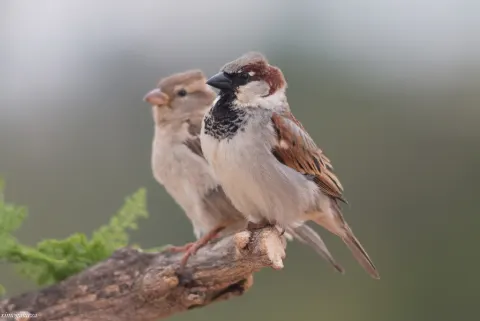
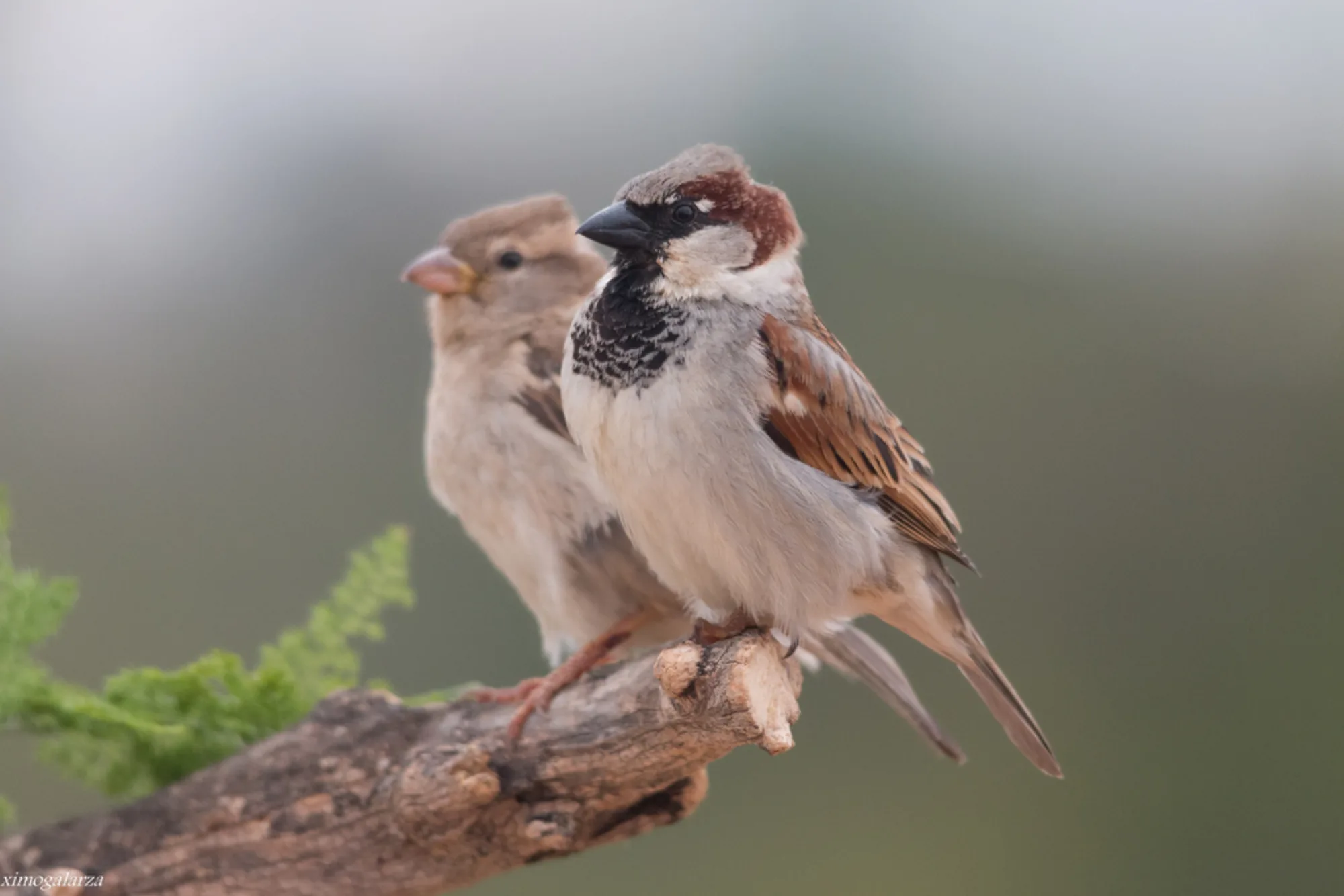
At about 16 cm long, the House Sparrow is a compact, full-chested bird with a rounded head and a short tail. Males have a grey crown, chestnut on the sides of the head, a black throat and a warm brown back streaked with black. Females are brown above and pale grey-brown below, with a distinct pale stripe above the eye; young birds resemble them. Listen, too, for the frequent short chirps used by birds in flocks or at rest.
The House Sparrow's native range covers much of Asia, most of Europe and the Mediterranean Basin; introductions have carried it to parts of Australasia, Africa and the Americas. It lives close to people in towns and countryside, although some Central Asian birds breed in open country away from human habitation. Look for flocks feeding on the ground or gathering in trees and bushes, where the birds may bathe together in dust or water. Adults eat mainly cereal and weed seeds, but also take insects, berries and other available food; in cities they may gather outside restaurants for scraps.
Nests are often tucked into eaves and other gaps in houses, though tree hollows and holes in cliffs or banks are also used. A clutch usually contains four or five eggs, and both parents feed the young, mostly on insects at first. Although widespread, the sparrow has declined in some areas and is persecuted as an agricultural pest. Cats and birds of prey hunt it, and it is also killed on roads.
Written from the English Wikipedia article House sparrow (CC BY-SA 4.0).
- Records
- 7,447,194
- Countries
- 200
- Atlas places
- 28
- Queen Elizabeth National Park· Uganda
- Namib-Naukluft· Namibia
- Dorob National Park· Namibia
- uKhahlamba-Drakensberg Park· South Africa
- Volcanoes National Park· Rwanda
- Walvis Bay· Namibia
- Amboseli National Park· Kenya
- Annapurna Conservation Area· Nepal
- Arenal· Costa Rica
- Arusha National Park· Tanzania
- Chitwan National Park· Nepal
- Chobe National Park· Botswana
- Iguaçu National Park· Brazil
- Iguazú National Park· Argentina
- Kibale National Park· Uganda
- Lake Manyara National Park· Tanzania
- Langtang National Park· Nepal
- Machalilla National Park· Ecuador
- Madikwe Game Reserve· South Africa
- Matobo National Park· Zimbabwe
- Nairobi National Park· Kenya
- Ngorongoro Conservation Area· Tanzania
- Nyungwe National Park· Rwanda
- Rwenzori Mountains National Park· Uganda
- Table Mountain National Park· South Africa
- Udawalawe National Park· Sri Lanka
- Yala National Park· Sri Lanka
- Zambezi National Park· Zimbabwe
These are open occurrence records, so they show where people looked for and recorded the House Sparrow as much as where it lives. Cells are up to 25 km across, and every location is generalised to its cell.
Generalised encounter areas, not exact locations. Each shape is a grid cell coloured by how likely the species is there.
- Very likelyUnited States25 km zone · high confidence · 4851441 records · updated 86 days ago
- Very likelyCanada25 km zone · high confidence · 907750 records · updated 86 days ago
- Very likelyPortugal25 km zone · high confidence · 108655 records · updated 86 days ago
- Very likelyUnited Kingdom25 km zone · high confidence · 102428 records · updated 86 days ago
- Very likelySpain25 km zone · high confidence · 98268 records · updated 86 days ago
- Very likelyMexico25 km zone · high confidence · 94278 records · updated 86 days ago
- Very likelyAustralia25 km zone · high confidence · 90795 records · updated 86 days ago
- Very likelyNorway25 km zone · high confidence · 81811 records · updated 86 days ago
- Very likelyBelgium25 km zone · high confidence · 78440 records · updated 86 days ago
- Very likelyNew Zealand25 km zone · high confidence · 77336 records · updated 86 days ago
Conservation status not assessed here yet, so every location is generalised to its grid cell.