Saxaul Sparrow
Passer ammodendri
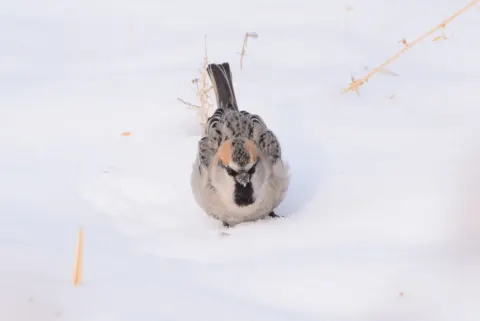
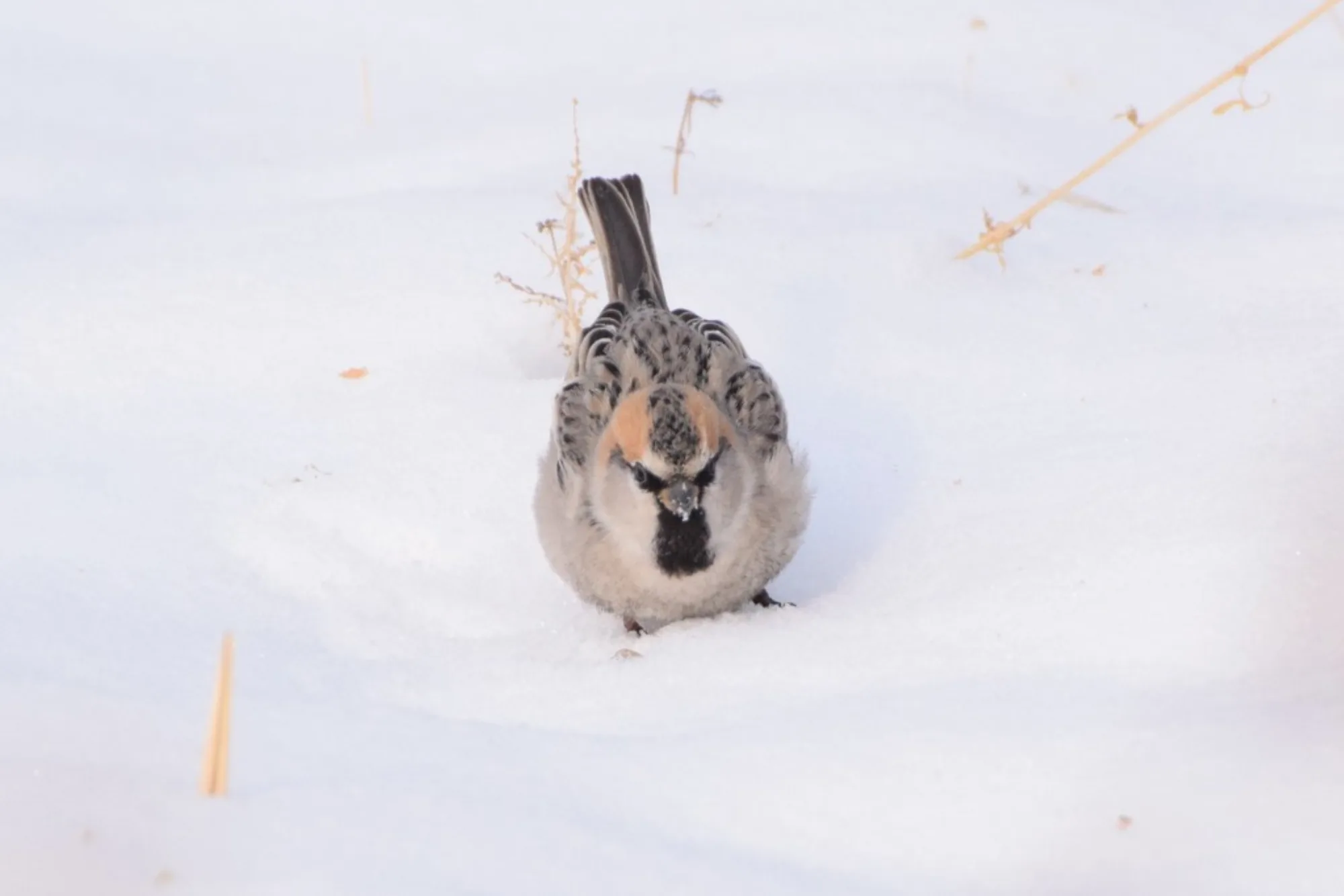
In the deserts of Central Asia, the Saxaul Sparrow blends sandy brown and dull grey plumage with distinctive head markings. It is among the larger sparrows, measuring 14 to 16 centimetres and weighing 25 to 32 grams. The male has black stripes along the top of its head and through the eye, with a russet patch at the sides of the crown and nape. Females are paler and lack the male's bold black head stripes. Listen, too, for a soft, musical chirp, or watch for the bird flying swiftly and often high above the ground.
Its range includes central Turkmenistan and reaches east into China's northern Gansu, across areas thought to be separated from one another. Look around desert rivers and oases, particularly where saxaul, poplar or tamarisk shrubs grow. The bird can also visit settlements and grain fields, especially in winter. Often shy and hidden among foliage, it searches for food in trees and on the ground. Seeds, particularly those of saxaul, make up most of its diet, supplemented by insects, especially during breeding. Outside the breeding season, it wanders in flocks that can include other sparrow species.
Breeding birds usually nest as isolated pairs, although small groups sometimes form. Their domed nests are made from grasses, roots and other plant material, with a soft lining of feathers, fur or plants. Tree cavities, earth banks and rocky slopes are among the places chosen for nesting. A pair normally raises two clutches each year, with five or six eggs per clutch, and both parents feed the young. Intensified agriculture and desertification caused by overgrazing appear to have taken away large parts of the bird's range.
Written from the English Wikipedia article Saxaul sparrow (CC BY-SA 4.0).
- Records
- 1,096
- Countries
- 5
No atlas park has a record of the Saxaul Sparrow in or around it yet.
These are open occurrence records, so they show where people looked for and recorded the Saxaul Sparrow as much as where it lives. Cells are up to 25 km across, and every location is generalised to its cell.
Generalised encounter areas, not exact locations. Each shape is a grid cell coloured by how likely the species is there.
- Very likelyKazakhstan25 km zone · medium confidence · 376 records · updated 80 days ago
- Very likelyChina25 km zone · medium confidence · 374 records · updated 80 days ago
- Very likelyMongolia25 km zone · high confidence · 335 records · updated 80 days ago
- LikelyTurkmenistan25 km zone · medium confidence · 11 records · updated 80 days ago
- RareUzbekistan25 km zone · low confidence · 0 records · updated 80 days ago
Conservation status not assessed here yet, so every location is generalised to its grid cell.