Great Tit
Parus major
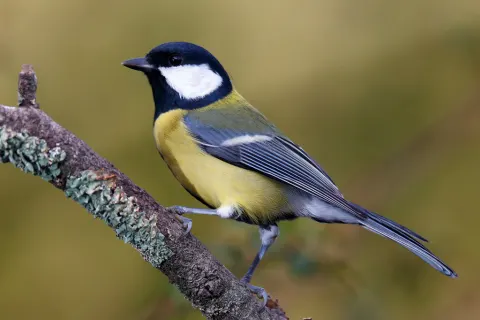
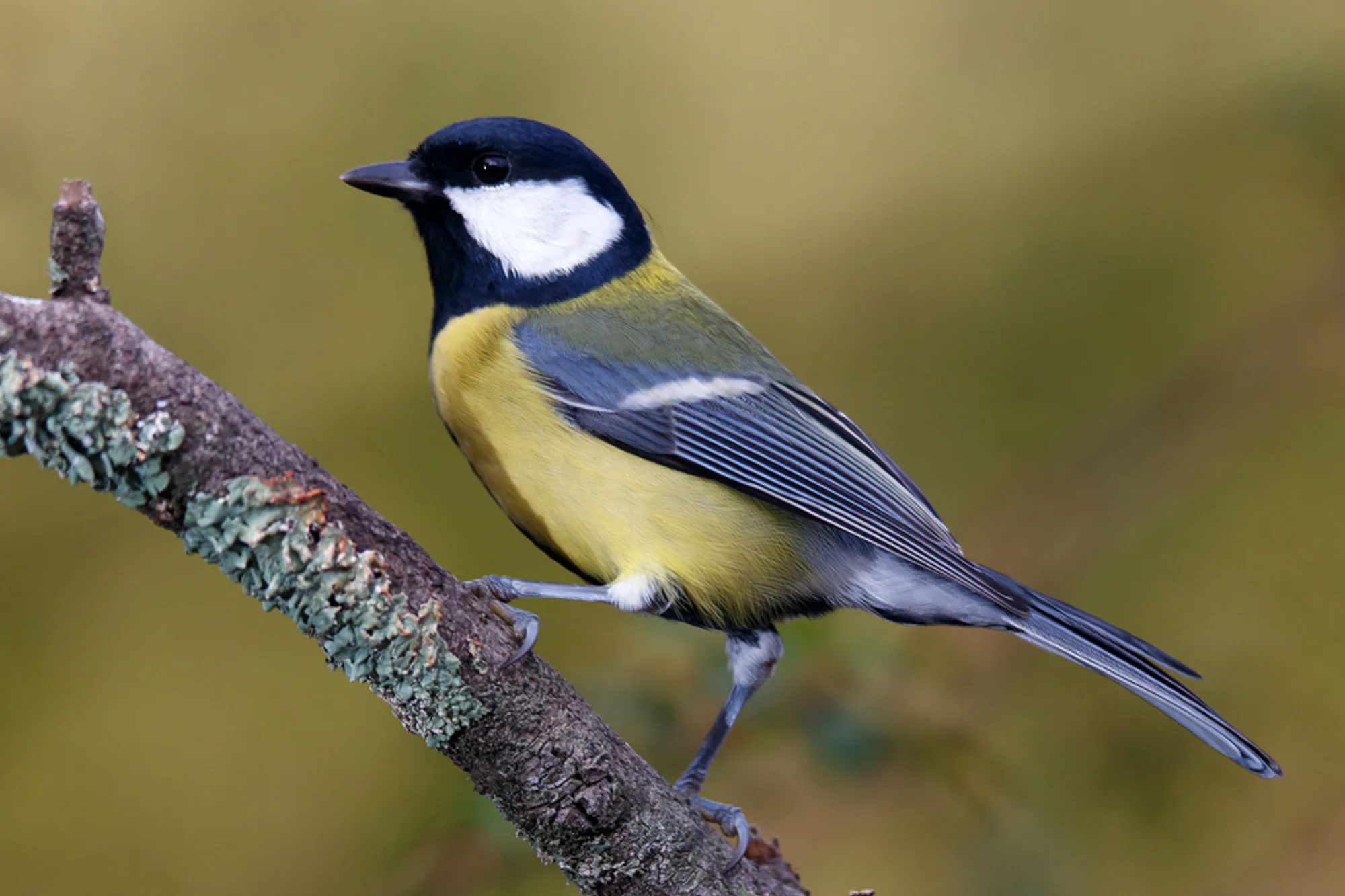
A black head, white cheeks and yellow underparts make the Great Tit (Parus major) a distinctive sight. This small bird measures 12.5 to 14 cm in length, with olive-green on its back and a black stripe down its breast. Females have duller colours and a narrower stripe, while young birds resemble females but have olive-brown necks. Listen, too, for its familiar "teacher, teacher" call, used to announce a territory.
Great tits occur across much of Europe, the Middle East and Central Asia, reaching the Amur Valley and northern China; they also live in parts of North Africa. Look for them in open deciduous woodland, mixed forest, forest edges and gardens, or in clearings within denser forest. They have adapted to human-altered places and can be common in urban parks and gardens. Pairs generally stay in or near their territories throughout the year, although harsh winters can prompt groups to move.
In summer, great tits pick insects and spiders from foliage; in autumn and winter they also eat berries and seeds, and may visit bird tables. They often forage on the ground and join mixed-species feeding flocks in winter. A female usually builds her nest in a tree hole, but may use a hole in a wall or rock face, or a nest box. She incubates the eggs alone, while both parents feed the chicks; pairs raise two broods in most years. Sparrowhawks hunt the birds, while woodpeckers, squirrels and weasels raid their nests, which can also harbour fleas. Some local populations have declined in poorer-quality habitats.
Written from the English Wikipedia article Great tit (CC BY-SA 4.0).
- Records
- 3,073,095
- Countries
- 73
- Atlas places
- 1
These are open occurrence records, so they show where people looked for and recorded the Great Tit as much as where it lives. Cells are up to 25 km across, and every location is generalised to its cell.
Generalised encounter areas, not exact locations. Each shape is a grid cell coloured by how likely the species is there.
- Very likelyFinland25 km zone · high confidence · 990842 records · updated 86 days ago
- Very likelyUnited Kingdom25 km zone · high confidence · 342164 records · updated 86 days ago
- Very likelyNorway25 km zone · high confidence · 317595 records · updated 86 days ago
- Very likelySweden25 km zone · high confidence · 283242 records · updated 86 days ago
- Very likelyFrance25 km zone · high confidence · 248289 records · updated 86 days ago
- Very likelyBelgium25 km zone · high confidence · 235418 records · updated 86 days ago
- Very likelySpain25 km zone · high confidence · 103147 records · updated 86 days ago
- Very likelyGermany25 km zone · high confidence · 50650 records · updated 86 days ago
- Very likelyCzechia25 km zone · high confidence · 45219 records · updated 86 days ago
- Very likelyIsrael25 km zone · high confidence · 45000 records · updated 86 days ago
Conservation status not assessed here yet, so every location is generalised to its grid cell.