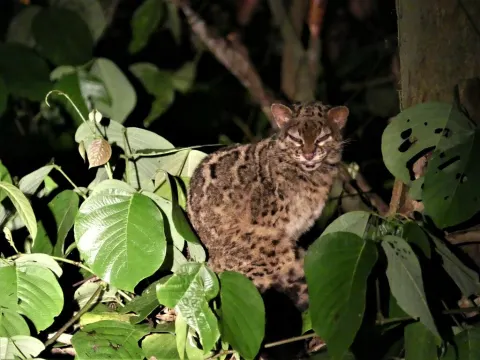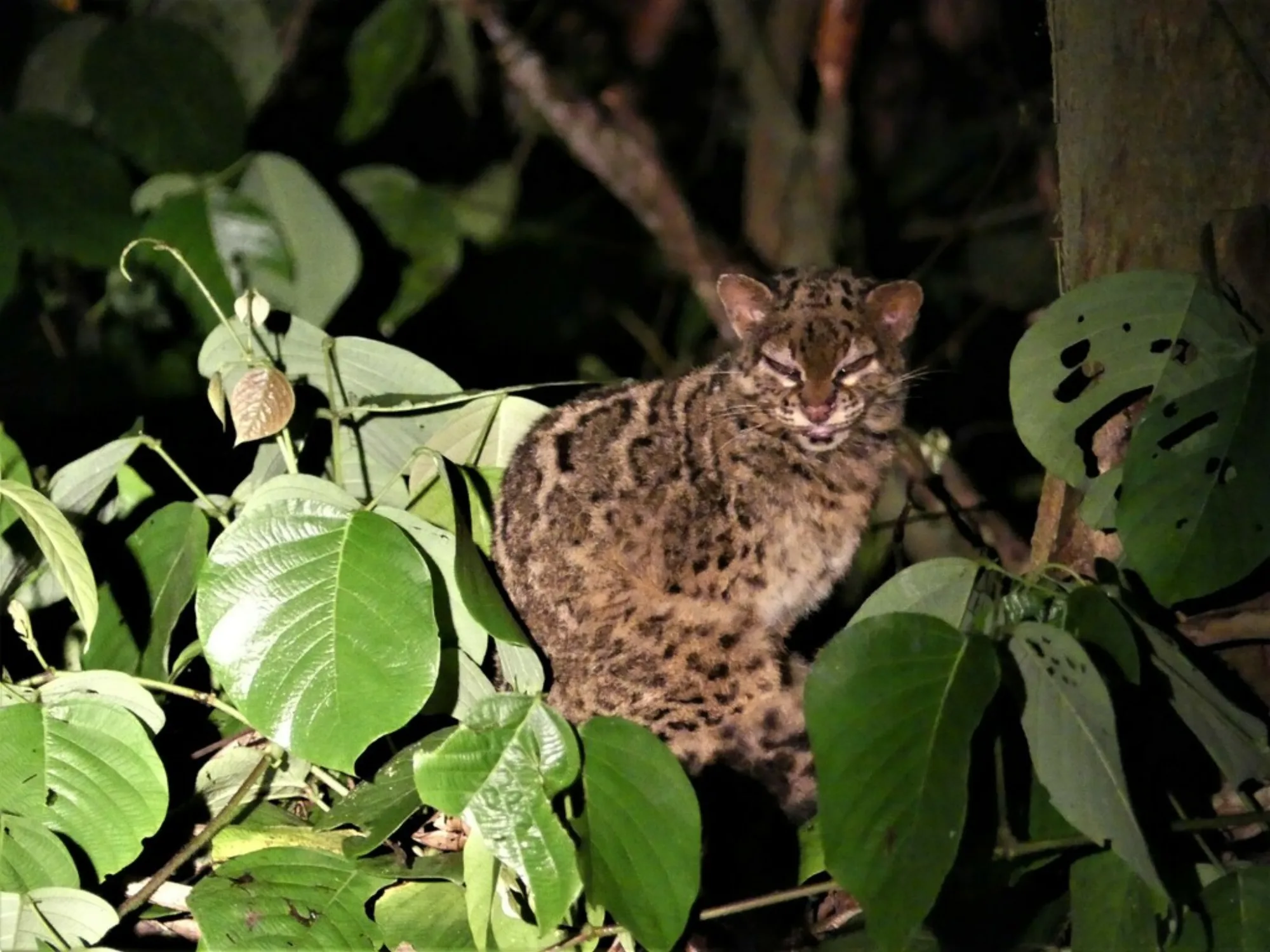
Marbled Cat
Pardofelis marmorata
This small wild cat, roughly the size of a domestic feline, is found from the eastern Himalayan foothills through Southeast Asia to the islands of Borneo and Sumatra. It typically inhabits moist tropical forests, including evergreen and deciduous areas, at elevations often reaching 2,500 m. The Marbled Cat is easily identified by its thick, soft coat featuring dark-edged, irregular blotches on its flanks. Its most striking feature is a bushy tail that can be as long as its head and body, serving as a vital counterbalance for its life in the trees.
Primarily arboreal, these cats use the forest canopy to hunt for reptiles, birds, and rodents like squirrels. While some individuals are active at night or during twilight, others have been observed hunting in the middle of the day. They are solitary animals with home ranges of roughly 5.8 km2. In the wild, they appear to depend on large tracts of intact forest to survive. When they breed, litters usually consist of two kittens, which begin to climb and eat solid food at two months old.
Despite their wide range, these cats face serious challenges from the loss and degradation of their forest homes due to logging and expanding human farms. Indiscriminate snaring is a major danger throughout the region. Additionally, they are occasionally targeted by hunters for their meat, bones, and skin, or used in local traditional ceremonies. Because they require undisturbed habitat, the ongoing expansion of human settlements remains a constant pressure on the remaining population.
Written from the English Wikipedia article Marbled cat (CC BY-SA 4.0).
- Records
- 3
- Countries
- 1
- Atlas places
- 0
These are open occurrence records, so they show where people looked for and recorded the Marbled Cat as much as where it lives. Cells are up to 25 km across, and every location is generalised to its cell.
Generalised encounter areas, not exact locations. Each shape is a grid cell coloured by how likely the species is there.
- Very likelyMalaysia50 km zone · medium confidence · 3 records · updated 4 days ago