Summer Flounder
Paralichthys dentatus
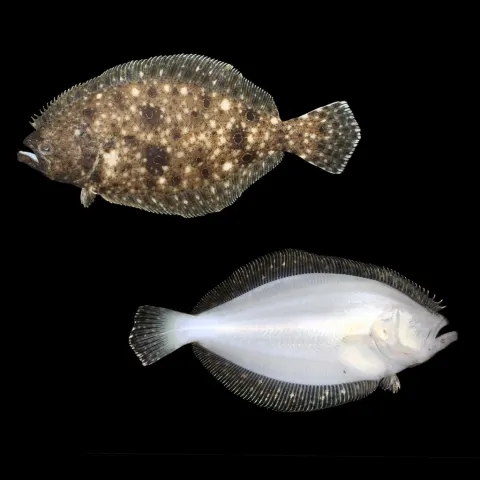
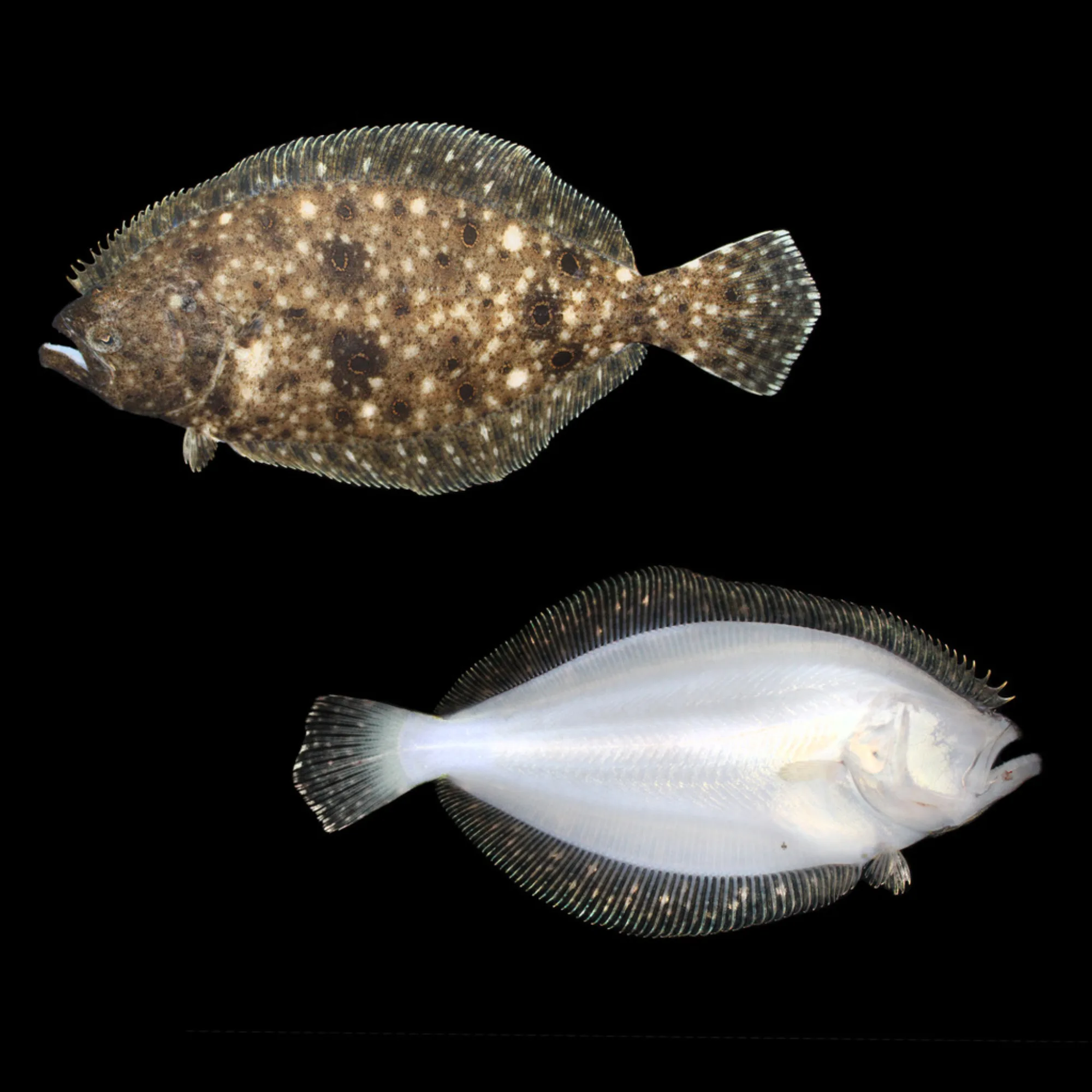
Look for eye-like spots on the flattened body of a Summer Flounder, a marine fish also known as a fluke. It usually grows to around 38.1 to 50.8 cm long and weighs around 0.4 to 1.3 kg, though some reach 9 kg. There are typically 5 to 14 spots, and the fish can change its colour and pattern to match the bottom beneath it. It can even reproduce details as fine as different grain sizes.
Summer flounder range along the western Atlantic coast, from Florida north to Nova Scotia, and possibly farther south. They are especially abundant between North Carolina and Massachusetts, with coastal and shelf waters off the northeastern United States among their most common haunts. In spring they leave deep ocean waters, where they spend the winter and spawn, and move towards shore. They remain in beaches, inlets, bays, estuaries, canals and creeks until autumn or sometimes early winter. They can burrow quickly into sandy or muddy bottoms, often lying buried with only the head showing as they wait for prey.
Adults are active predators that eat mostly fish, including sand lance, menhaden and small bluefish, as well as squid, shrimp and crabs. Although they usually live near the bottom, they can swim quickly over short distances, feed at mid-depths and chase prey to the surface. Summer flounder reach maturity at around 2 years and can live up to 20 years. They are important to commercial and recreational fisheries, with trawling a typical commercial method. There has been concern and debate over whether overfishing is causing their numbers to decline.
Written from the English Wikipedia article Summer flounder (CC BY-SA 4.0).
- Records
- 8,097
- Countries
- 2
No atlas park has a record of the Summer Flounder in or around it yet.
These are open occurrence records, so they show where people looked for and recorded the Summer Flounder as much as where it lives. Cells are up to 25 km across, and every location is generalised to its cell.
Generalised encounter areas, not exact locations. Each shape is a grid cell coloured by how likely the species is there.
- Very likelyUnited States25 km zone · medium confidence · 8062 records · updated 80 days ago
- PossibleCanada25 km zone · medium confidence · 35 records · updated 80 days ago
Conservation status not assessed here yet, so every location is generalised to its grid cell.